Posted on

Jonathan Edwards Shortlisted for The 2015 Roland Mathias Prize for Poetry

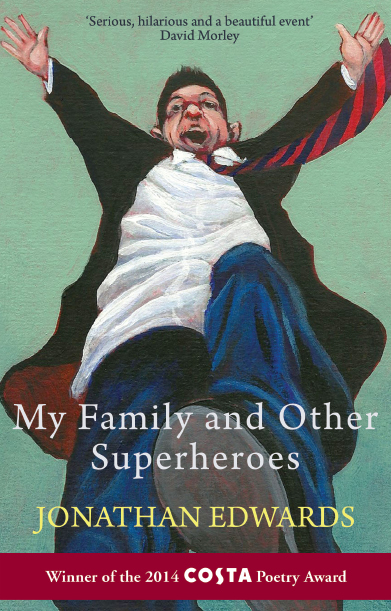
This cover shows a colourful painting of a school boy stomping with excitement viewed as if looking from the ground. The text reads: My Family and Other Superheroes, Jonathan Edwards.

Jonathan Edward’s has been shortlisted for Wales’ top poetry prize: The Roland Mathias Prize for Poetry for his best selling collection, My Family and Other Superheroes.
The Roland Mathias prize for poetry is one of the categories at the Wales Book of the Year awards. Three books are chosen in each of the Poetry, Fiction and Non-Fiction categories in both Welsh and English. The winner of each category will then compete against the other category winners for the overall accolade of book of the year.
The Wales Book of the Year Award is presented annually to a book either written by a writer born or living in Wales or that has a strong connection to Wales and Welsh culture.
Jonathan adds the shortlisting to an already impressive list of accolades. His debut collection, My Family and Other Superheroes, which combines pop culture with familial relationships, has already picked up the Costa Prize for poetry as well as being shortlisted for the Fenton-Aldeburgh Best First Collection.
Jonathan will compete for the £2000 prize against Tiffany Atkinson and Patience Agbabi. If he wins his category, he will be in the running for the overall £6000 Wales Book of the Year award. Previous recipients of the prize include fellow Seren authors Owen Sheers for Pink Mist (2014) and Rhian Edwards for her debut collection Clueless Dogs (2013, Seren).

Posted on

Pascale Petit Shortlisted for 2015 Hippocrates Prize for Poetry and Medicine

Pascale Petit has been shortlisted for the Hippocrates Prize for Poetry and Medicine, in the Open category. The shortlisted poem is entitled ‘In the Giraffe House’ which is from Pascale’s next collection in progress Mama Amazonica. Now in its 5th year, the short-listed entries have been selected from around 1000 entries, from 31 countries by judges poet Rebecca Goss, psychiatrist Professor Femi Oyebode and doctor and writer Theodore Dalrymple. At £5000 first prize in both Open and NHS categories, this is one of the highest value poetry awards in the world for a single poem. The winners will be announced at an International Symposium on Poetry and Medicine at the Medical Society of London on Friday May 22nd 2015. Pascale’s latest collection Fauverie is available from Seren.

Posted on

Friday Poem – Goodbye

Today it’s the 70th anniversary of VE Day, marking 70 years since the end of the Second World War in Europe, and so today’s poem comes from Alun Lewis’s Collected Poems.

Alun Lewis (1915-1944), the remarkable poet and story writer, died, aged 28, in Burma during the Second World War. Some critics see him as the last of the great Romantic poets, a twentieth century Keats. Others view him as the bridge between pre-war poets like Auden and Yeats to post-war poets such as Hughes and Gunn. He was born and raised in Depression-struck south Wales and, following degrees in history at Aberystwyth and Manchester, became a teacher there. Early in 1940, despite his pacifist inclinations he enlisted and, after long periods of training, joined the war in India.

Becoming a soldier galvanised Lewis’s writing. By 1944 he had written two collections of poems and one of short stories, all published to considerable acclaim. Firmly established with Keith Douglas as the leading writer of the Second World War, Lewis’s death in an accident while on active service was a huge loss to English literature. Collected Poems comprises a body of work which has endured and which transcends the label ‘war poetry’; it is complete in itself and full of promise of greater things.

Goodbye

So we must say Goodbye, my darling,
And go, as lovers go, for ever;
Tonight remains, to pack and fix on labels
And make an end of lying down together.

I put a final shilling in the gas,
And watch you slip your dress below your knees
And lie so still I hear your rustling comb
Modulate the autumn in the trees.

And all the countless things I shall remember
Lay mummy-cloths of silence round my head;
I fill the carafe with a drink of water;
You say ‘We paid a guinea for this bed,’

And then, ‘We’ll leave some gas, a little warmth
For the next resident, and these dry flowers,’
And turn your face away, afraid to speak
The big word, that Eternity is ours.

Your kisses close my eyes and yet you stare
As though god struck a child with nameless fears;
Perhaps the water glitters and discloses
Time’s chalice and its limpid useless tears.

Everything we renounce except our selves;
Selfishness is the last of all to go;
Our sighs are exhalations of the earth,
Our footprints leave a track across the snow.

We made the universe to be our home,
Our nostrils took the wind to be our breath,
Our hearts are massive towers of delight,
We stride across the seven seas of death.

Yet when all’s done you’ll keep the emerald
I placed upon your finger in the street;
And I will keep the patches that you sewed
On my old battledress tonight, my sweet.

Order Alun Lewis: Collected Poems from our website.

Posted on

Friday Poem – Street Scene

house of small absences

Today’s poem is from Anne-Marie Fyfe’s latest collection, House of Small Absences, due for release this month.

Anne-Marie Fyfe’s poems have long dwelt on the role that the spaces we inhabit, the places in which we find security, play in our lives: House of Small Absences is an observation window into strange, unsettling spaces—a deserted stage-set, our own personalised ‘museum’, a Piedmont albergo, underground cities, Midtown roof-gardens, convent orchards, houseboats, a foldaway circus, a Romanian sleeper-carriage—the familiar rendered uncanny through the distorting lenses of distance and life’s exigencies, its inevitable lettings-go…

Street Scene

‘Nowhere’ is a setting, a situation and a state of mind.
It’s not on any map, but you know it when you’re there.
– Don George, Tales from Nowhere

When you turn your back on the street
and walk away one block, then two,
the over-familiar street-view’s exposed
as propped-up storefronts and verandahs,
sceneries of wings and facades
that could shudder and collapse
in the whish of the tenderest summer breeze.

The scene’s drained first of Technicolor
and then slips slowly out of focus,
passers-by strutting staccato
into the maze of tram-line junctions
that never make it into town’s gazetteer.

Each new city block takes you further
from the grip of a reality that’s already
packing-up shop behind you, shipping
for storage or the next production.
You’d do best to maintain a brisk walking pace.

Pre-order a copy of House of Small Absences from our website.

Posted on

Revealing the Independent Publishers

Last week we put together some logos of six different independent publishers, some of them British and some of them not, to see if you could identify any of them by their logos alone. Today we’re going to reveal which publishers those logos belong to, and tell you just a little about them!

persephone books

Persephone Books was founded in 1999 by Nicola Beauman, whose original concept was to publish a handful of lost or out-of-print books each year. The majority of these books would be inter-war novels and short stories written by women, and so the name Persephone was chosen as a symbol for female creativity. Though they sell the majority of their books online, they also have a bookshop in London where they are based.

honno_logo

A little earlier, Honno Press was founded by a group of volunteers in 1986 who wanted to increase the opportunities for women in the realms of Welsh publishing. They asked for support from the Welsh public, and in the first 6 months 400 people became shareholders in the company. To this day they still only publish work by the womenof Wales, and have published everything from fiction to poetry to non-fiction. They are based in Aberystwyth.

tpp

Twelfth Planet Press are a little further afield – in Australia, to be exact! Founded in 2009 and based in Yokine, Western Australia, Twelfth Planet Press specialises in speculative fiction, whether it’s Fantasy, Science Fiction, Horror, or any sub genre in between! Their aim is to publish fresh fiction away from the typical work seen in the speculative fiction genre today, as well as to promote Australian fiction to a wider audience and give a louder voice to women writers.

2ravens

A little closer than that, Two Ravens Press is based in Scotland. Founded near Ullapool in 2006, they later moved to the Port of Ness in 2013. Quite possibly the most remote independent publisher in Britain, they publish contemporary literary fiction, non-fiction and poetry, some of which has won a variety of major literary awards.

gomer

Back to Wales now, to a publisher who may be a little more familiar to many of you. Gomer Press was founded back in 1892, and to this day it’s still run by the same family! They specialise in English and Welsh books for both children and adults, whether it’s fiction, non-fiction or poetry, and are based in Llandysul, west Wales.

Mercier

Based in Cork, Mercier Press are Ireland’s oldest independent publishers, having been around since 1944. Mercier rose to prominence publishing books which explored topics such as religion, women’s rights, domestic violence, the sexual revolution and drug abuse, some of which had previously been banned in Ireland. They publish both fiction and non-fiction, and offer an alternative voice to the Irish publishing world.

So, did you guess any correctly?

Posted on

Friday Poem – Finding a Fossil

Today’s poem is from John Ormond’s Collected Poems, edited by Rian Evans and introduced by Patrick McGuinness, which is due to be released next month.

John Ormond (1923-1990) is one of the remarkable generation of poets born in south Wales in the early 1920s which includes Dannie Abse and Leslie Norris. A journalist on Picture Post during its heyday in the 1940s, he was a friend of fellow Swansea writers Dylan Thomas and Vernon Watkins, both of whom were key influences on a poetry of consistently high standards. A significant number of his poems, many of them elegiac, probe his Welsh roots, demonstrating an abiding concern with family and locality. Others focus on particular aspects of the natural world, seeking to capture their elusive quiddities. Stylistically, they vary from the extremely plain to the highly-wrought; are witty and ironic, paradoxical and conceited. Typically unsentimental, shapely and meticulously crafted, his are the poems of a sensibility which delights in explorations, probes complex themes and problematical areas of feeling, and refuses to settle for easy answers.

In addition to his writing Ormond had a distinguished career with BBC Wales as a director and producer of documentary films, which include studies of Welsh painters and writers such as Ceri Richards, Kyffin Williams, Dylan Thomas, Alun Lewis and R.S. Thomas. The insight and visual awareness which mark his films also inform his poetry, a selection of which was published in the Penguin Modern Poets series.

This Collected Poems edited by Rian Evans, draws together all of Ormond’s work, including unpublished material. It includes an Introduction by poet, novelist and critic Patrick McGuinness, notes and commentary of the poems re their geneses, backgrounds, allusions and meanings, and a bibliography of Ormond’s prose writing, films and writing about him. An index of titles and first lines completes this essential book.

Finding a Fossil

Maidenhair fern in flint;
An ancient accident
Shows me time’s imprint.

A leaf preserved and pressed
Between leaves of stone; crossed
Rest and unrest.

An image that grew green
Took ground in the rock grain:
Dark; now light again.

Luck interlaced each line
And dying vein with stone.
They return to the same sun.

The casual life of fronds,
Air and the tongues of friends;
Green begins, grey ends;

Except that remembered shapes
Live, and that at one’s lips
Love speaks as loves lapse.

Graftings (so fused in chance
Among cold stars that dance
Gestures of permanence)

Persist and contrive to invent
From fragment and element
A mindful firmament.

Pre-order a copy of John Ormond’s Collected Poems from our website.
Posted on

How Well Do You Know Your Independent Publishers?

When you go iPrintnto a bookshop and see our signature star on one of the spines, we hope you immediately think of us and know that the book you’re about to pick up has been published by an independent publisher that prizes quality over quantity and individuality over hype.

But how well do you know your independent publishers? If you were given nothing but a logo, could you identify a specific publisher?

Below are the logos of six independent publishers – some of them are British, and some of them are international – how many of them do you know? Leave your guesses in the comments below. You have until next week!

publog1publog2 (1)

Posted on

Friday Poem – A Psalm for the Scaffolders

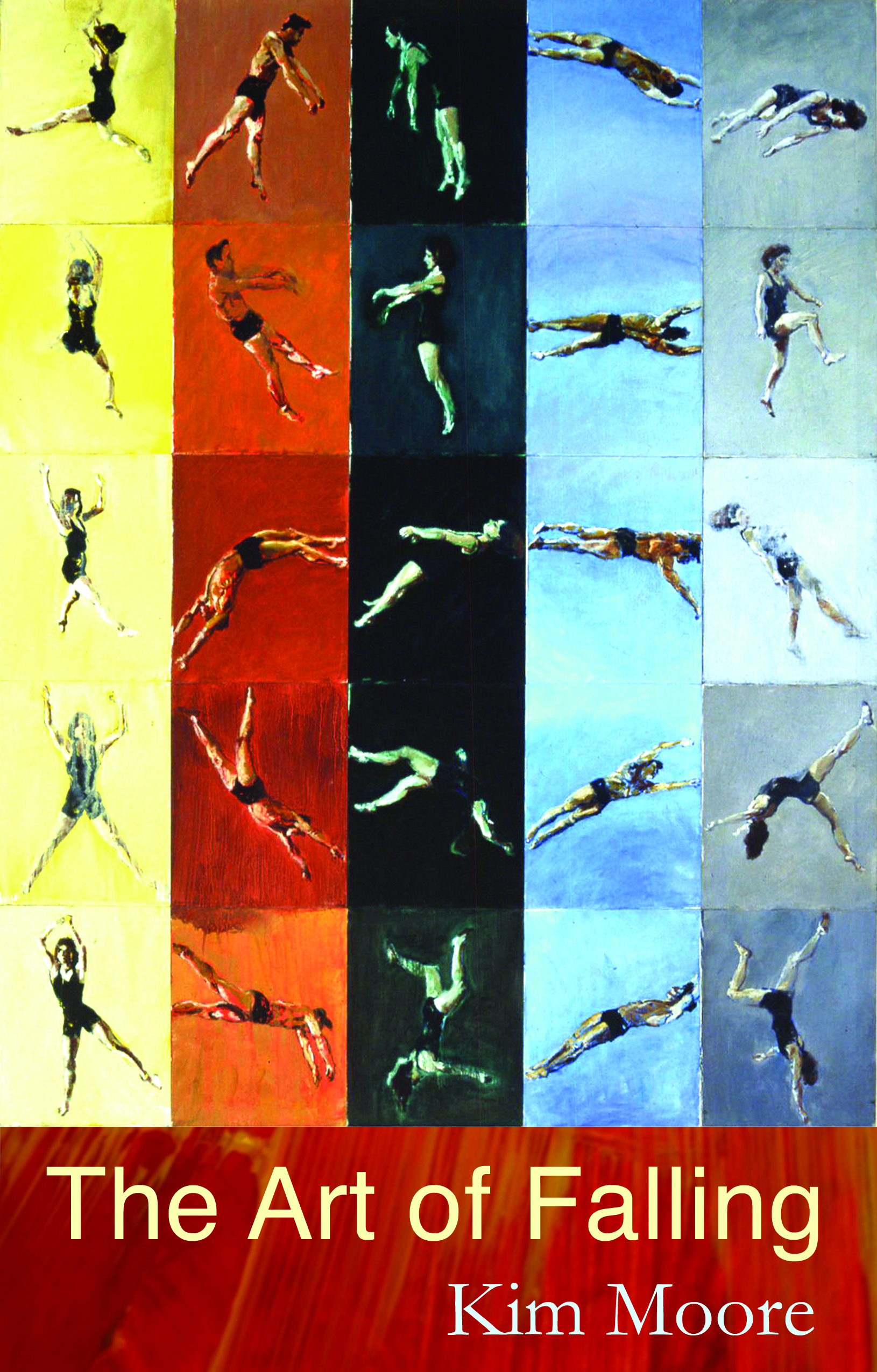
Today’s poem is from Kim Moore’s debut collection, The Art of Falling. Check out our interview with Kim here.

Kim Moore lives in Barrow, Cumbria. She has an MA from Manchester Metropolitan University. Her poems have been published in the TLS, Poetry Review, Poetry London, and elsewhere. She regularly appears at festivals and events, her prize-winning pamphlet, If We Could Speak Like Wolves (Smith-Doorstop) was chosen as an Independent Book of the Year in 2012 and was shortlisted for other prizes. Moore won an Eric Gregory Award in 2011 and the Geoffrey Dearmer Prize in 2010. In 2014 she won a Northern Promise award. She writes a thoughtful blog and has a wide social media following. The Art of Falling (Seren 2015) is her debut collection.

A Psalm for the Scaffolders

who balanced like tightrope walkers,
who could run up the bracing
faster than you or I could climb
a ladder, who wore red shoes
and worked bare-chested,
who cut their safety vests in half,
a psalm for the scaffolders
and their vans, their steel
toe-capped boots, their coffee mugs,
a psalm for those who learnt
to put up a scaffold standing
on just one board, a psalm
for the scaffolder who could put
a six-inch nail in a piece of wood
with just his palm, a psalm
for those who don’t like rules
or things taking too long, who now
mustn’t go to work uncovered,
who mustn’t cut their safety vests
or climb without ladders, who must
use three boards at all times,
a psalm for the scaffolders
who fall with a harness on,
who have ten minutes to be rescued,
a psalm for the scaffolder who fell
in a clear area, a tube giving way,
that long slow fall, a psalm for him,
who fell thirty feet and survived,
a psalm for the scaffolder
who saw him fall, a psalm for those
at the top of the buildings, the wind whistling
in their ears, the sky in their voices,
for those who lift and carry
and shout and swear, for those
who can recite the lengths of the boards
and tubes like a song, a psalm for them,
the ones who don’t like heights
but spent their whole life hiding it,
a psalm for those who work too long,
a psalm for my father, a psalm for him.

Order The Art of Falling from our website.

Posted on

An Interview with Kim Moore

Today we’re talking to poet Kim Moore about her debut collection, The Art of Falling, which you can order from our website here.

Kim Moore lives in Barrow, Cumbria. She has an MA from Manchester Metropolitan University. Her poems have been published in the TLS, Poetry Review, Poetry London, and elsewhere. She regularly appears at festivals and events, her prize-winning pamphlet, If We Could Speak Like Wolves (Smith-Doorstop) was chosen as an Independent Book of the Year in 2012 and was shortlisted for other prizes. Moore won an Eric Gregory Award in 2011 and the Geoffrey Dearmer Prize in 2010. In 2014 she won a Northern Promise award. She writes a thoughtful blog and has a wide social media following. The Art of Falling (Seren 2015) is her debut collection.

Has the idea of falling, be it literally or metaphorically, always fascinated you, or did you find yourself writing about the many ways in which we fall purely for this collection?

The short answer is no, not consciously, but unconsciously. I think the concept of falling must have been something that has always been in the background. My father is a scaffolder and has had two serious falls – once when my twin sister and I were born and then again when I was twenty-one when he fell thirty feet from scaffolding and was lucky to survive. However, I didn’t realise I was writing about falling a lot until I wrote the title poem of the collection – and I only wrote that because David Tait, a good friend and wonderful poet set me a challenge to write a poem about falling. We used to take it in turns to do this – to set each other challenges – I didn’t even think at the time to ask him why, or what type of falling he meant. I actually forgot all about it and didn’t write the poem until six months later but looking back, the seed was definitely planted in that moment. Once I’d written the poem I realised that there were lots of poems about different types of falling throughout the collection – the book was maybe three quarters done by this point, so maybe I was just being very slow on the uptake.

In poems such as ‘My People’ and ‘A Psalm for the Scaffolders’ there’s a real sense of proud, working-class history. Is it fair to say you have a fondness for writing about the ‘every day’ hero?

‘My People’ is one of the poems I feel most guilty about writing because as well as hopefully communicating my pride, love and admiration for the people and background I came from, I’m being quite critical as well. It was an exhilarating poem to write, but it was also quite nerve-wracking. My people are ‘the type of people who would argue with their teacher if the child has detention’. Now I’m a teacher so I see it from both sides, of course. I actually wrote it when my husband started tracing his family tree and got quite far back and I realised I couldn’t. The poem was a way of finding out who my people were.

As for ‘A Psalm for the Scaffolders’ I definitely have a fondness for writing about my poor old dad! I think he likes it though – and to me it is really interesting because his life and the way he has worked, doing the same job since he left school is a way of working that is dying out, I think. I have a lot of admiration for that, for the physical hard graft of doing the same job for forty odd years.

I couldn’t help noticing the recurring animal imagery throughout The Art of Falling. There are plenty of wolves amongst your poems – ‘And the Soul’; ‘If We Could Speak Like Wolves’; ‘How Wolves Change Rivers’ – and also the incredibly powerful poems ‘The Language of Insects’ and ‘When I Was a Thing with Feathers’. In what way do animals help you to explore human nature through your writing?

I have never managed to answer this question about what the wolves mean in my poems, so I will skip over that one. Part of me also wants to duck out of answering it – I don’t really want to know. I like that they wander in and out of my poems when they feel like it though.

Halfway through writing the sequence which makes up the central sequence of this book, I got lost. I couldn’t find a way of saying what I wanted to say. I didn’t want to write a narrative sequence, with a beginning, a middle and an end. I started reading Ovid’s Metamorphoses and that is when everything shifted for me and I was able to carry on writing. The poems have a lot of animals in them, but perhaps more importantly, they have a lot of transformation in them, which was a way I found of writing about violence and the loss of not just identity, but of speech.

You play the trumpet, so I imagine there must be many musicians you admire. What is it about John Lennon and Wallace Hartley that made you want to write about them in particular?

It is actually obsessive people in general that I like writing about – and most musicians are obsessive – you have to be to practice enough to be good.

I actually wrote the John Lennon poem to take part in a competition to write a poem about John Lennon. It is what I call a research poem – I went to the library and read as many books about John Lennon as I could find and then wrote the poem, putting together the things that I read that interested me.

As for Wallace Hartley, I was helping to put together a project as part of my work as a music teacher. I read that he was found with his violin still with him and it was this that made me want to write something about him.

Congratulations on the publication of your debut collection! What are your future plans for your writing?

Thank you! My future plans are pretty simple – just to keep writing, and to always read more than I write. In September, I’ll only be working 2 days as a music teacher so this will hopefully give me a little bit more time. I haven’t written for the last six months – basically since I handed in the final proofs of the book, and then I’ve just started writing again last week, strangely coinciding with the book being delivered. I’ve started writing a few poems about scaffolding and a few poems about running which is my new obsession at the minute so I’m planning on carrying on with those.

Order The Art of Falling from our website.

Posted on

Friday Poem – Edward Hopper on Long Island

Tailor's Three Sons Mara Bergman

Today’s poem is from Mara Bergman’s pamphlet The Tailor’s Three Sons & Other New York Poems, which won the 2014 Mslexia Women’s Poetry Pamphlet Competition!

The Tailor’s Three Sons & Other New York Poems, the Mslexia magazine prize-winning pamphlet published by Seren, is the fruit of author Mara Bergman’s rich memories of her childhood on Long Island and Manhattan. Now living in the UK, she looks back and assembles an appealing cast of characters for us: a grandmother who lives with precarious memories of war-torn Europe in a ‘railroad apartment’ where passing trains make ‘a whole room shake’; a cousin Sharon who makes a weekly pilgrimage to a nail salon, the bottles of nail varnish, ‘lined up like sweets’. There is the ghost of an uncle, spotted in the likeness of a man on the London-Hastings train. We meet an ‘Englishman in New York’ and experience, along with the author, ‘East 13th Street or How I Met My Husband’.

The title poem is inspired by the author’s visit to the Tenement Museum in New York’s Lower East Side, where Bergman vividly imagines the lives of immigrants when many thousands docked in ships at Ellis Island and the Lower East Side was ‘the most crowded place on the planet’. She envisions the lives of the tailor’s three sons she learns about during a museum tour: ‘afternoons they’d elbow through the teeming streets’, come home to a bowl of soup and share a single sofa for a bed. These poems are written with a great deal of warmth and empathy and with a quietly deceptive casual tone. We can see the author, as a small ‘Girl with a Pen’ entranced by her reading a biography of Charlotte Brontë.

Mara Bergman says: ‘I am fascinated by people and their stories. Having lived in England for many years, I often think, What if… and have tried, in my writing, somehow to meld my life in England with the one I left in New York. Here are poems about people, the process of work and art, and distance, in time and place.’

Edward Hopper on Long Island

He left the neon-lit cafés and deserted stations
for a winter of snow, mounds of it,
steeped on decks through a neighbourhood
where he didn’t know a soul.
He had given up city lights, city life,
to see the sun rise from a corner of a garden,
a flock of geese pummel across clouds.
At last the chance to study the filaments
of a squirrel’s tail, the shock of red cardinal.
He’d go to bed later and later,
wake up earlier until
there was no discernible difference
between darkness and light.
Three a.m., looking out on the snow
when a plane passed over the row of split-
levels, he spotted that thin divide
where streetlight met houselight – light
on the side of a building his favourite thing.
Maybe he wasn’t so far from his life,
maybe it was then he stopped questioning
what he was doing amid the snowlight
and a pale orange glow
over the telephone wire, heat steaming.

Order The Tailor’s Three Sons & Other New York Poems from our website.