Posted on

Short Story of the Month | ‘The Dig’ by Graham Mort

short story of the month the dig graham mort

Our new Short Story of the Month is ‘The Dig’ by Graham Mort, from his newest collection, Terroir, in which past and present intertwine as amateur archeologists dig for answers in an area whose violent, territorial history they know nothing of.

the dig from terroir by graham mortAbout Terroir:
From England to Europe, Africa to South America, these stories from prize-winning short story writer Graham Mort explore relationships: father and child; man and wife; man and his environment.
All these stories are sensitively told and beautifully written, bringing fresh perspectives to our place in the world around us.
Graham Mort has won the Edgehill and Bridport and Short Fiction short story prizes.


The Dig

This is an extract. Read the full short story for free on our website.

A Thistlethwaite, red-haired like all her clan. Longshanked, full-breasted, tall. Freckled, grey-eyed, jug-eared, a crooked smile creasing into dimples. Climber of rockfaces for hawk’s eggs. Horse breeder, dog hater. Broadshouldered, a fighter who’ll take on her brothers and anyone else. Fey, man-shy, loyal. Fierce to the lie, quick to offence. Footsore now, limping from a bruised knee where the gelding took her into a dry stone boundary.
Homeward bound, the moor’s peat squelching underfoot, the heather springy, bog cotton in the hollows. Hungry and used to it.

The Land Rover lurches on the bridleway, loaded with wire ladders and lamps, yellow waterproofs, digging gear. The man’s helmet lies beside him on the front seat. His hair is spiky grey, his hands badly scarred from a fire. The flesh has grown back in purple patches. He’s got a blue thumbnail where a hammer missed. He wears a diver’s watch with a black plastic wristband. Sun shows up the scratches on the spattered windscreen, tyres jog over stones and ruts and into mud puddles. The exhaust stinks in low gear. He’s arranged to meet the others at the dig. This one’s been on the go for months and you never knew who’d turn up.

She’s a long hour from home after trading her grey horse in the next dale. There are coins in her purse but she’s packed it tight with grass to stop them chinking. She rode the gelding bareback to the Sykes place, now she has the walk home. It was a good sale. The bridle and harness are
tight under her jerkin. She’s taken a short cut over a flank of moorland, crossing a corner of Abel Rintner’s land, past his new peat cuttings where turves are piled. She’s black to the ankles and there’s a foul gas from the moss. She could have played it safe and detoured by the valley head,
then down past the inn where there were other folk. There’d be drunken, groping bastards too. Fenmen and Dutchlanders draining the land for the monks, gabbling, fetching up phlegm and laughter. She can’t bear that. No need if the light holds. Her feet catch in rushes. She can hear the calling of fat lambs. Soon they’d be cutting their throats for Eric’s wedding.

There’s a dirty Peugeot estate parked where the bridleways meet. Dark blue with a roof rack. Two other cavers are already climbing into their gear. A woman in her late thirties with pulled-back hair and acute blue eyes; a fifty-year-old man, bow-legged, short and bearded. He’s coiling a climbing rope clarted in dried clay and she’s fastening her overalls over rubber boots. Their greeting is a stubbing of cigarette butts, a faint smile, nods to the stile, the causeway they’ve laid across the marsh that leads to the dig. Another path goes up over the limestone edge, past the killing pit – a swallow-hole with almost sheer sides, twenty yards across and twelve deep. They’d help excavate that for an archaeological dig, uncovering broken animal bones and Mesolithic flints. Hand axes, arrow tips, flensing blades. The ancient people had hunted with dogs, driving red deer, elk, auroch, and wild boar over the edge then stoning them to death. They’d been proud of that dig, the way it made sense of things, of the past. The man with the
scarred hands slams the Land Rover door and takes two yellow plastic trugs from the back. They pick up their lamps, two folding spades, a short-handled pick. The bearded man carries the rolled-up ladder and the woman with blue eyes lifts a coil of rope.

Jogging across the moor to strike the track, Hannah’s breath is harsh now. She’s anxious to get to the commons below. Sun is dropping over the sea about thirty miles west. The air is cooling, smoke coiling from the farmstead she’s too close to. A flight of geese follows the river to the estuary in
a double vee. She stumbles, pauses, rights herself, touching a hand to her sore knee. There’s the sudden hiss and flicker of plumage. A streaking bird is attacking her. Then the arrow strikes into her forearm, almost parallel to the bone, the point driving right through. She sucks her breath, freckles starring her suddenly white face. She glares round quickly and keeps moving. She should have covered her hair. That was stupid. The mistake will cost her. She’s wearing an amber amulet that hangs from a leather thong. It tosses as she runs. The arrow stings, evilly. She needs to get out of view, jags to the left, drops into a gulley and lies listening for dogs. Nothing. She follows the gulley down, stumbling, nursing her arm, trying to let blood drip onto her and not bare rocks where they can track her. There’s a little water in the beck bottom, not much.

They walk up the lane in single file, trudging a little after their day of work. Each to their own: wrought iron making, timberwork, the work of the body. There’s a gate on the left leading to the wooden causeway laid over the moor. The timber smells of creosote. The man with the beard grimaces, but the woman half smiles, bends her head a little closer as she swings the gate back onto its catch, savouring a memory. They move across the peat bog, feeling the planks sink a little under their weight. There are black pools on either side. Petroleum from the peat has stained them with iridescent patterns. A stand of bog cotton stirs in a slight breeze coming off the Irish sea. The man in the lead flexes his fingers and switches hands on the trug. The woman’s eyes are paler here, bluer, as if cut from underwater stones. She’s thinking of a bright room, how she loves the touch and smell of babies though she’s had none of her own. Their pure skin, their tiny hands reaching to their awed mothers’ faces.

Voices, thick and faint, not far off. A hundred yards. Maybe more. Men’s bass tones. She pauses, hunched over. Dark blood is oozing where the arrow tip has gone through.

Continue reading ‘The Dig’ for free here.


Graham Mort’s short story collection Terroir is available to buy from the Seren website: £9.99.

Claim 20% off when you become a Book Club Member.

Posted on

Friday Poem – ‘Skirrid Fawr’, Owen Sheers

friday poem skirrid fawr owen sheers

Today marks the start of the National Eisteddfod, this year in Abergavenny, and our Friday Poem talks of an area just a few miles north – Ysgyryd Fawr, or The Skirrid. The poem is taken from Abergavenny poet Owen Sheers’ second collection, Skirrid Hill.

skirrid fawr friday poem owen sheersIdeas of separation and divorce are important in Owen Sheers’ eagerly-awaited follow up to his acclaimed debut collection The Blue Book. The geographical divides of borders, the separation of the dead and the living, the movement from childhood to adulthood, the ending of relationships. Such divides are both moments of ‘mark-making’ and moments of absence. In this collection it is often the awareness of such separation – past or impending – and the juxtaposition of these diverse states – that provides the friction from which the poems are born.


Skirrid Fawr

Just like the farmers who once came to scoop
handfuls of soil from her holy scar,

so I am still drawn to her back for the answers
to every question I have never known.

To the sentence of her slopes,
the blunt wind glancing from her withers,

to the split view she reveals
with every step along her broken spine.

This edge of her cleft palate,
part hill, part field,

rising from a low mist, a lonely hulk
adrift through Wales.

Her east-west flanks, one dark, one sunlit,
her vernacular of borders.

Her weight, the unspoken words
of an unlearned tongue.


Buy your copy of Skirrid Hill from the Seren website: £8.99
Claim 20% off when you become a Book Club Member.
Save

Save

Save

Posted on

Aspie-Chromatics | Carol Rumens on Asberger’s, ASC and Poetry

aspie-chromatics carol rumens asberger's syndrome poetry

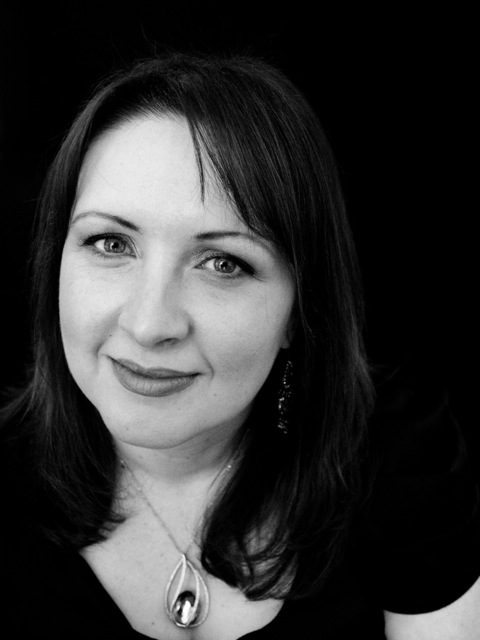
Carol Rumens is the author of sixteen collections of poems, as well as occasional fiction, drama and translation. Here she talks about Asperger’s Syndrome and Autistic Spectrum Condition (ASC), the misunderstandings and mysteries still surrounding these conditions, and how her awareness of Asperger’s Syndrome has affected her understanding of her own creative process.

Aspie –  someone with Asperger’s Syndrome

Chromaticsthe study of colour

When my grandson was diagnosed with autism it was as if a stone had been hurled into a quiet pool. The ripples spread through his immediate family, particularly affecting my two daughters (one being his mother) and myself. We re-evaluated our lives from a dizzy perspective. Autistic spectrum condition is a genetic condition. It’s a doubtful gift passed from generation to generation. A lot of us were implicated!

At first I was very uncomfortable with the idea that I had Asperger’s Syndrome. I’d always considered myself eccentric. My self-esteem relied on a sense, since earliest childhood, that I was creative, one of those people who could paint, draw, play music and write, even if they weren’t always very good at thinking straight or mixing with the other kids. I was an introvert – fine. So were a lot of intelligent people. I didn’t need close friends: I needed a room of my own, plus a typewriter. So what?

Perhaps being an Aspie made me less guilty of the wrongs I’d done to others in my life, but, equally, I was less responsible for the good. The best of my ‘good’ self – my poetry – was just a symptom, an expression of pathology.

I began the “On the Spectrum” sequence partly to express that grief. But I soon struck notes of defiance and humour. I remembered strange, disconcerting experiences I’d had as a child, and I measured them against some of the diagnostic criteria of Asperger’s Syndrome. Some were in tune with the criteria. But others weren’t.

I will have more questions in future: I haven’t finished telling the story. For instance, it’s said that Aspies lack empathy, and that we misunderstand metaphor. I wonder where this leaves the Aspergers poets – or indeed the women with Aspergers.

Sensory over-stimulation is one of the affects of Autistic Spectrum Condition: there’s neurological and experiential evidence. But wouldn’t that susceptibility be more likely to increase empathy? Perhaps autistic people, especially women (the gender which is socially conditioned for empathy) have an excess rather than a lack of response to others, but deny it because it feels chaotic and scary? An inability to grasp metaphor might be the result of a similar subconscious defence-mechanism –because metaphor is also sensuously stimulating, and therefore potentially disruptive.

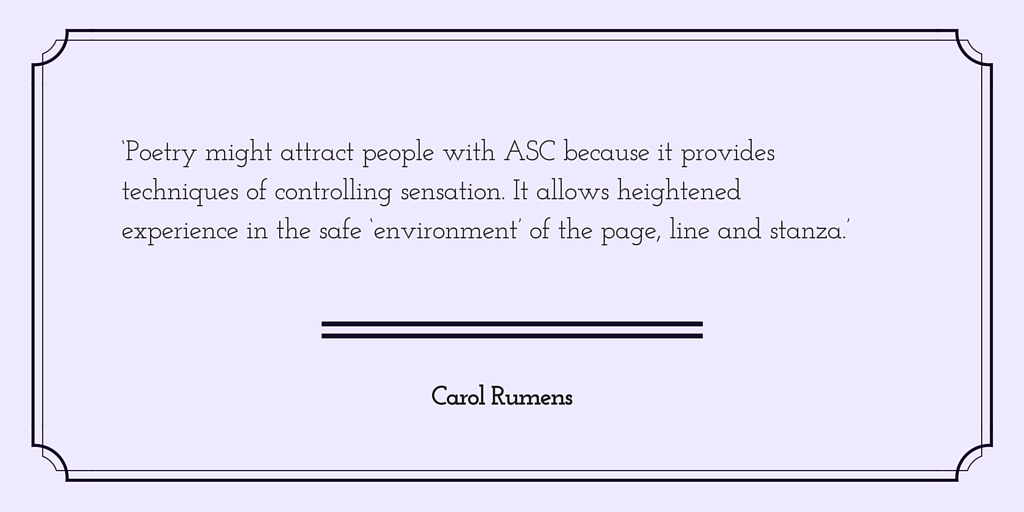
Poetry might attract people with ASC because it provides techniques of controlling sensation. It allows heightened experience in the safe ‘environment’ of the page, line and stanza. It foregrounds pattern-making. It allows repeated patterns to be safely interrupted. I realise now that, whatever the genetic ‘prompt’ towards an activity for an individual, it doesn’t invalidate the activity. Being an Aspie poet doesn’t damage the poetry, but the pride.

And so, having overcome my pride and prejudice, a faintly crusading element entered my attitude to autism. The condition needs a lot more fresh thinking. I’m not generally someone who wants poetry to earn its bread as a foot-soldier in the army of good causes. But I want to speak for a greater understanding of autism, and I choose to do it through the medium I’m best able to employ. Rather than use poetry as propaganda, I would simply ask it to report back sometimes from the field, like a travel correspondent in the complex, many-coloured terrain of a newly discovered country.

What I’d like to do now, besides filing more dispatches, is to edit an anthology of poems by autistic poets. Certain poets have already ‘come out’ and I suspect there are potentially many more. Autism is a richer, wider, more polychromatic spectrum than so far defined. In fact, to know autism would be to know consciousness, which would be to see God. I don’t think anyone can, but I hope we can build some better microscopes.


Animal People Carol RumensCarol Rumens’ latest collection, Animal People, is available on the Seren website. The striking final sequence, ‘On the Spectrum’, focuses particularly on Asperger’s Syndrome and how it may be experienced by young women, as well as exploring some of the effects of Autistic Spectrum Condition (ASC).

Buy your copy now: £9.99
Claim 20% off when you become a Book Club Member


Save

Save

Posted on

Friday Poem – ‘Outcast Hours’, Rhian Edwards

Clueless Dogs Rhian Edwards

This week our Friday Poem is taken from Rhian Edwards’ dark and sensual debut collection Clueless Dogs.

Winner of Wales Book of the Year 2013
Winner of the Roland Mathias Prize for Poetry 2013
Winner of Wales Book of the Year People’s Choice 2013
Shortlisted for the Forward Prize for Best First Collection 2012

clueless_dogs72Full of verve and humour, with a spiky syntax featuring hard-edged consonants, Rhian Edwards’ language has a winning honesty and intensity. Poems like ‘The Welshman Who Couldn’t Sing’ chronicle a fraught childhood in Bridgend, south Wales, where the sensitive child escapes through imaginative games of ‘Playing Dead’ and ‘Broken Lifeboat’. Later poems confidently explore teenage lusts, student rivalries, damaged peers and tense situations. Although the author doesn’t flinch from ruthless depictions in which we are often implicated by her use of the second person ‘You’, there is an underlying sweetness, an elegiac thread most evident in the poems of maturity.

Outcast Hours

White light weighs heavy, bullying
bright as squash courts. I fix a dirty look
on the electric clock. The walled
minutes stagger their blinks.

Wheel-footed suitcases scurry
about me like clueless dogs,
flip flops tick-tock
on the polished rink of the concourse.

One girl’s patience is vivid,
measured by the careful brush strokes
of plum on her toenails,
the soft turning of pages.

Her boyfriend hibernates,
his legs stretched out before him.
Ankles crossed, he wags his foot
conducting his concert of sleep.

A ponytailed mother raises
an eye for her wandering son.
Shc scoops him up and breathes in his scalp
in chase of a smell that is running away from her.

The antique couple are butchering time.
Their teeth tear through baguettes
raining faded confetti
onto their open laps.

Shy of games and companions, fidgeting
in plastic-boned chairs, we comb the air
for that splintered voice,
dictating when our sky will ship us.


Buy your copy of Clueless Dogs now: £8.99

Claim 20% off as a Book Club Member

Posted on

Jasmine Donahaye wins Welsh Book of the Year Non-Fiction Award

Jasmine Donahaye’s powerful memoir, Losing Israel, triumphed in the Creative Non-Fiction category against strong competition.
The three titles shortlisted for the Open University in Wales Creative Non-Fiction award all, in very different ways, dealt with examining Wales’ position in the world, themes of globalisation and the significance of culture.
Wales Unchained by Daniel G. Williams (University of Wales Press) was praised for its brilliantly entertaining, scholarly prose. Woman Who Brings the Rain (New Welsh Rarebyte) by Eluned Gramich was highly regarded, ‘small but perfectly formed’. Yet it was Losing Israel by Seren author Jasmine Donahaye that scooped up the prestigious award as her ‘strange book’, a weaving-together of birdwatching, memoir, creative writing, and travel, blew the judges away.
Judge Justin Albert urged the public to go out and buy copies of all three books, saying the quality of each is such that you won’t simply be able to read them once. We concur!

Posted on

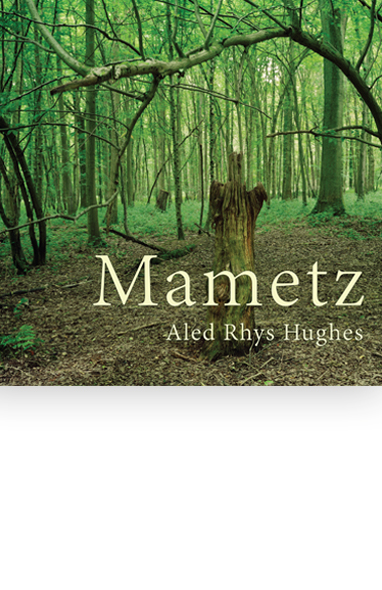
Aled Rhys Hughes talks to the BBC about what inspired his photography of Mametz Wood

Aled Rhys Hughes has been visiting Mametz Wood, the site of the most significant battle in World War I for Welsh troops, for over five years. The striking contemporary photographs Hughes has taken over this period have just been published in Mametz, to mark the centenary of the Battle of Mametz Wood.
What inspired Hughes to keep returning to this landscape? Hughes explores this question in two special radio broadcasts, on BBC Radio Wales and BBC Radio Cymru, both available to listen to online.
‘Does a place retain some sort of memory of what’s happened there – over the years or over the centuries? It’s very clear to me that in Mametz Wood… there is a memory there of what’s happened a hundred years ago.’ – Aled Rhys Hughes
Listen in English to the Aled on the BBC Radio Wales Arts Show, or in Welsh to BBC Radio Cymru Stiwdio Gyda Nia Roberts.

Posted on

Friday Poem – ‘Talking in the Dark’, Christine Evans

Friday Poem Talking in the Dark Christine Evans

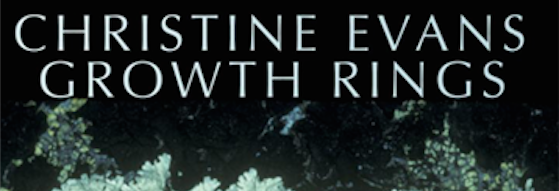
This week our Friday Poem is from Christine Evans’ sensitive collection, Growth Rings, which was shortlisted for Wales Book of the Year 2007.

Friday Poem Christine EvansThis collection from Christine Evans follows well-received ’Selected Poems’.  Hers is a persuasive voice, highly attuned to the vagries of the seasons, to the landscapes and inhabitants of the beautiful Llyn Peninsula in North Wales where the author has made her home.
As well as vibrant short lyrics on everything from ’Bluebells in Nanhoron’ to jets flying over Wales, there are a series of tender elegiac pieces on relatives, meditations on the last moments of Shelley and the fates of the Brontes, and a number of poems featuring the mysterious Island of Bardsey.

Talking In the Dark

Now the air is indigo with evening
together by the boathouse where we’ve sprawled
an hour or more, felt earth’s breath cooling,
we wake mind-echoes of ‘the real world’.
Night prompts us all to visions of tomorrow.

A subtle fullness, like a ripening field
contains us, names and knowledge weightless now.
The biosphere, Helen thinks, might still have the power
to heal pillage, maiming, poison. Protests fly:
excuse for doing nothing, weak, evasion.

Although we can’t agree what should be done
a tribal dignity begins to hover.
Shadows with eyes that hold the light, we are
communicators, not just talking faces.
First stars beckon in a deepening sky.

The universe accepts our hopeful voices
but sea demurs with one slow-hushing sigh.


Buy your copy of Growth Rings now: £7.99

Claim 20% off as a Book Club Member

Posted on

Jasmine Donahaye’s Losing Israel wins New Welsh Review Best Travel Book Poll

Congratulations to Jasmine Donahaye for winning the New Welsh Writing Awards 2016 Best Travel Book Poll for Losing Israel, a moving and honest account of the author’s relationship with Israel, which spans travel writing, nature writing and memoir. Voted for by the public, Losing Israel was the overwhelming winner from a shortlist of three titles that comprised Wildwood: A Journey through Trees by Roger Deakin (Penguin) and A Time of Gifts by Patrick Leigh Fermor (John Murray). Losing Israel has also been shortlisted for the Wales Book of the Year 2016.