From nature, to places we call home and poetic inspiration – today we talk to Polly Atkin about her debut collection, Basic Nest Architecture.
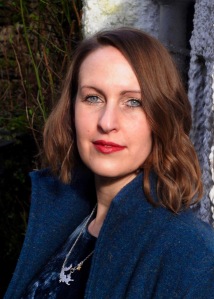 Polly Atkin lives in Cumbria. Her debut poetry pamphlet bone song (Clitheroe: Aussteiger, 2008) was shortlisted for the Michael Marks Award, 2009. Her second poetry pamphlet Shadow Dispatches (Seren, 2013) won the Mslexia Pamphlet Prize, 2012. In 2014 an extract from her first collection, Basic Nest Architecture, was awarded New Writing North’s Andrew Waterhouse Prize for ‘reflect[ing] a strong sense of place or the natural environment’. Polly has taught English and Creative Writing at Lancaster University and the Universities of Strathclyde and Cumbria.
 In Basic Nest Architecture, the contrast between city and country, natural and unnatural, is at the forefront of many of the poems – did this theme emerge organically through the process of your writing, or was there a conscious fascination with the urban & rural you sought to explore from the outset?
I think the poems try to trouble the idea of these binaries – I’m not a fan of binaries generally; they always over-simplify – and especially the way people use terms like ‘natural’ or ‘unnatural’ or ‘rural’ or ‘urban’ to certain ends. The natural/unnatural dichotomy in particular is something that really bothers me. Natural to whom, or what? Unnatural how, and in what context?
There’s a very practical movement behind the appearance of some of those concerns in the poems – in 2006 I moved to Lancashire, and then to the Lake District – after seven years living in East London. People often think of the Lake District as a kind of little wilderness, but it’s actually one of the most populated national parks, with over 40, 000 people living within its boundaries. It contains towns and villages and a vast array of different kinds of managed lands, yet we are constantly encouraged to see it as wild and empty ‘Nature’, including by the Lake District National Park Authority themselves. People have a tendency to associate the rural with the past, and the urban with the future or with modernity. This association is as ancient as cities themselves, and hard to challenge. I don’t know what the best answers to our current environmental crises are, but re-examining some assumptions about how we live, and what we live with, seems pretty central to me. I’ve been doing that in a very small way in my own life, and I hope the poems are doing that too.
Which do you find a better source of poetic inspiration – the natural world or the urban one? Do you think your poetic style has shifted as you’ve moved from city to country?
I would never say one or other was more ‘inspirational’. A poet I respect a lot said to me a while ago ‘you’ve found your place’, and I think that’s the key, for me at least. I loved living in London whilst I was there, but when I left, it was coming out of a long fever or something. I had never loved a place I lived in before Grasmere, only the things a place provided for me, and the ways it allowed me to live. Really loving the place I woke up in every day was a radical difference for me.
As for style … I’m very much of the mind that it is important to keep learning and developing and changing, as a person, as an artist. What influences that change and growth can be many things, from what you read, to social and political changes, to changes in your environment. If I’m still writing the same way in ten years time that I am now, I’ll have to have a serious word with myself, if someone else doesn’t get there first.
In ‘Buzz Pollination’ we see a bee attempting to take pollen from a woman’s bracelet: ‘tricked by the blossom/ of my bracelet’s fat fake pearls, their delicious/ lustre’. The pearls are pretty yet useless – would you say this is indicative of the human preoccupation with aesthetics?
Partly … people can get very focused on the external without considering usefulness, and yes, that might suggest a preoccupation with aesthetics over function. But I wouldn’t say beauty didn’t have a purpose. Going back to the first question, those beads are something inorganic that is mistaken as organic. It’s not the fact that they’re not ‘natural’ that’s the problem, or that they’re fake pearls and not flowers, but that they’re in the wrong place. The bee needs flowers, and the flowers need the bee. But from my very selfish human perspective, the bee’s inappropriate attraction to my bracelet made me feel like the bee and I had some kind of connection. I liked it; liked the fact it kept coming back to me, as though that made me special, even though I knew on a larger scale that meant both the end of the bee, and the end of pollination. So maybe it’s really about human selfishness, and prioritising the human experience over the needs of the non-human.
Several of the poems seem to express the view that urbanization is destroying the natural world in the name of progress, particularly in the poem ‘The New Path’. Do you think that more should be done to protect British wildlife? Do you hope that your poetry inspires its readers to be more active in protecting it?
That’s a big ask for a poem, isn’t it? The most I can hope for is that some of these poem might make some readers question some of the ways they respond to the things around them, including, but by no means limited to, animals. There are a lot of debates about what animals should or should not be protected. I’m very aware of my status in Cumbria as an off-comer – an incomer, raised in an urban environment – exactly the kind of person who would sentimentalise foxes or badgers, and prioritise of the aesthetics of the landscape over practical concerns. ‘The New Path’ is literally about a new path, which seemed grotesque in its insistence on ease of movement, and in its inappropriateness in the landscape. But, like the road in the epigraph, ‘we take it nonetheless’. Why? Because it’s easier. If it allows access to someone who was unable to use the more aesthetically pleasing old path, maybe it’s not the new path that’s unreasonable.
Some of the poems capture the unease and discomfort at not feeling at home in either your location or your mind – for example ‘Dreams’ and ‘Colony Collapse Disorder.’ Did you find it difficult to write about such personal feelings, particularly when writing about your illness, or was this cathartic?
I wouldn’t say it was either particularly difficult or particularly cathartic, no more so than writing anything. Chronic illness, pain, and all the strange and marvellous things that come with them, are facts of my life. I write about them in the same way as I write about anything. Another way of looking at it is that all my writing is filtered through my mind and my body, my experience of the world, so I am always writing through those things, through personal and bodily feelings, whether they are the subject of the poem or not. Everything is both personal and totally impersonal in a poem. Once you write about it, it is outside you. It no longer belongs to you. I do joke a lot about ‘the Plath consolation’, that idea of ‘grit into art’, but it’s a very troubled concept, particularly where Disability is concerned. I recently heard David Constantine answer a similar question, and he said (in my poor paraphrase) that writing can’t be redemptive, or consolatory, that it can’t change the facts of real life, but that what it does instead is imagine different ways of being, different human possibilities. I thought that was very beautiful.
Lastly, what can we look forward to next? Are you working on any other exciting projects, or appearing at any events soon?
I’m working on new poems, but I’m not quite sure how they’ll come together yet. I’ve been working on a sequence about experiences of venesection (taking blood) as a treatment for Haemochromatosis, which will be included in a Wellcome Trust funded project called Books of Blood. Two of the poems from this sequence are going to be published in an anthology, Gush (Fronetac House, 2018), ed. by Rosanna Deerchild, Ariel Gordon and Tanis McDonald. I’ve got some other possible projects lining up but I can’t talk about them yet!
I’m lucky to have quite a few readings and events over the next few months including:
- Guest Poet at The Garsdale Retreat, ‘Writing The Land: Crafting Poems from Inspired Communion’, Sedbergh, Wednesday August 23rd 2017.
- Reading for Caught by The River at The Good Life Experience, Hawarden Estate, Flintshire, Saturday September 16th, 2017.
- ‘Northern Poets’ event at Durham Book Festival, Saturday October 14th.
- Reading with Elizabeth Jane Burnett at Kendal Mountain Festival, Brewery Arts Centre, Kendal, Saturday November 18th, 2017.
I put new events up on my website, so keep an eye on https://pollyatkin.com/events/ if you’re interested.
Basic Nest Architecture is available on our website: £9.99
Join our free, no obligation Book Club for 20% off every time you shop with us.


 ‘To a Comrade in Arms’ was originally published in Lewis’ first collection Raiders’ Dawn, which appeared during his period of service in Burma during World War Two. Raiders’ Dawn featured fourty-seven poems, and effectively answered the critics’ questions about the absence of war poets in that conflict. Alun Lewis is often seen as a poetic mouthpiece for the reality of the Second World War, his poetry faithfully communicating the mundane and sombre details he experienced.