Carolyn Jess-Cooke’s third collection We Have to Leave the Earthdeftly interweaves the personal and the political. Climate change is confronted in a sequence about the Arctic; poems that are vividly descriptive of an extreme landscape, sensitive to the effects of global warming. A second sequence, The House of Rest, is a history in 9 poems of Josephine Butler, (1828-1906) a pioneering feminist activist. There are also tender poems about family, mental health, motherhood and the earth.
The Seren Poetry Podcast is a new series of in-depth interviews with Seren poets. Episode 5 with Carolyn Jess-Cooke is available to listen to now.
Simply search ‘The Seren Poetry Podcast’ in your favourite podcast app and follow or subscribe to have all future editions delivered straight to your podcast feed. Available on all platforms including Apple Podcasts, Spotify and Google Podcasts. Don’t forget to leave us a review if you like what you hear.
The Estate Agent’s Daughter by Rhian Edwards is both powerfully personal, local to the author’s Bridgend birthplace, and performative, born to be read aloud. In the title poem, the protagonist is reimagined as a surrealist house, foreshadowing both the heartbreak (a shattered first marriage) and joy (the birth of a daughter), that feature in the work that follows. Employing sly irony, close observation and sharp wit, the poet confronts a myriad of themes, from family and the body to the word of disillusioned dating. Throughout she combines her visceral skill for description with a feminist forthright courage to speak of difficult things.
The Seren Poetry Podcast is a new series of in-depth interviews with Seren poets. Episode 4 with Rhian Edwards is available to listen to now.
Simply search ‘The Seren Poetry Podcast’ in your favourite podcast app and follow or subscribe to have all future editions delivered straight to your podcast feed. Available on all platforms including Apple Podcasts, Spotify and Google Podcasts. Don’t forget to leave us a review if you like what you hear.
Still uses the title as a fulcrum to balance paradoxical concerns: stillness and motion, memory and forgetting, sanity and madness, survival and extinction. The old man in the title poem is seen standing, backlit by an open door. Fixing this in the mind is both memorial and a means of partial forgetting, of releasing him into history. The closing set of poems ‘Still Air’ focuses on a small landscape in the Usk Valley, observing the multiple, complex, endlessly moving parts of nature in the stars, geology, the seasons, the days. Lively and thought provoking, this is a beautifully crafted, insightful and intelligent collection.
The Seren Poetry Podcast is a new series of in-depth interviews with Seren poets. Episode 3 with Christopher Meredith is available to listen to now.
Simply search ‘The Seren Poetry Podcast’ in your favourite podcast app and follow or subscribe to have all future editions delivered straight to your podcast feed. Available on all platforms including Apple Podcasts, Spotify and Google Podcasts. Don’t forget to leave us a review if you like what you hear.
This week’s Friday Poem is ‘Heirloom’ by Ilse Pedler from her collection Auscultation. You can hear Ilse chatting poetry and her job as a vet in episode 2 of The Seren Poetry Podcast which is available now on all podcast platforms.
Auscultation, which means listening and specifically, in medicine, listening to sounds that come from the body’s internal organs. If listening is a central theme of this collection, it is also about being heard. There are poems about vets waiting rooms and surgical instruments, about crisis calls, about overhearing farmers and pet owners and colleagues. There are also poems about surviving a stern childhood and a heartbreaking sequence about being a stepmother. This is a compelling set of poems from a striking new voice.
The Seren Poetry Podcast is a new series of in-depth interviews with Seren poets. Episode 2 with Ilse Pedler is available to listen to now.
Simply search ‘The Seren Poetry Podcast’ in your favourite podcast app and follow or subscribe to have all future editions delivered straight to your podcast feed. Available on all platforms including Apple Podcasts, Spotify and Google Podcasts.
Auscultationis available on the Seren website: £9.99
Create your free Seren account and enjoy 20% off every book you buy direct from us.
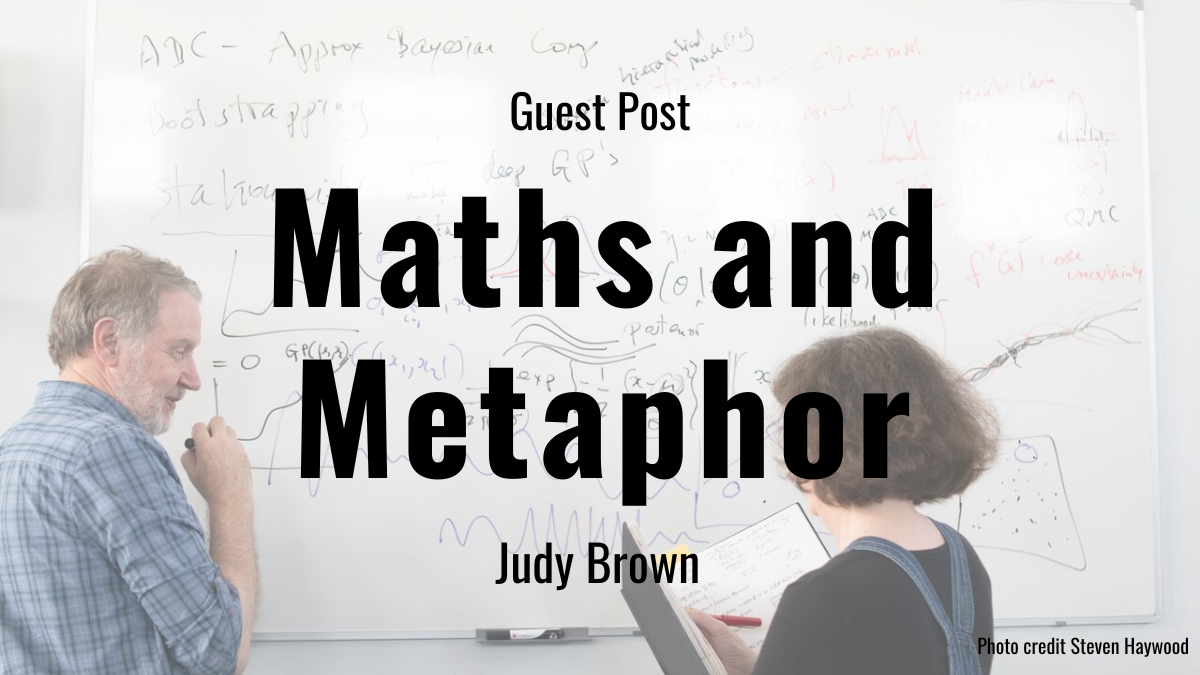
Judy Brown’s new collection Lairs was partly born out of a residency Exeter University’s Institute of Data Science and Artificial Intelligence. In this guest post she discusses the experience and how maths and poetry have more in common than you might think.
Lairs brings together something primal and secret – the lair as haven for a wild or feral animal – with the poem framed as a mathematical equation. In these terms, the ‘lair’ is a kind of nest, a beautiful accumulation of dense detail. The poems are introspective, by turns mocking, fearful and analytical. Judy Brown’s use of language is innovative, while maintaining moments of vulnerability and moving self-awareness. In these exquisite poems, the lair is both the community at large and a dark and intricate interior space where something wild still survives.
Maths and Metaphor
Before this summer, if someone had told me maths could be as much fun as writing poems, it wouldn’t have been a long chat. Professor Beth Wingate, mathematician and poet, did say as much to me in July but by then it was too late: it had become obvious. Residencies teach you things – often not what you expected.
This was a summer of empty campus lawns, rain, whiteboards crammed with notation, hours spent looking up half-heard maths phrases on Wikipedia, metaphors I splashed everywhere and tried to hold onto to avoid panic, attempts not to look stupid, looking stupid despite everyone saying, kindly, ‘There are no stupid questions.’ And lots of questions, lists of them collected amongst my drawings and notes in a big A3 sketchbook – a necessary navigation aid in this slightly frightening, very exhilarating experience. This sort of messy process is how I write anyway, I just hadn’t ever been quite so at sea.
Judy Brown’s residency sketchbooks
To backtrack a little: Arts and Culture University of Exeter has a programme that matches creative practitioners with research academics. The area under consideration can be quite sharply defined, the methodology and the outcome full of openness. I’d been attracted by the measured strangeness in the language used by Professor Peter Challenor, a statistician whose work involves producing approximations of what complex mathematical models (of the human heart, the ocean, the climate) would be likely to predict across a wide range of situations, together with exact assessments of how much you can rely on those predictions. The models themselves are often too expensive and slow to be run as many times as you’d like – just like the planet and the human body – so the techniques used by Peter’s team in the Institute of Data Science and Artificial Intelligence are of critical value, but also a little magical, seeming to create bricks out of straw.
Peter had said in his brief ‘There is always a discrepancy,’ but I had no idea how many sorts of discrepancy existed. The team’s specialisation is called uncertainty quantification – and when didn’t a poet love a paradox?
I was lucky. Peter turned out to be interested in everything, a member of the Poetry Book Society, and an eloquent explainer who could shift in and out of maths notation and take up my hesitant and extravagant metaphors to talk to me in a language I knew.
Judy Brown and Professor Peter Challenor. Photo credit: Steven Haywood
I had five weeks of great conversations – about writing on proper blackboards, machine learning, the problems of multidimensionality, different types of probability, heart surgery, whether a mathematical model is a metaphor, the importance of pattern and of deviations from it. We talked about Jack Underwood’s essay ‘On Poetry and Uncertain Subjects’ (The Poetry Society) – how our kind of uncertainty made poems hospitable, how unacknowledged uncertainty for Peter made things dangerous.
I only have a maths GSCE but I wasn’t too worried. I quite like feeling a subject is full of things I don’t know and knew that the not-knowing would itself generate ideas that would lead to poems. In the end I felt I’d been allowed to walk further into another world than I anticipated, with tiny, occasional flavours of what it might be like to know how to move in those regions as of right. As with poetry, it turns out that even small amounts of maths are worth having.
I knew that metaphor is what I think with, and where many of my poems originate – it’s central, not decorative. The fact that I couldn’t think anything without it was demonstrated very clearly over these weeks when I kept asking ‘What is it like in there?’, ‘What kind of creature is it?’ That was our difference, maybe – the poet’s obsession with specificity where a small precise detail stands in for a big abstract thing. Or maybe it’s not so different, I still don’t know.
The experience also underlined the importance of play for writing, and for problem-solving. At school I always wanted a structure to put what I learned in – that’s often what a teacher gives you – a particular shaped bucket, and you fill it. Here I had no time to get even a small bucket; there were only the structures I already had – metaphor, language, question, answer, and sometimes just the process of sitting and drawing.
Close up of one of Judy’s sketchbooks
This was semi-feral learning in the sense that when people told me about their work I was able to choose the questions and Peter’s team worked to give me answers that might make sense in the language of the asking. I also tried to learn as much of their talk as I could – even a few equations. It felt amazing for someone middle-aged to be learning in this essentially childlike way, like a car wash for the brain. It felt just like writing.
I’ve written quite a few poems from this – now on the Arts and Culture website and in issue 2 of Finished Creatures magazine, and migrating into the manuscript of my next collection Lairs. I have lots more drafts and ideas. While the maths is not always apparent, I couldn’t have written them without that huge new space in my head. I’m slowly reading a book about calculus and watching the odd MIT lecture or Isaac Newton Institute seminar on probability or uncertainty quantification. It still feels flukey, strange, to be treasured.
Judy Brown
Read Judy’s maths-inspired poem ‘Some Security Questions’ on the Exter Arts and Culture website.
‘Uncertain Rigours’, a short film by Steve Haywood about the residency, can be viewed on the Exter University Arts and Culture website.
Much With Body is a startlingly original second collection. The beauty of the Lake District is both balm and mirror, refracting pain and also soothing it with distraction. Much of the landscape is lakescape, giving the book a watery feel. Atkin also draws on the journals of Dorothy Wordsworth, from a period late in her life when she was often ill. In common with the works of the Wordsworths, these poems share a quality of the metaphysical sublime. Their reverence for the natural world is an uneasy awe, contingent upon knowledge of our fragility and mortality.
The Seren Poetry Podcast is a new series of in-depth interviews with Seren poets. Episode 1 with Polly Atkin is available to listen to now.
Simply search ‘The Seren Poetry Podcast’ in your favourite podcast app and follow or subscribe to have all future editions delivered straight to your podcast feed. Available on all platforms including Apple Podcasts, Spotify and Google Podcasts.
This week’s Friday Poem is ‘The Leech House’ by Rhiannon Hooson from her forthcoming collection Goliat.
Goliat is the second collection by Rhiannon Hooson, a follow-up to her Wales Book of the Year nominated debut, The Other City. An intelligent and beautiful book, Goliat offers absorbing stories of a precarious world on the brink of climate emergency. Employing startling imagery and a deep sense of history, these poems explore the irreplaceable beauty of a wild world, and the terrible damage that humans might do to each other and the earth.
Create your free Seren account and enjoy 20% off every book you buy direct from us.
Join us at 7:30pm at Chapter in Cardiff on National Poetry Day Thursday 6th October to see Rhiannon launch Goliat at Seren First Thursday alongside Hilary Llewellyn-Williams. If you can’t join us in person, we’re also streaming via Facebook live. Find the details on our website.
This week’s Friday Poem is ‘Fish. Oh. Fish’ by Judy Brown from her forthcoming collection Lairs.
Lairs brings together something primal and secret – the lair as haven for a wild or feral animal – with the poem framed as a mathematical equation. In these terms, the ‘lair’ is a kind of nest, a beautiful accumulation of dense detail. The poems are introspective, by turns mocking, fearful and analytical. Judy Brown’s use of language is innovative, while maintaining moments of vulnerability and moving self-awareness. In these exquisite poems, the lair is both the community at large and a dark and intricate interior space where something wild still survives.
This week’s Friday Poem is ‘The meaning of employable’ by Bryony Littlefair from her forthcoming debut collection Escape Room which will be published on National Poetry Day.
Escape Room is the long-awaited debut collection by Bryony Littlefair. This is a collection exploring the possibilities of freedom, goodness, meaning and connection under late capitalism. Can we escape the imperatives of money, gender and human fallibility to freely construct our own identities – should we even try This complexity is balanced with a resolute joy, humour and irony. If you’ve ever grappled with ‘a desire you could not understand / like wanting to touch dark, wet paint’, had an identity crisis at a corporate away day, or just not known what to do with your Sunday morning, the Escape Room is open for you.
This week’s Friday Poem is ‘Prayer’ by Grahame Davies from his collection Lightning Beneath the Sea.
Lightning Beneath the Seais the first collection of poems in English by Grahame Davies, featuring the work that he has honed over the years as he has read them at literary festivals, conferences and events world-wide. Well-known for his prize-winning Welsh-language poetry and fiction, and for his scholarly non-fiction, he brings a native warmth, an intimate, conversational tone, and a raised civic awareness to these poems.