Posted on

International Day of the Girl 2016

international day of the girl

Today is International Day of the Girl, a day designed to raise awareness about gender inequality and the barriers girls come up against, from birth to adulthood. In recognition, here are a few Seren writers whose books highlight the challenges girls and women face.

Six Pounds Eight Ounces, Rhian Elizabethsix pounds eight ounces
‘My first word was clock only it came out as cock. That was when my mother knew I was trouble.’
Rhian Elizabeth’s introduces us to Hannah King, a self-assured young girl brought up in the Rhondda Valley within a community that offers little prospect for her future. Situated in turbulent surroundings, in conflict with family and community, Hannah is pulled towards a dark instability. Both comic and tragic, this is a gripping portrayal of girlhood in Wales.


The Way the Crocodile Taught Me, Katrina Naomithe way the crocodile taught me
In Katrina Naomi’s collection we see a girl in fear of her domineering step-father whose ‘flashing anger’ (‘Portrait of my Step-father as a Xmas Tree’) threatens to bubble up at every turn. We see the trials a woman can face: sexual assault, aggression, misuse. This is an emotive collection that refuses to shy away from depictions of violence and abuse, yet remains resolutely uplifting.


folk music sheenagh pughFolk Music, Sheenagh Pugh
Set in a country lying somewhere between Wales and central Asia, in a time which might be the middle ages or the near-present, Folk Music is a work of fiction that draws parallels with the oppressive, patriarchal regimes still existing today. Central to the story is the convention that, on marriage, a woman does not speak to anyone, except in private to her husband, until the birth of her first child. Pugh explores the possibility for both oppression and empowerment in this subtly-entwined narrative, which asks whether the abandonment of tradition is a positive thing, or may leave us only with rootlessness and dislocation.


fighting-pretty-smallFighting Pretty, Louise Walsh
Walsh peers into the macho world of boxing with tenderness and telling humour. Reeling from divorce, jobless and living back home with her embittered father, Lizzie throws everything she has into training to be a boxer. Despite battles with her weight and other demons, Lizzie fights on, determined someday box for Wales, and wear the coveted red vest. This story breaks down the barriers separating men and women in sport, just as the Olympics have begun to give women better representation (in 2012, for the first time, 10 men’s Boxing events at the London Olympics were joined by three women’s events).


the tip of my tongue trezza assopardiThe Tip of my Tongue, Trezza Azzopardi
This re-telling of the Mabinogion story Geraint and Enid transforms a medieval heroine who won’t be silenced into a brace 1970’s girl from downtown Splott in Cardiff, who, no matter how difficult the circumstances, always seems to get the last word.
The original Enid from Celtic mythology defends her misguided husband by warning him of approaching villains, even though he has forbidden her to speak. Trezza Azzopardi’s young Enid is also unlikely to respect a gagging order.


This list features just a few of the many talented Seren women writers. Discover them all on our website.


Want to get involved with International Day of the Girl? Join the conversation online by using the hashtag #DayoftheGirl on Twitter.


Posted on

Friday Poem – ‘Savoy Hotel, London’, Rosie Shepperd

friday poem rosie shepperd

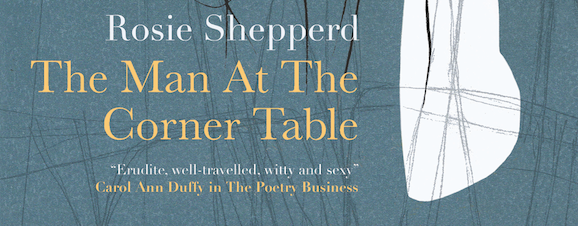
This week our Friday Poem is from Rosie Shepperd’s tantalising debut, The Man at the Corner Table. You can hear Rosie read from this collection live on National Poetry Day, 6 October, at Berkhamsted Waterstones alongside Caroline Smith and Graham Clifford.

the man at the corner table rosie shepperdThe Man at the Corner Table crackles with the unexpected. The voice is one of urban sophistication; a merciless charm that teases and tempts us with sensual evocations of food and place. The reader is surprised with tastes, scents, colours and textures. There is a winning insistence on detail offered with an irony that blends into satire.


Savoy Hotel, London
Those nights downstairs at the American Bar;
it’s not just the chairs that show gilt in the telling.
Back then we were almost quite something.
You and London were lean;
your eyes, a fraction off-centre as you
struggled not to say,
We have this connection. My God.
You overplayed.
And not just your hand.

My role in this mellow
drama was to shift that arse
you loved to chase and twitch my best side
close to the oh-so-Maraschinos.
Too long ago, they were fruit in a tree.
Some tree.
I guess they were something for me
to play with; the pretence
we were ever friends was just
a way to simulate sharing.

30:70 and I never found out
who made the best bet
but I do know that’s the wrong word.
Early is just another kind of late and
anyway, you were always
there each night, every night. There’s
no fool like a blind
fool; thank God I didn’t see the edge
till I was over and out
the other side.


Buy your copy of The Man at the Corner Table now: £9.99

Claim 20% when you become a Book Club member

Posted on

National Poetry Day 2016: All you need to know

National Poetry Day is an annual celebration of poetry and all things poetic. Started in 1994 by William Sieghart, it has engaged millions of people across the country with reading, writing and listening to poetry.

This year, National Poetry Day is taking place on Thursday 6th October. The 2016 theme is Messages – think texts, emails, letters, cards, speech; sad messages, hopeful ones, happy messages and even unspoken ones. They could be spooky, paranormal messages or those you hear every day, such as “hello” and “goodbye”.

Say it with a poem – be inspired by this years theme of Messages, and write a poem of your own to express yourself!

poetry-book-coverposterfinalupdate2-675x1024Download this year’s FREE poetry eBook – Messages: National Poetry Day 2016 is a free anthology of wonderful Messages poems – old and new. The fourteen poets in this eBook (created by MacMillan Children’s Books with Forward Arts Foundation) are all National Poetry Ambassadors.
Featured poets: Deborah Alma, Liz Brownlee, Paul Cookson, Sally Crabtree, Joseph Coelho, Matt Goodfellow, Sophie Herxheimer, Rachel McCrum, Brian Moses, Michaela Morgan, Joshua Seigal, Roger Stevens and Indigo Williams.

Download your free copy of the National Poetry Day 2016 anthology here.

Get involved! Attend one (or more) of the many National Poetry Day events happing all over the UK.
There are loads of events happening on and around National Poetry Day, 6th October, including two of our own:

First Thursday: New Fiction and Poetry at Chapter, Cardiff
Seren’s monthly celebration of new poetry and fiction returns after the summer break. Join us for readings from our special guests and then the famous open mic.
Cardiff poet and author Peter Finch presents: The Roots of Rock, from Cardiff to Mississippi and Back, and Jayne Joso reads from her new novel, set in the outskirts of tokyo: My Falling Down House.

Berkhamsted Waterstones: Caroline Smith, Graham Clifford & Rosie Shepperd
Celebrate National Poetry Day at Berkhamsted Waterstones with an evening of poetry readings, featuring three Seren poets: Caroline Smith (The Immigration Handbook), Graham Clifford (The Hitting Game) and Rosie Shepperd (The Man at the Corner Table).

Take a look at the National Poetry Day events map and go along to anything that catches your eye.

Take advantage of free online resources – There are loads of resources on the National Poety Day website, including advice on how to get your school enjoying poetry, news, and free poems to read and share. Take a look here.


Seren’s own celebrations will kick off with a flash poetry sale – keep an eye on our website (or social media channels) on 6th October to take advantage of our special National Poetry Day book offers!


Save

Posted on

Friday Poem – ‘A Pembrokeshire Artist’, Tony Curtis

A Pembrokeshire Artist Tony Curtis Llangwm

This week we have a treat for you – our Friday Poem is one of the new poems from Tony Curtis’ forthcoming From the Fortunate Isles: New and Selected Poems (Seren, October 2016).

From the Fortunate Isles: New and Selected Poems, Tony CurtisFrom the Fortunate Isles, published in celebration of the author’s 70th year, features poems from ten of Curtis’ published collections as well as a substantial number of new poems. This is a poet whose themes and variations remain consistent: a profound interest in the wars of the last century, an abiding fascination for all art forms, particularly painting and poetry, tender attachments to family, and (most evident in the poem below), a deep affection for his roots in West Wales.


A Pembrokeshire Artist
John Knapp Fisher (1931 -2015)

An evening with the rain coming in,
that sea so cold and unsettled, a heavy graphite,
you’d not have gone out with your mackerel lines
in the Viking or any of her successors
from the stone-brick embrace of Porthgain.

We’ve eaten our fill at your wake, John,
the Sloop Inn squeezed tight
with suits, black ties and memories.
Wives, patrons, grandchildren.
Photos of you through all seven ages on the screen.

Inland to Wolf ’s Castle and as far south as the cathedral
the farms, haggards and holiday lets
shrug down for the cold night.
You’d have worked to conjure the reluctant light
discovered in them under this empting, moonless sky.

And the first scurp coming would have dabbed
your paper, blossomed and been coaxed,
smudged, into the finished sketch.
Now the county will have to sing its own spirit,
compose its own shape, keep its own watch.


If you would like to listen to Tony read from his forthcoming collection and other books in his native Pembrokeshire, don’t miss his event at the Llangwm Literary Festival, Saturday 12th August. More details here.

You can buy copies of Tony Curtis’ poetry collections, anthologies he has edited, critical essays, and other writing direct from us (20% off for Book Club Members):
Crossing Over
Heaven’s Gate
Tokens for the Foundlings (ed Tony Curtis)
After the First Death (ed Tony Curtis)

Wales at War
Real South Pembrokeshire
Keep an eye out on the Seren website – Tony’s new collection, From the Fortunate Isles: New and Selected Poems, is coming soon…

Posted on

Gloriously gothic book launch: Bethany W. Pope in Cardiff

Gloriously gothic book launch Bethany W Pope Cardiff

Join us for a night of gothic romance as Bethany W. Pope reads from Masque, her rich and psychological re-telling of Gaston Leroux’s classic, The Phantom of the Opera.

The event is at the new Octavo’s Book Cafe & Wine Bar in Cardif Bay, Wednesday 22 June, 5:00-7:00pm, and is free for all to attend.
Bring your friends, have a glass of something decadent, and listen to the story unfold.

Bethany W. Pope launch Cardiff

Tell us you’ll be there! Click ‘going’ on the Facebook event page or RSVP by email to: [email protected]

About Masque:
Masque is a richly gothic retelling of Gaston Leroux’s phantom of the opera story by debut novelist Bethany W Pope. Centre stage is promising young singer Christine, who, despite being devoted to her art, attracts the attention of both the Phantom (Erik), and rich Parisian theatre owner Raoul.

The intensely ambitious Christine finds herself caught between the twin evils of the Phantom’s murderous pursuit of artistic perfection and Raoul’s ‘romantic’ vision of her as a bourgeois wife. Her own desire to follow her operatic career becomes her guiding light, but none of the three leading characters can control the directions in which their passions lead them, while the beautiful masked skull of the opera house itself looms large over their respective fates. The resulting mix of love, rage, art and murderous intent, is explosive.

Love, lust, adventure, romance, and the monstrous nature of unfulfilled creativity await you here.

Everyone wears a mask. Look beneath it, if you dare.


Posted on

International Dylan Thomas Day 2016 | News and Offers

international dylan day 2016 offers

Happy International Dylan Thomas Day! This year is the second annual celebration of Dylan Thomas, held on 14th May to mark the date Under Milk Wood was first read on stage at 92Y The Poetry Center, New York in 1953.

International Dylan Thomas Day 2016 Dylan Day offers Seren

We have a number of Dylan Thomas related books in our store, and for today only, these titles are 50% off:

dylanday

Dylan Remembered: Volume One: 1914-1934, ed. David N. Thomas
Paperback:
£12.95

£6.48
Hardback:
£25.00
£12.50
This is the first of two volumes of transcribed interviews about the poet Dylan Thomas. Journalist, broadcaster, and author Colin Edwards interviewed numerous sources close to Thomas for a planned biography of the poet, but he was unable to begin work before his early death. The transcribed tapes have been edited into two collections, with the second due in 2004. Startling new information about Thomas’s life and writing is disclosed, including influences on his writing and the sources from which he drew inspiration and storylines.

Dylan Remembered: Volume Two: 1914-1934, ed. David N. Thomas
Paperback:
£12.95

£6.48
Hardback:
£25.00
£12.50
This second volume culled from the Colin Edwards Archive of interviews with Dylan Thomas’ family, friends and colleagues made during the 1960s covers Thomas’ ‘adult’ life from his move, aged 20, to London to become a professional writer to his death in New York 51 years ago. It is a story which we think we know, but the archive sheds new – often contradictory – light on a life which has been much mythologised.

Fatal Neglect: Who Killed Dylan Thomas, David N. Thomas
£9.99
£5.00
Who and what killed Dylan Thomas? The death of this iconic writer, in New York in November 1953, remains shrouded in mystery fifty-five years later. What might have been a triumphant new departure in his career and life with the first production of Under Milk Wood, and plans to work on operas with Igor Stravinsky and Samuel Barber turned instead into a requiem for man whose life spiralled out of control.
Leading Dylan Thomas authority David N. Thomas draws on his extensive research, and uncovers startling new evidence, to produce the definitive answers in a superbly written account which balances historical context with forensic detail, Thomas’ character with the demands made upon him by friends, lovers and his reading public.. His verdict is a chilling study of a poet, a place and a death.

Advantages of the Older Man, Gwyneth Lewis
£7.99
£4.00
A light-hearted novella exploring the strange case of a Swansea woman who is apparently possessed by the spirit of Dylan Thomas. Naturally all is not as it seems. The woman, who works in the Dylan Thomas Centre, meets a rather different Dylan from the one she knows by repute, one who doesn’t really fit in with the ghosts of other poets in heaven and is desperate to train himself to join the fitter shades of the long distance runners instead. Her own life, which has been lonely and sad, is completely transformed by the encounter.
Fluent and entertaining, the story is written with all the confidence and panache you would expect from the former national poet, also a playwright and award-winning author of fiction and non-fiction. Alongside the humour there is a warmth and pathos, and some pithy observations on poets and poetry and the nature of fame.

This offer ends midnight, 14th May, so take advantage before the time runs out!

And as always, there are events running all across the UK in celebration of Dylan Day, so when you’re finished browsing our website take a look on the Literature Wales website to find a Dylan Day event near you.

Posted on

St Ives Residential Course 2017

Kim Moore David Tait poetry course 2017

Kim Moore: St Ives Residential Poetry Course 2017

“After a sell-out course in 2016 in St Ives, I’m really pleased to announce that I’ll be co-tutoring another residential poetry course at Treloyhan Manor Hotel in St Ives, from the 20th-26th February 2017.  I’m very excited to announce that my co-tutor this year will be the fabulous poet David Tait.…”

Find out more about the St Ives poetry course on Kim Moore’s blog.


Source: St Ives Residential Course 2017

Posted on

Ritual, 1969 | An interview with Jo Mazelis

Ritual, 1969 Jo Mazelis interview

Our Marketing Officer Rosie Johns talks to Jo Mazelis about her new short story collection, Ritual, 1969, which is newly available.

Have you got a burning question of your own you would like to ask Jo? Or would you like your copy of Ritual, 1969 signed? If so, come to John Smith’s bookshop, Swansea, this Thursday for the book launch. This event is free to attend, all are welcome, and refreshments will be provided. Find more details here.

Ritual, 1969 by Jo Mazelis

What are little girls made of? What will they become? Will they run away to the circus or become dressmakers, teachers or servants? From the playground to adulthood the path is beset with misunderstandings, missed dates and hidden traps for the unwary.
This darkly gothic collection of stories explores the unsettling borderland between reality and the supernatural. Ranging from early twentieth-century France to 1960s South Wales and contemporary Europe, Jo Mazelis’ singular vision and poetic language creates characters caught up in events and feelings they do not fully understand or control, giving the book its uncanny focus. Not all is as it seems in a world where first impressions may only conceal disguises and false trails – and there’s no going back.
A thrilling third collection from the author of Jerwood Award winning novel Significance.

Your novel Significance was set in France while many of the stories in Ritual, 1969 are located in Wales. As a Welsh writer, do you see any importance in the issues of place and identity?

I think with Significance it had to be set abroad because I wanted to explore ideas about escape and rebirth as a starting point. The same novel could, I suppose, have been set in a small coastal town in Wales, but it just wouldn’t have been the same – I mean in the sense of my imaginative process. It had to be in an unfamiliar territory, yet one that is perceived as innocent and safe.

The stories in Ritual, 1969 weren’t planned or written as a collection – therefore the fact that so many are set in Wales is probably due to my thinking and experiences over the last twelve years or so. This also raises the question of whether Welsh writers should only write about Wales and the Welsh. The MA I did many years ago was ‘Writing the Celtic Archipelago’ and involved a sort of comparative study of the 20th century literature of small nations; from Wales to Éire, Northern Ireland and Scotland. In one tutorial I raised the issue of Muriel Spark as she wasn’t included in the course and was firmly told that she was not a Scottish writer. The argument was that she didn’t write about Scotland or live there, which I have always found rather puzzling. Then very recently I read Ian Rankin’s introduction to Spark’s novel Symposium and his first words were, ‘Muriel Spark was the greatest Scottish novelist of modern times’.  He goes on to say that although she lived abroad, ‘her roots are evident in everything she wrote.’ Aside from feeling vindicated after almost twenty years, I think his words make clear something I have always believed, namely that my roots inform everything I write.

The period when these stories were written also coincides with my travelling all over Wales for a variety of reasons, so the landscape figures directly as a place of reality and imagination. I also made a sort of conscious effort to travel imaginatively through time, so that the stories are set in different periods as well as different locations.

Ritual, 1969 contains stories that are often given hauntingly uncertain endings. What made you choose to give the reader so much room for interpretation?
The writer Paul Auster said, ‘The one thing I do in all my books is to leave enough room in the prose for the reader to inhabit it’. I suppose I must do the same but unconsciously. Saying that it seems almost deliberately vague or evasive to attribute any aspect of writing to the unconscious because it suggests that what the writer is producing is a stream of consciousness or work that is unmediated or without art or craft, but this is my experience.

When I write I don’t think about any potential or ideal reader and very often I have no idea where a story is going. It is a process of discovery for me as much as for the reader. When I first began seriously writing stories in 1987 I had not studied literature or creative writing beyond GCSE as I had gone to Art College not university. I had however read a great deal, but I think because I was essentially self-taught, I tended to doubt myself and worried that ‘real’ writers would not work in the same way as me. ‘Real’ writers would have the whole thing mapped out and they wouldn’t rely on intuition or the unconscious. I later read something John Fowles said about his novel The French Lieutenant’s Woman; how he had a recurring image during the autumn of 1966 of ‘A woman [who] stands at the end of a deserted quay and stares out to sea’ and he explained that he wrote the book to discover her story. It was this and other things a broad range of writers said which made me realise I was not unique in my approach and that was reassuring.

It has often been my experience that I don’t notice the underlying themes of my stories until after publication. It is only then that my later university education in literature seems to kick in and I can begin to analyse my work more like an academic. I realise that very often my fiction can be read on two levels, one which is simply the plot and characters, and the other which is connected to philosophy, politics, myth and culture. So the story ‘A Bird Becomes a Stone’ could be read as a crime mystery. Actually it’s a story whose title I changed several times and the other titles were far more prosaic. At the point I changed the title for the third or fourth time I thought I was being almost flippantly artful, but later I realised that the new title with a living thing, a bird, changing into a dead thing, a stone actually was the key to the story’s meaning. This was not just in the sense that something dies, but it also speaks to the whole process of art – a bird carved out of a stone, or a film of a bird or a poem will outlive the bird itself. Does this mean that a carved representation is somehow more important than the living creature?

A similar question is evident below the surface in ‘The Flower Maker’ a story set during a period of war and turmoil concerning a displaced woman who makes and sells artificial flowers from scraps of silk and satin in order to survive. Art and what should be sacrificed for it emerges in story after story, whether it is poetry or circus performance or film or photography or novels. If the endings to my stories are enigmatic then perhaps it’s because I can’t and won’t answer that question.

There are many female characters who seem to be struggling for survival and against alienation throughout the collection. Did the diversity of female characters and experiences in these stories appear with a conscious plan in mind?
As with my other collections of short fiction, these stories were written over a fairly long period of time – some were created as far back as 2003, others as late as December 2015, so there was no guiding principle as such, no sense of any relationship between them in terms of a book. Penny Thomas, my editor at Seren was really helpful in selecting these from the rather larger group of stories I presented her with, thus helping the book to become a cohesive whole. I think the effect of this is that the stories speak to one another; though clearly I was also at different times experimenting with the idea of linked stories.

If these stories have a common theme then I think it might be that they expose gender as an artificial construct, so much so that it almost seems as if all of the female characters are ‘performing femininity’ rather that behaving naturally or instinctively. In this sense there is once again a dichotomy between the false and the real, the surface and what lies beneath; between art and nature, dreams and reality.

In my earlier short story collections Diving Girls and Circle Games there were far more stories about men and their particular perspectives  –  I was interested in ideas about patriarchy and men’s internalised view of their ‘natural’ superiority, so these characters were often white, middle-class Englishmen. Of course you can’t generalise about anyone on account of their gender, race, class or religion, and it was fairly hard to get inside the head of some of these male characters, especially at moments when they were acting badly, then performing mental tricks of self-justification, but these stories were an important aspect of my feminism because they interrogated power itself at a micro-level. Having said that I also wanted to interrogate or dispel some myths, for example those to do with a relationship between a lecturer and a student (who is over the age of eighteen) as I felt that such a relationship would not be simply about a predator and his victim. It seemed important that the female character has to have some degree of free will, that she is responsible for her own choices.  Just as he is.

I suppose in some ways I am exploring the limits of knowledge and how none of us can really understand how it feels to be someone else, or why people do the things they do whether for good or ill. In the story ‘Word Made Flesh’ which was commissioned by Wales Arts Review, a young Irish woman is never listened to. Because no one knows her tragic story she grows increasingly lonely and alienated and cannot sleep at night – so in this story it’s a case of important knowledge not withheld but ignored.

These themes about knowledge also appear in the stories about teenage girls and children, recurring again and again in different guises, whether it is a poem that never gets discussed, or the secrets and/or fantasies of many of the characters. It could be argued that a lot of these characters are trying to live their lives according to the wrong script – which is the case in ‘Whose Story Is This Anyway’ and ‘The Murder Stone’. One of the questions I am asking is, why are people so deceived and so enduringly self-deceiving? Why do so many women feel so self-conscious about their imperfections, so eager to construct their image based on artificial and/or idealised figures whether these are dolls or glamorous female celebrities?

The two epigraphs at the start of the book by William Blake and Mary Wollstonecraft are there as lodestones to the stories’ meaning, but were added long after most of the stories were written.  One addresses the issue of corrupted beauty and nature, the other the issue of truth with particular regard to education and these themes are revisited in many of the stories.

Which character was the hardest to bring to life, and why?
Characters either come to life or they don’t. I tend not to think of them as separate entities from the story itself – they are woven in, creating a tapestry, rather than appliquéd on. Or perhaps instead of using a metaphor which employs a traditionally female art form I might say that the idea for a story appears in my mind like a block of marble. I chip away at it to reveal the figures and the narrative that is locked in the stone.

I wish I could give a simple answer to this question but after writing fiction for so long I have acquired something I learned about via Flannery O’Connor, namely ‘the habit of art’. I began to read the stories of Flannery O’Connor in 1975, then in 1988, when I began to steadfastly write, I bought ‘Mystery and Manners: Occasional Prose’ which is a collection of her non-fiction work. O’Connor has been a huge and enduring influence on my short stories making me wonder some time ago if the notion of Southern Gothic couldn’t be extended to absorb Southern Welsh Gothic. Strangely, many years ago I bought a rare hardcover 1st edition of a Flannery O’Connor novel for 50p. I was exceedingly poor for many years, in debt and fear and worry constantly which is a miserable way to live. Then in an idle moment I looked up the value of this particular O’Connor novel and found it was worth a lot of money – I had a brief and dizzy moment of thinking that Flannery had saved me, that this was fate that it was her book not any other. There was only one problem, the copy I possessed had no dust jacket and this meant it was virtually worthless. So if there is a lesson to be learned from that it is that an author’s worth is in their words, not in any abstract artefact. Though the story might have had a more rewarding and uncanny ending had I sold the book for thousands.

To return to the question, I think if a character fails to come to life then the story is a failure and I abandon it. I’ve got a lot of abandoned stories; some might be worthy of resuscitation, others are beyond hope. I think the cause of the half-written stories is usually lack of time – I find I can’t begin a story then pick up the thread weeks later, the original impulse or train of thought has gone. Sometimes a story will just emerge fully formed and my pen can barely keep pace with my mind – but that is a fairly rare occurrence and it hasn’t happened for a couple of years.

One of the recurring themes in this collection seems to be the idea that the journey towards womanhood is fractured and complicated. Where did your focus on this theme stem from?
This is complicated – in part it was due to the fact I was researching the late sixties and early seventies for another novel. This research was focused on the general history of the period but also specifically Swansea where I grew up. I have also been working on several autobiographical pieces for years now, though nothing so organised as a full length book, though I did at one point think about putting all of these together and calling it ‘Experiments in Autobiography: a Sampler’. One of these memoir pieces was published in New Welsh Review in 2015 as ‘The Girl in Red Boots’ – other pieces have appeared in non-fiction anthologies published by Honno, Parthian and Pandora, and in the online journal, Wales Arts Review.

One of these pieces was about an unforgettable and terrible event that occurred in the early seventies. This was brought vividly back to life in 2003 when the identity of a serial killer who murdered three girls in the Swansea area was discovered using DNA. I had been at the same nightclub on the same Saturday as the murdered girls. My friend and I were a similar age; we were probably dressed in similar clothes, may have danced next to those girls. I always think it could have been me and my friend – we were just lucky, unlike them.

Because of this autobiographical writing I was thinking very deeply about the 60s and 70s time the news broke about Jimmy Savile and his crimes. I think it is almost impossible to make people understand how very different things were up until the 1990s. Indeed it was hard for me to remember or perhaps trust my memory about the period: during my research I found that news stories in the local and national papers that were quite mind-boggling; there was a man who had battered his wife to death who was given a suspended sentence from a sympathetic judge because it was said the woman nagged him, while a young man was sent to prison for two years for possession of a very trifling amount of cannabis, and in a report about a school teacher having a relationship with one of his pupils the girl was referred to as a ‘Lolita’, the implication being that this teenager had tempted a ‘good and respectable family man’.

The other source for a lot of the 1969 stories were several books by Peter and Iona Opie which confirmed everything I remembered about The Levitation Game but also rhymes and games I had forgotten. From them I found the quite remarkable fact that The Levitation Game was first recorded in the seventeenth century. These games, and the lore of the playground, were passed on through generations of children, were not part of the taught curriculum and are for the most part left behind in childhood. I think, though it’s hard to be certain, that finally, under pressure from health and safety, television, smart phones and the greatly curtailed freedom of children to ‘go out and play’ they are now disappearing.

I think as a woman it is easier for me to understand how female lives can be fragmented, but that doesn’t mean that men’s aren’t also – or at least some men’s. I certainly found my early life to be difficult, both at home, at school and at Art College aged eighteen – the last of these was probably the worst but perhaps only because everything that happened before came to a head at that point. So at nineteen, after one year of college, my education stopped and I worked for years and years in a variety of low paid jobs as a waitress, chambermaid, shop assistant, barmaid and library assistant. I had no sense of any future, hardly any useful qualifications, no A levels, no confidence, seemingly no hope. I had also lived through a variety of personal tragedies, terrible experiences and other disturbing and often inexplicable events. So the idea of a fragmented life is very familiar to me.

You can purchase your copy of Ritual, 1969 direct from our website, or get your copy at the John Smith’s launch event, 21 April, 12:00-2:00pm.


Posted on

Happy St David’s Day 2016

happy st davids day 2016

Dydd Gŵyl Dewi Hapus! Happy St David’s Day to one and all.

This is a day to celebrate Welshness, so that means warm Welsh cakes, bunches of fresh daffodils and one or two good Welsh books to read.

Why not celebrate this St David’s Day by investing in a new book published by one of the fabulous Welsh publishers? Visit your local bookshop or gwales.com to see the great selection of Welsh books out there.

happy St David's Day


Want to know more about our Welsh publishing friends? Read a little about each of them below.

Parthian’s long list of gorgeous titles include Rebecca F. John’s award-winning short story collection Clown’s Shoes.

Firefly Press have loads of great children’s books including Branford Boase-longlisted Aubrey and the Terrible Yoot.

Honno has a well-deserved reputation for publishing some of the best women’s literature in Wales.

Gwasg Carreg Gwalch publishes an astounding range of Welsh interest books for adults, children and visitors to Wales in both Welsh and English language.

Cinnamon are an innovative press, publishing fiction, poetry and non-fiction books, not defined by genre but by their ability to be thought-provoking and to say something new.

Gomer is the oldest publisher still running in Wales and publishes across the board with children’s titles, plays, poetry, bilingual books and more.

Graffeg have produced and published over 100 illustrated books since 2003, with titles about food, arts, culture, heritage and architecture, gardens, landscapes, photography, sport and lifestyle.

Y Lolfa started out as unofficial printers to the new, activist Welsh Language Society in the ’60s, and have evolved to produce an ever-widening range of popular books in both Welsh and English.

University of Wales Press publishes around 70 new books and journals a year, primarily in the fields of European studies, philosophy, literature, history, Welsh and Celtic studies.

And lastly there’s us here at Seren, bringing new poetry, fiction and non-fiction to you each year. From our list we suggest Jerwood Fiction Uncovered Prize-winner Significance, Man Booker Prize-longlisted The Last Hundred Days or Costa Poetry Award-winner My Family and Other Superheroes for some extra-special St David’s Day reading.

There is an astounding amount of literature produced in Wales each year, everything from fiction, to guide books, to scholarly material. We hope you find a new book to fall in love with this St David’s Day. Support Welsh publishing, because #WelshBooksMatter.


Posted on

Help the Homeless: A Charity Evening with Rosie Shepperd

Rosie Shepperd is teaming up with Waterstones Guildford to present a charity launch of her debut collection, The Man at the Corner Table.

Join Rosie and the Waterstones team at 18:30 on Monday 7th December for a sophisticated evening that will include wine, canapés, and a talk from Rosie about her dazzling collection. The event itself is free, but any who wish to attend are encouraged to make a donation, however large or small, to the Number Five Project, a Guildford-based homeless shelter.

Number Five offers short-term emergency accommodation for homeless men and women over the age of 18; they provide a hot meal, a hot shower, a bed for the night and breakfast the next morning, as well as 1-2-1 key-worker support to all residents.

For those of us lucky enough to have never been homeless, we can’t possibly imagine just how awful homelessness is. People who are homeless are in danger of being attacked, abused or stigmatised, and as the weather gets colder, many homeless people will not survive the winter.

So if you can, attend the launch and make a donation – if you can’t make a donation, why not spread the word? You could make a difference!