Posted on

Friday Poem – ‘How to make a good crisp sandwich’, Katherine Stansfield

Friday Poem How to make a good crisp sandwich

Did you know it’s British Sandwich Week, 20-26 May? Yes – there really is a day (or week) for everything. And in celebration, our Friday Poem is Katherine Stansfield’s ‘How to make a good crisp sandwich’.

playing house katherine stansfieldThis is a poem that really does what it says on the tin: ‘crisps don’t work alone’, the poet warns, then proceeds to carefully list the potential permutations of this most British of sandwiches. ‘Who does this sandwich want to be?’ You may not have asked yourself this question before – so grab the bread, open a pack of crisps, and ponder.
Katherine Stansfield’s poetic debut, Playing House is marked by a concise wit, a distinct voice and an unsettling view of the domestic.
‘Striking imagery, strange leaps of thought, wit and menace aside, the unmistakeable thrill of Katherine Stansfield’s poetry is in the voice. It addresses the world directly, takes it personally, and comes at the reader from constantly unexpected angles, a tangible, physical thing.’ Philip Gross


Friday Poem Katherine Stansfield How to make a good crisp sandwich


Playing House is available from the Seren website: £9.99

Join our free Book Club for 20% off every book you buy from us.


Posted on

Friday Poem – ‘Hues’, Elizabeth Parker

Friday Poem Hues Elizabeth Parker

Our Friday poem this week is ‘Hues’ by Elizabeth Parker, from her recently released debut collection, In Her Shambles.

‘Hues’ is a shimmering, lyrical account of a river journey that highlights Parker’s artful skill with language and surrealist imagery.
In Her Shambles is a ‘radiantly-written’ collection from a ‘rising star of British poetry’ (David Morley), filled with poems that are emotionally rich, vibrant and original. From the alternative reimagining of Lavinia from ‘Titus Andronicus’ through to the collection’s opening, ‘Crockery’, where a potential lover is fragmented into reflections, In Her Shambles offers a fascinating, observational account of things seen aslant.


In Her Shambles is available from the Seren website: £9.99

Join our free Book Club for 20% off every book you buy from us.


Posted on

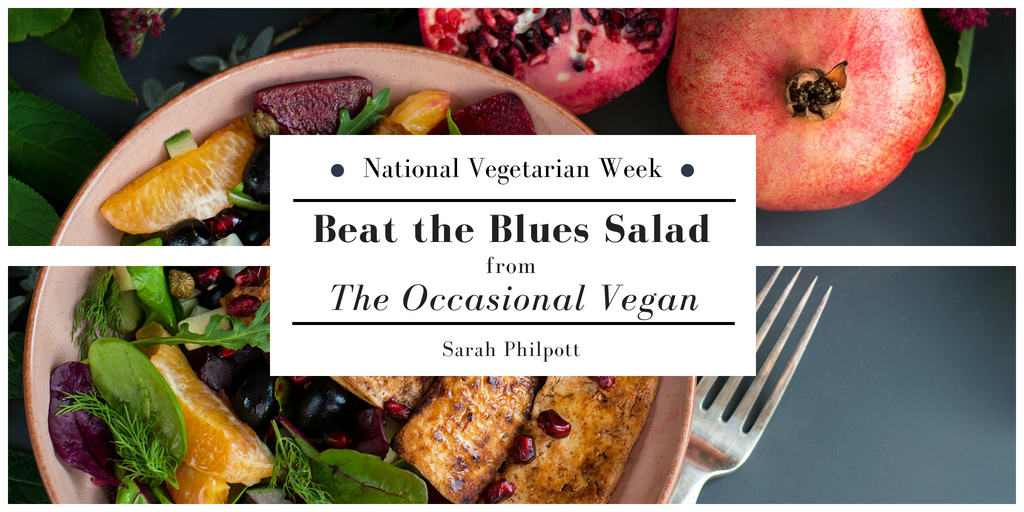
Beat the Blues Salad recipe – National Vegetarian Week

National Vegetarian Week Beat the Blues Salad recipe

National Vegetarian Week 2018 runs from 14-20 May and is the perfect excuse to indulge in exciting and colourful veggie fare – so out with blandness and in with this scrumptious salad!

Sarah Philpott’s Beat the Blues Salad brings together smoky marinated tofu, beetroot, orange and salty black olives in a celebration of all things plant-based. You will need to press and marinate the tofu so we suggest doing this in the morning before you head to work – or even the night before (it takes a little time but it’s oh so worth it).

Beat the Blues Salad

Ingredients

For the salad
– 1 x 400g block firm tofu
– 2 bags of lettuce or spinach– 1 cucumber, diced
– 2-3 large beetroots, peeled and sliced (or use the vacuum-packed kind)
– 3 tsp capers, drained
– 1 330g jar pitted black olives
– 2 oranges, divided into segments
– 1 tbsp sesame oil
– Flat-leaf parsley (optional)
– Pomegranate seeds (optional)

For the marinade
– 3 tbsp soy sauce
– 1 tsp sea salt
– 2 tbsp maple syrup
– 1 tsp smoked paprika
– 1⁄2 tsp cinnamon

Directions
Take the tofu and use kitchen roll or a clean tea towel to blot and absorb all its water. Take a heavy wooden chopping board or a hardback book and place it on top of the wrapped tofu. This will press down on it and absorb excess moisture. Leave for 30 minutes or more then slice into medium-sized strips.

Make the marinade by mixing together all the ingredients. Pour into the base of a large dish and place the slices of tofu into it, making sure to turn them so that both sides are covered in the marinade. Leave to marinate for at least 30 minutes.

Heat the sesame oil in a large frying pan over a medium heat. Fry the tofu slices for 5-10 minutes or until golden brown, turning occasionally – you may need to do this in two batches. Remove from the pan and set aside while you make the salad. Simply combine all the ingredients in a large bowl then drizzle with a little sesame oil. Divide into bowls and serve with the smoked tofu. Garnish with the parsley and pomegranate seeds.

The Occasional Vegan Sarah Philpott


The Occasional Vegan is available from the Seren website: £12.99

Join our free Book Club for 20% off every book you buy from us.


Posted on

Short Story of the Month | ‘The Visit’, Jaki McCarrick

The Visit Jaki McCarrick Short Story of the Month

May’s Short Story of the Month is ‘The Visit’ by Jaki McCarrick, an award-winning writer of plays, poetry and fiction.

the scatteringMcCarrick won the 2010 Papatango New Writing Prize for her play, Leopoldville, and her play Belfast Girls, developed at the National Theatre London, was shortlisted for the Susan Smith Blackburn Prize and the 2014 BBC Tony Doyle Award. The Scattering, from which ‘The Visit’ is taken, was shortlisted for the Edge Hill Prize.

‘The Visit’ takes place against the backdrop of Bill Clinton’s visit to the border town of Dundalk in Ireland – a visit that was very much a part of the Peace Process. 


The Visit

This is an extract. Read the full short story for free on the Seren website.

It had been a day of weather: snow and wind, sunshine and rain.
Water dripped from the overhanging hedges in the drive and
the path was thick with pine needles. Brendan made a mental
note to sweep them up once Pat had gone. He stopped before
the gates and pulled his trousers up by their creases to check
his shoes and thought that maybe he should’ve worn his boots.
He walked on. Pat would make him forget. Pat could make you
forget all kinds of silly woes. He glanced over at Coogan’s and
noticed the stars and stripes flag, still and wet on the pole.
After McCaughey’s he looked over at Joy Callan’s neat line of
laundry crowning her raised side lawn: a small satin-rimmed
blanket, black stockings, two blue ballroom gowns, a pair of
orange nylon pillowcases. As he approached her house he saw
her in the yard, bright and chic in pink slacks and a tight white
jumper. She was raking up leaves. He watched her part the
dresses then yank the wet leaves into a pile. It made him smile;
she might have hung the gowns out after she’d raked, but Joy
always seemed to do things differently from others. And anyway,
he was glad, because she made the task so mesmerising. He
recalled how after her husband had gone she had kept body and
soul together by moonlighting, rather originally he thought, as
a mushroom picker in Clones. Otherwise, as a relief teacher
she had taught both his children in the Friary, though she had
not been popular. He waved and wondered would she be at
the Square tomorrow. He made a mental note to call in one
of these evenings with the picture of Sean’s wedding in the
paper.
Walking on, his thoughts returned to Pat. He looked forward
to seeing him. There would be much talk of the ‘great
adventures’ as Brendan called them, the London times, the days
of the Black Lion where he had been manager for nearly a
decade and where Pat had been its most notorious barfly. He
was proud to think he’d organised some of London’s most
celebrated lock-ins, booked musicians from Dublin and Doolin
and Donegal, and had the likes of David Bailey and Donovan
in attendance. Soon he and Pat would be reminiscing about
those times, about the dog races at Hackney and White City,
the times they’d played poker in Holland Park with Jack Doyle.
He walked up the cobbled lane towards the station. He could
see clearly on the cold day the sprawl of the town towards the
hills. The trees by the church were draped in ropes of white
lights, and a flurry of flags hung from Carroll’s Apartments. He
was amazed to think that here, in this small dot on the face of
the globe, he and Pat would stand together tomorrow evening
and see the President of America.
The big station clock said ten to three. He had a few minutes
yet to gather his thoughts, stare over at the glass wall of the
brewery. He sat outside on the iron seat. The gulls hovered
above him, filling the air with their cries. The sweet wort’s more
pungent today, he thought, as his gaze fixed on the huge copper
kettle glistening through the glass. It had been his first job in
the brewery to wash the kettle out once the sweet wort had been
siphoned off. He would then prepare it for the following
morning’s shipment of hops and grain. He had spent the best
part of five years inside that copper drum, up to his ankles in
the remnants of fresh hops, proteins and sticky clumps of
caramelised sugar. It had given him time to think; to put into
perspective all that had happened in ’74.
There was a rumble on the tracks. He turned and saw the
sleek green body of the Enterprise stack up like a metallic snake
along platform two. He walked over and watched from the
ticket office. The doors of the carriages swung open. Women
with pull-up trolleys, young men in dishevelled suits, Mrs Little
and her daughter, Edel. As the crowds dispersed he saw a ghost,
the tall, hulking frame of Pat Coleman standing stock-still on
the busy platform. The springy hair was all white, the once firm
chest now visibly lax. Brendan watched his friend remove a
cigarette from behind his ear, ask a girl for a light, then take
three or four concentrated puffs before flicking the stub behind
him onto the tracks. Pat’s short-sleeved shirt seemed frowsy
and unironed; the thick brown arms with their blue tattoos
recalled to Brendan Pat’s nickname on the sites: Popeye. Popeye
Pat had had the strength of ten men, and once, in a drunken
rage, Brendan had seen him flatten as many.
He followed Pat’s gaze. Up to the pale, elusive sky of the
North; out to the striking sweep of the white-capped hills, the
green spire of the Protestant church peeping up against them.
He began to feel unfamiliar pangs of pride for the town, as if
through Pat’s languorous impression, he, too, was glimpsing
it for the first time. The town was his wife’s town, and he had
always found it hard to appreciate its people with their
wariness, their industrious, practical approach to things. His
wife had been right; he had put up a resistance. She had
accused him often of hiding away in the brewery kettle like a
genie. But the friendships he had formed here had been
without the closeness of his London bonds. The men he knew
from the town were nothing like that famous man on platform
two.

Continue reading ‘The Visit’ for free here.


Posted on

Seren authors at Hay Festival 2018

We are thrilled to see such a varied mix of Seren author events at this year’s Hay Festival.
On Monday 28 May, Barney Norris and David Owen Norris will discuss how the culture of our past shapes and speaks to the present. Punctuated by solo piano pieces by David, this conversation will mirror the content of new book The Wellspring. Get your ticketsOn the same evening, astronomer Martin Griffiths will talk about Celtic mythology and stargazing, demonstrating how the night sky can be interpreted through tales of figures from the Mabinogion and other Welsh legends. Get your tickets
Cultural historian Jonathan Miles will guide you through the landscape around the Capel-y-Ffin chapel, an important area for artists David Jones and Eric Gill, in his walking event on Wednesday 30 May. Get your tickets
Catch acclaimed novelist Christopher Meredith in conversation with Diana Wallace on Saturday 02 June. Christopher will read from new book Brief Lives. Get your tickets 
On the final evening, Sunday 03 June, Paul Henry and Brian Briggs perform their poetic and musical collaboration, The Glass Aisle. Get your tickets 
See the full Hay Festival programme & book tickets on their website:http://hayfestival.com/wales/home

Posted on

Audience of 150 for double poetry book launch

A packed and captive audience of 150 joined us at Waterstones Bristol last night for the launch of two new poetry collections: Visiting the Minotaur by Claire Williamson and In Her Shambles by Elizabeth Parker. The pair were joined by fellow Bristol-based ‘Spoke’ poets Paul Deaton (A Watchful Astronomy) and Robert Walton (Sax Burglar Blues) to make a quartet of Seren voices. Skilled violinist John Pearce accompanied, filling the silences with Bach and other classical pieces.
We were thrilled to see such a large audience come out in support of our authors and would like to thank everyone who attended. 
If you enjoyed the event (or if you had to miss it), take a look at our events page to see what’s coming up in the near future.
 

Posted on

Friday Poem – ‘Penguin Love’, Nerys Williams

On Wednesday the world celebrated its cutest holiday, World Penguin Day, so in continued praise of these adorable birds our Friday Poem this week is ‘Penguin Love’ by Nerys Williams.

Nerys Williams Sound ArchiveTaken from Nerys’ 2011 collection Sound Archive, ‘Penguin Love’ is a vibrant and evocative portrait of black, white and yellow – of curiously wistful creatives who stand ‘angled at constellations’ and ache for the gift of a perfect smooth stone – the symbol of budding penguin romance.
Sound Archive was shortlisted for both the Forward Best First Collection Prize and the Michael Murphy Prize, and won the Poetry Now / Mountains to Sea DLR Strong Award. This is a strikingly original debut in which the poet conjures a complex music, intriguing narratives, and poems full of atmosphere that query identity, gender, and the dream of art as a vehicle for emotion and meaning.


World Penguin Day poem Penguin Love Nerys Williams


Sound Archive is available from the Seren website: £8.99

Join our free Book Club for 20% off every book you buy from us.


Posted on

Paul Deaton on Therapy, Honesty, and Exiting the ‘Poetry Closet’

Paul Deaton therapy poetry

This article was originally published in Therapy Today (April 2018) and we thank the editors for granting permission for its reproduction here.

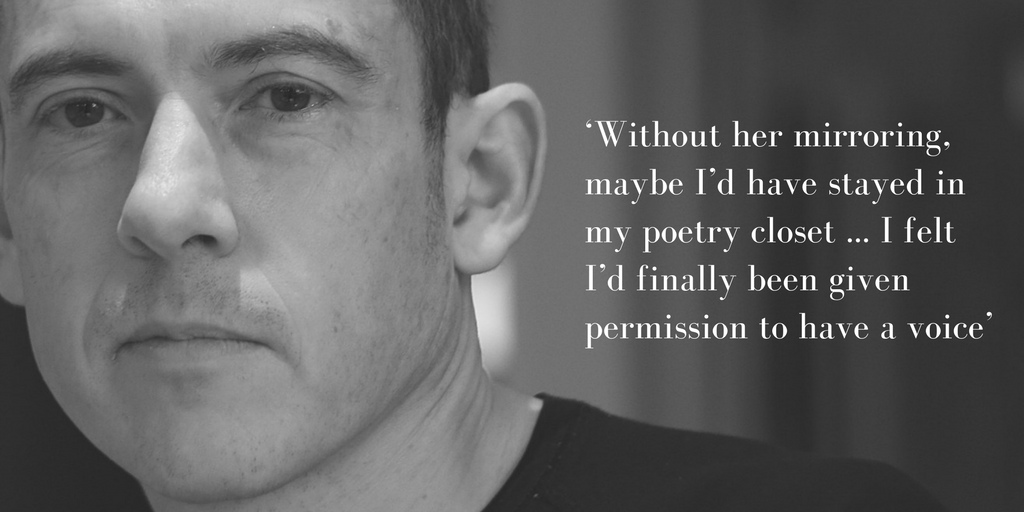
‘Without her mirroring, maybe I’d have stayed in my poetry closet. Her affirmation was the turning point in my adult life. I felt I’d finally been given permission to have a voice’

Ten years ago, when I was 40, I saw an advert for a poetry course at Bristol University. It was an adult learning programme, which, sadly, is no longer offered. I had to submit six poems before being accepted. I’ve always written, and always used poetry as my mirror, to know and explore who I am. But I’ve always done so as a guilty pleasure, a closet hobby.
The course was run by a grounded, passionate and sometimes fearsome poet. It was challenging in the way that therapy is challenging; getting the poems to a level of truth and meaning, of genuine authenticity, isn’t easy. People often get the wrong idea of poetry; they think of it as something flaky. I was struck by how powerfully my teacher responded to my work. She was serious about it. She said it had value, more than I had chosen to give it. Tellingly, what she conveyed was that she believed in it.
Looking back, this was a huge moment. She opened a door that had been firmly shut. Without her mirroring, maybe I’d have stayed in my poetry closet. Her affirmation was the turning point in my adult life. I felt I’d finally been given permission to have a voice.
Up to that point I’d been working in publishing sales. I’d graduated in psychology as a mature student when I was 33. In my final year, I fell ill with Hodgkin’s disease. Even though I eventually came out with a top degree, when I graduated, rather than being full of confidence, I was broken. I had lost hope in my own future. I also felt I’d failed. The sales job was some bizarre gesture to my father; I was still trying to get his love, to prove to him I could be a man in a man’s world. It wasn’t me at all.
My relationship with him had been tense, difficult and baleful. I didn’t trust him, and that lack of trust fed into me. I wouldn’t trust myself or my own instincts. That poetry course opened the door to a side of my personality I had done my damnedest to shut away. Once open, there was no going back to the repressed darkness. I’d found a little light and began a process of reliving that opened out my 40s. I could no longer afford to not be myself. There wasn’t time.
I started to trust in my more nuanced skills – thoughtfulness and reflectiveness; to trust that I could be and offer something else. I entered therapy and was ‘blessed’ by a male therapist, week in and week out. It was a revelatory experience to trust a man. Like a new tide, I returned to my love of psychology, and finally had the confidence to start my counselling training. And, amid the study, my new job with the NHS, gardening work and marathon running, I followed on with a commitment to my poetry. I sent my poems into the world, and to my surprise, they were published.

Paul Deaton poetAbout Paul
Paul Deaton is a poet, writer and counsellor-in- training at BCPC Bath. Seren has just published his first full-length poetry collection, A Watchful Astronomy.


Paul Deaton A Watchful Astronomy

About A Watchful Astronomy:
A Watchful Astronomy is such an unclouded, moving and accessible collection it should be prescribed by the NHS for those who say they cannot stomach poetry because it’s too difficult or irrelevant.’
– Poetry School
Haunted by a father ‘like a wounded bear’, the poems in Paul Deaton’s debut collection, A Watchful Astronomy, are tense, exact and often beautifully formal.


Posted on

Graham Clifford to run Virgin London Marathon for Griffin Schools Trust

Last year the Griffin Schools Trust established a new tradition of a Griffin Schools Trust member of staff running the Virgin London Marathon to raise money for the Trust’s preferred children’s charity of the year. Over £5,000 was raised for the NSPCC when Ange Tyler, one of Griffin Trust’s founders, started the tradition.
This year Graham Clifford, Seren author and Head of Willow Brook Primary School, will be running to raise funds for MACS charity who help children born without eyes or with under-developed eyes. If you would like to support Graham in his run and MACS in the amazing work they do, please follow this link: https://donorbox.org/gst-fundraising-2 ​
Graham Clifford is the author of The Hitting Game (2014) and the Poetry Wales Purple Moose Prize-winning pamphlet, Welcome Back to the Country.


Posted on

Siobhán Campbell video poem funded by British Council Northern Ireland

Siobhán Campbell’s ‘When all this is over’ is one of three poems that has been recorded to video with funding from British Council Northern Ireland, as part of the Peace and Beyond Conference in Belfast commemorating twenty years since the Good Friday Agreement. 
Watch the video for ‘When all this is over’, featuring images taken by Bernarde Lynn.
 
Siobhán Campbell’s latest collection is Heat Signature.