Posted on

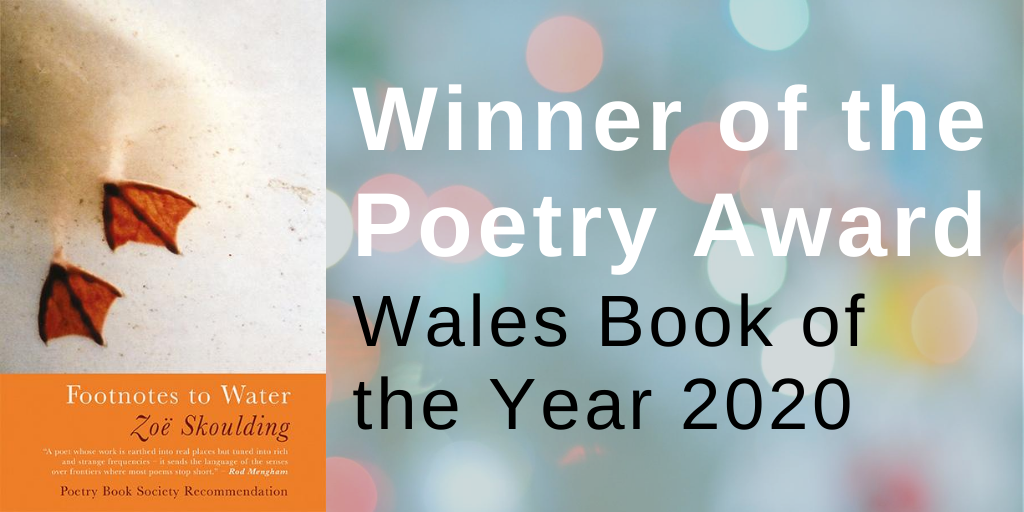
Zoë Skoulding wins the Poetry category in Wales Book of the Year 2020

We are delighted that Zoë Skoulding and her collection Footnotes to Water have won the poetry category in the Wales Book of the Year 2020.

In Footnotes to Water Zoë Skoulding follows two forgotten rivers, the Adda in Bangor and the Bièvre in Paris, and tracks the literary hoofprints of sheep through Welsh mountains. In these journeys she reveals urban and rural locales as sites of lively interconnection, exploring different senses of community, and the ways in which place shapes and is shaped by language.


Zoë was shortlisted for the award alongside two other titles, Erato by Deryn Rees-Jones and Fur Coats in Tahiti by Jeremy Over (Carcanet). The English-language winners were announced in a special awards programme on 31 July hosted by Nicola Heywood Thomas and broadcast on BBC Radio Wales.

Speaking about her win, Zoë said: “I’m delighted by this award, especially as Footnotes to Water is in conversation with Wales in all sorts of ways. Some of the poems grew out of dialogues with artists Ben Stammers and Miranda Whall, whose work explores Welsh landscapes through visual and performance art, while my own thinking about place and its relationships developed while I was editing Poetry Wales. I’m also glad that this award – and the shortlist – recognises the excellent work done by Seren Books in sustaining English-language poetry’s role in Wales’s cultural life.”

Amy Wack, poetry editor at Seren added: “Zoë Skoulding’s wonderfully inventive and subtly musical work remains both challenging and delightful, so pleased she has won this prize.” Lleucu Siencyn, CEO of Literature Wales, also commented that Zoë’s work “always feels fresh and new.”

The winner of English-language Book of the Year was Niall Griffiths with his novel Broken Ghost (Jonathan Cape) and Babel by Ifan Morgan Jones (Y Lolfa) was the overall winner of the Welsh-language award.

Speaking about the awards, Lleucu Siencyn said: “Wales Book of the Year is one of the highlights of our cultural calendar, and this year more than ever we are extremely pleased to be able to continue to shine a light on our incredible literary talents. Literature helps to guide us through our darkest hours, as well as bringing joy and hope to readers of all ages. Wales consistently produces excellent writers, and this Award is testament to this each year. Congratulations to all of this year’s winners!”

Wales Book of the Year is an annual award hosted by Literature Wales. Other categories include Fiction, Creative Non-fiction and, new for this year, Children and Young People. You can see the full list of winners in both Welsh and English on the Literature Wales website.


Footnotes to Water is available on the Seren website: £9.99

Watch Zoë reading alongside the other two shortlisted poets at our online WBOTY Poetry Shortlist Reading which is now available on our Youtube channel. 

[youtube=http://www.youtube.com/watch?v=1dVT-NARt5k]
 

Posted on

Friday Poem – ‘Wintering’, Rhiannon Hooson

Friday Poem Rhiannon Hooson Wintering

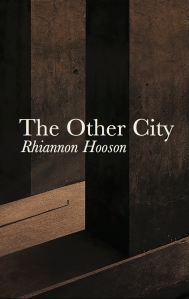
Rhiannon Hooson’s incredible debut collection, The Other City, has just appeared on the Wales Book of the Year shortlist – and this week our Friday Poem is one from its pages: the seasonally-appropriate ‘Wintering’.

The Other City Rhiannon HoosonThe Other City offers us elegant, artful verse of precision and insight. Sharply focused, beautifully resonant, deeply felt, these poems tend to travel in distinct streams: characters like Zeus, Narcissus, Ariadne, and Ganymede sit alongside reworkings of Welsh history, both ancient and modern. Other poems explore the idea of otherness and the uncanny, where actions are done and undone, and the familiar made unfamiliar.
This is a poet who can re-imagine scenes from Greek myth, from Welsh history, and make them as urgent and compelling as her poems about personal relationships.


Rhiannon Hooson Wintering


The Other City is available from the Seren website: £9.99

Join our free Book Club for 20% off every book you buy from us.


Posted on

An extract from Boy Running | Wales Book of the Year shortlist

extract from Boy Running Wales Book of the Year

The winners of the Poetry, Non-Fiction and Fiction Categories, and the overall Wales Book of the Year Winner, will be announced in just two weeks. Seren have two titles in the running for the awards, and before we find out the results, we thought you might enjoy reading an extract from each of our nominated books. Look below and you’ll find an extract from Boy Running by Paul Henry (shortlisted for the Open University in Wales Creative Non-Fiction Award).

Studio Flat

Socks hang like bats from a skylight.
They may be dry in time for the moon.
The camp site owner’s water-feature
drains more blood from the sun.

Cars queue for the narrow bridge.
Birds catch their pulses and fly.
I am suddenly old. What’s an attic
but a bungalow in the sky.

And where are you, my sons?
I heard your voices in the bells
of snowdrops pulled by the wind.
These tulips have lost their smell.

Perhaps I could tell you, one day
where the snowdrops went, why old men
dry their socks on the moon, and what
darkened the skylight, just then.


Ring

I can’t get the ring out of my finger.
How long till it disappears
this ghost ring, twenty years deep?
I’m branded. Is it the same with you?
Your fingers were slenderer than mine.


We hope you enjoyed reading this free extract from Boy Running by Paul Henry. Keep an eye on the Seren blog, as we will be announcing the Wales Book of the Year Awards results in just over two weeks time.

About Boy Running:
Paul Henry has gained a reputation as one of of the best poets in the UK. Boy Running is his beautiful sixth collection and the first to follow  The Brittle Sea: New and Selected PoemsAlso a singer-songwriter, Henry is known for his precise lyricism, intimate tone and a cast of characters inspired (like Dylan Thomas) by his childhood by the sea in Aberystwyth, West Wales.

Posted on

An extract from Losing Israel | Wales Book of the Year shortlist

An extract from Losing Israel by Jasmine Donahaye Wales Book of the Year shortlist

The winners of the Poetry, Non-Fiction and Fiction Categories, and the overall Wales Book of the Year Winner, will be announced in just under a month. Seren have two titles in the running for the awards, and before we find out the results, we thought you might enjoy reading an extract from each of our nominated books. Look below and you’ll find an extract from Losing Israel by Jasmine Donahaye (shortlisted for the Open University in Wales Creative Non-Fiction Award).

1 – Motherland

It is the year of clogs and flared skirts, of shiny striped shirts with big collars, the year the PLO infiltrates by boat on the coast north of Tel Aviv and takes a bus-load of passengers hostage. It is spring, 1978 and I am ten years old. Security at El Al Airlines is high. I know the names Abu Nidal and Abu Jihad and Leila Khaled – Leila Khaled, that woman who is somehow not really a woman, but a terrorist.
Israel is an impression of barbed wire and rusting yellow warning signs on the beaches, the scent of orange blossom and the stink of sewage, hot nights and ruins – and a huge sprawling network of strangers who are relatives. It is my mother’s first return home after fifteen years of self-imposed exile, and it opens in me a wound I can never heal – a longing to come home to a place that can’t be home.
Now whenever I return, it is the long straight road through the valley to the kibbutz that catches at me – after Afula, that dusty way-station; after the last turnings, where it straightens out into the old Roman road that runs through the Jezreel Valley or the Plain of Esdraelon or Marj Ibn Amer, depending on your political orientation, or language, or biblical inclination. ‘The Ruler Road’ my mother called it, that first time we went back in 1978. The mass of Mount Gilboa rises on your right, and far off in the distance there’s a shimmering above the road where the border lies, some twenty kilometres away. Beyond it rise the Jordanian mountains, the mountains of Gilad or Gilead, after which my grand-father Yair named himself and my family – Hagiladi, a man of that place. On either side of the road stretch the fishponds, where you can see white-fronted blue and chestnut Smyrna kingfishers, and pied kingfishers and black-winged stilts; and then, looming up under Gilboa, the complex of the prison moves into sight, watchtowers and barbed wire topping the long external wall, which runs alongside the dusty road. A short distance beyond the prison a trilingual green metal sign points out the left turning to the kibbutz.
Through every return, the kibbutz lies like a magnet at the centre, exerting a force that pulls each journey into a curve inward to its core. Even now, after I have learned its other story, it exerts its pull. This is where my mother is from, and so I have always felt that this is in some way where I am from, too. No matter what I learn about its history, what I feel about its government’s acts, its citizens’ electoral choices, what I think about its political foundations and exclusions, Israel is inextricably caught up with my mother – my inaccessible, elusive mother, who left her community and her country, but inwardly never left, who carried her home all the years of my childhood not in a book, as some anti-Zionists will say the ‘true’ Jew does, but in the locked chamber of her heart.


We hope you enjoyed reading this free extract from Losing Israel by Jasmine Donahaye. Keep an eye on the Seren blog, because next week we will be publishing an extract from Paul Henry’s gorgeous poetry collection, Boy Running, which is shortlisted in the Wales Book of the Year, Roland Mathias Poetry Award category.


Losing IsraelAbout Losing Israel:
In Losing Israel the search for her family’s past and the part her forebears played in the newly created Israel reveals unsettling knowledge about kibbutzim and land clearances in northern Israel. Challenged by this new and unwonted information, Donahaye’s notion of history and her understanding of Israel, of her grandparents and of her identity is completely transformed.

Buy your copy now: £12.99 direct from the Seren website (sign up to be a Seren Book Club Member to claim 20% off)

Save

Posted on

Nine reasons to vote for The Rice Paper Diaries for the Wales Book of the Year People’s Choice Award.

Francesca Rhydderch has been shortlisted for The Wales Book of The Year Award for her debut novel The Rice Paper Diaries.

Nine of the shortlisted English language titles will also compete for the People’s Choice Award, where you get to have your say and vote for your favourite.

Francesca faces stiff competition from the likes of Tessa Hadley and Owen Sheers for the honour and here’s nine reasons why we think The Rice Paper Diaries deserves your vote:

  1. It shows us a different side to the Second World War. We normally think of WW2 as affecting our troops and those at home in Britain. The Rice Paper Diaries gives us an insight into what it was like to be a British expatriate interned by the enemy far from home and the difficult process of repatriation after the war.
  1. The story is authentic. Brian Edgar a WW2 blogger, whose parents were interned at the same concentration camp as Francesca’s protagonists, described it as “A magnificent book that anyone who enjoys first-rate literary fiction should consider reading”.
  1. Its four stories for the price of one. We hear four sides of the story from the perspectives of Elsa, Tommy, their daughter Mari and their Chinese amah Lin.
  1. It was Seren’s best selling novel of 2013. Its first print run was a sell out! (Don’t worry you can still get your hands on a copy here).
  1. It was a Kindle best seller, reaching the number 4 spot in the Kindle top 100.
  1. It drew critical acclaim from reviewers. Adrian Masters couldn’t recommend it highly enough and Laura Wainwright described it as a “rare, brave and unforgettable novel”.
  1. Even the competition thinks it’s great! Tessa Hadley (also shortlisted for Clever Girl) endorsed the book as “ Very fine, so truthful-feeling and subtle”.
  1. It’s been shortlisted for The Wales Book of the Year Award and Longlisted for the Guardian’s Not The Booker Prize and The Author’s Club First Novel Awards.
  1. It’s international. Fran was invited to take part in the Beijing Book Fair and it’s currently being translated in to Mandarin!

What are you waiting for? Vote now!

Posted on

The Cardiff International Poetry Competition is open for submissions and Rhian’s a judge!


Wales Book of the Year winner, Rhian Edwards, will be judging this year’s Cardiff International Poetry Competition along side Samantha Wayne Rhydderch and Lemn Sissay.

The competition offers one of the largest monetary prizes for a poetry competition of its kind with a first prize of £5,000. The second placed entry will receive £500 and third £250. Five runners-up will receive £50 each. All entries to the competition will be judged anonymously, so this is a great opportunity to have your poetry judged on its own merits, whether you are first time poet or an experienced wordsmith.

Entries close on 14th March. For more information or to download an entry form 
visit the Literature Wales website.