

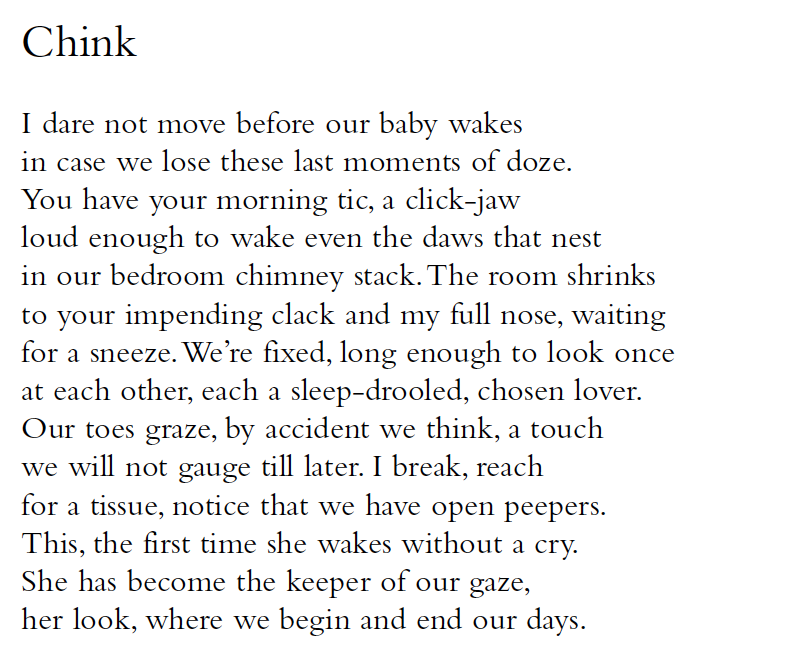
This week’s Friday Poem is ‘Chink’ by Siobhán Campbell from her collection Heat Signature.

Celebrate Valentine’s Day with poetry collections that explore many different kinds of love. Don’t forget to sign up to our book club for 20% off all books you buy directly from us.

With a musician’s ear and an artist’s eye, Paul Henry’s poems of love and fatherhood, informed by the Welsh-speaking community of his childhood, bridge both the rural and urban experience. The Brittle Sea reacquaints readers with Henry’s vast gallery of characters, from the boy having his hair cut in ‘Daylight Robbery’ to the ghosts of his long, Newport poem, ‘Between Two Bridges.’ The new poems section includes the popular ‘Steel’, inspired by the Welsh national rugby team; others which revisit some of ‘The Visitors’ from The Milk Thief; and a moving elegy for the painter Anthony Goble.

Heat Signature is the intelligent, provocative new collection of poems from Siobhán Campbell. An Irish poet, Campbell has inherited a rich vocabulary, the necessary ‘slant’ point of view, and a store of lively anecdote. This is a poetry that resists rapture and/or easy solutions, it rather glories in difficulty: the cussed, intractable nature of humanity, of a natural world beset with swarming bees, weeds and feral horses. There is a beautiful balance throughout between the forthright and the ironical. Heat Signature continues her fascination with her homeland in all its incarnations, both ancient and modern. These poems challenge preconceived notions as they resist cliché.

Masculine Happiness is a provocative yet subtle collection which explores the author’s ambivalence towards models of masculinity handed out to us by the media and modern society. Complex, ironic, layered, fashioned with an acute and subtle intelligence, these poems are as likely to reference Elvis as Borges. There is also a considerable amount of humour here, along with astute satire and insightful character poems. Foster-Morgan’s work repays the careful attention of thoughtful readers.

You is a book-length poem by the late poet John Haynes. The ‘You’ of the title is the narrator’s partner and wife of many years. The book is not just a celebration of, and meditation on, personal love and devotion, but a record of how such love moves out of a family and is refracted out into the community and the wider world. The tensions inherent in this are compounded by the cross-cultural nature of the union. The narrator is a white British man and his wife was born and raised in Nigeria. Exploring a partnership based on culturally quite different – and in some aspects painfully incompatible –conceptions of ‘love’, the poem is knit together by philosophical themes of ‘I’ and ‘you’ seen from many perspectives. Shortlisted for the T.S Eliot Prize.

Other Women’s Kitchens by Alison Binney’s introduces us to a gifted new voice who writes with flair and feeling about coming out and coming of age as a gay woman in 21st century Britain. Winner of the Mslexia pamphlet prize for poetry, the collection explores the challenges of discovering and owning a lesbian identity in the 1980s and 1990s and the joy of finding both love and increased confidence in that identity as an adult. An adroit admixture of the heart-wrenching and the humorous, the book features shaped and ‘found’ pieces, traditional narrative and compact prose poems. Beautifully entertaining, pointedly political and often very funny, Other Women’s Kitchens is essential reading.

Taking its title from the muse of lyric poetry, Rees-Jones’s fifth collection Erato questions how we know and write about the beauty and the horrors of the world. Documentary-style autobiographical narratives are set alongside lyric fragments and poetic sequences as the repetitions of trauma and the errors and erasures of memory are explored. This is a book full of flames and scars, landscapes and animals; at its heart is a desire for the transformative music that runs beneath words, and an understanding of the bodies we inhabit when we love. Shortlisted for the T.S Eliot Prize.

A Second Whisper is a thoughtful and sensitive collection that reflects the changing identities of a woman: in motherhood, in widowhood, in friendship and grief. There are elegies to the loss in 2014 of her mentor and partner, the poet Dannie Abse which are a tribute to their deep friendship. There are also poems to her late husband who died in 2006 and for their children and for relationships from the author’s past in New York City and Denmark. The poems are both elegiac and celebratory: they move and change tone as the author travels to the past and negotiates through the geography of grief and feelings of displacement in London, and finally opens to her new life in the present.
Browse a wide range of fantastic poetry collections on our Poetry pages, or visit Coming Soon to pre-order books coming out in 2022.

Our Friday Poem this week is Siobhán Campbell’s ‘The longing of the bees’ from her most recent collection, Heat Signature.
 ‘The longing of the bees’ is a boisterous and artful study of these small and essential insects, without which, the poet warns, ‘nothing is fertile’.
In Heat Signature we often find that the natural world is full of portents and warnings – here, the incipient violence of the swarm is detected, a force that seems unamenable to censure or even warning. Throughout the collection there is a blend of dark comedy, tragedy and politics – and this is entirely typical of Campbell’s complex, thoughtful and profoundly entertaining poetry.

Heat signature is available from the Seren website: £9.99
Create your free Seren account and enjoy 20% off every book you buy direct from us.
Tomorrow many of you will be celebrating Ireland’s foremost patron saint, and so today we feature Irish poet Siobhán Campbell’s witty rumination on cultural customs, ‘Why islanders don’t kiss hello’.
Taken from Campbell’s most recent collection, Heat Signature, ‘Why islanders don’t hiss hello’ is not simply a humorous piece about the awkward and personal nature of the continental cheek-kiss, but also – as with much of Campbell’s poetry – a wry commentary on the political: ‘Perhaps we are not fully of the Europe…’
Heat Signature is Siobhán’s sixth collection, and its complex style is entirely characteristic of the poet’s spikey voice: infused with an intelligence that resists easy answers to the conundrums that have faced her Irish homeland, but also suffused with a grudging admiration for the citizens who have survived their tumultuous history.

Heat Signature is available on the Seren website: £9.99
Join our free Book Club for 20% off every book you buy from us.
This week our Friday Poem is ‘The shame of our island’ from Siobhán Campbell’s brand new collection, Heat Signature.
In ‘The shame of our island’ we are confronted with a sense of contested history, in which the hunter’s tongue-in-cheek aim is to ‘see the steaming innards’ of his almost-extinct prey. The ‘shame’ of the title permeates the poem, with the speaker’s questions demanding justification, yet receiving no answer.
Heat Signature is Siobhán Campbell’s fourth full collection, and is composed in her characteristically spikey voice: infused with an intelligence that resists easy answers to the conundrums that have faced her Irish homeland, but also suffused with a grudging admiration for the citizens who have survived their tumultuous history. The blend of dark comedy, tragedy and politics is entirely typical of Campbell’s complex, thoughtful and profoundly entertaining poetry.
The shame of our island
is that we killed the wolf.
Not just the last
but the two before that.
I knew a man who met a man
who was the cousin removed
of the great-grandson of the man
who killed the third-last wolf
on the island.
Slit it he did,
to see the steaming innards –
how long they were, how tightly wound.
Had it a white paw to the fore?
That gene would have been recessive.
Was there a black bar across the yellow eye?
No time to notice its différence.
Is this a wolf with its bared teeth
and its lairy smell
and its fetlock tipped with white?
Is this wolfish?
Heat Signature is available from the Seren website: £9.99
Join our free, no-purchase-necessary Book Club for a 20% discount every time you shop with us
Attend the Heat Signature book launch in London
Join us at The Flying Horse on Wednesday 15 March, 7:30pm, where we will be celebrating the launch of Heat Signature with a poetry reading by the author and book signing opportunity. Refreshments will be provided and entry is free, so bring your friends for an evening of poetry and merriment.
Find out more
St Patrick’s Day has just passed and fittingly, our Friday Poem this week comes from Irish poet Siobhán Campbell’s collection, Cross-Talk.
 Acerbic, cool, controlled, this is poetry with attitude. Many of the stories in this collection start in Ireland and although the cadences are sweetly lyrical, the narratives are otherwise. Politics here is intrinsic to the tales of the sly, the warped, the landlady “Mean as Ireland in the 50’s”. Nature is deftly invoked as a counterpoint to human illusions. The apparently personal poems here are cast in a more tender, yet characteristically unsentimental light. Campbell brings the lyric close to the conflicts that spur our passions, both personal and political. While full of wit, this collection challenges the reader by dealing with fundamental questions of borders, identity, violence and responsibility.
Siobhán’s poem ‘Framed’ has just won the Oxford Brookes International Poetry Competition 2016, and ‘The same people living in the same place’ was just the featured reading at the launch of The Stinging Fly’s In the Wake of the Rising edition, edited by Sean O’Reilly.
Campbell
“I shall never deny those who came to this gnarled coast
with a skinful of sopped hope and started with their brood
this trail that would become the family you call yours.
You know in Ulster Scots they don’t use the word ‘lane’
but have to say ‘wee road’. The laming of a tongue
will map it out of mind unless it has a name.
Raymond, Ursula, the two Hughs, who laid on betting sheets,
knew when to settle odds and how to be discreet,
paid blind to the sidelong flutter of small groups.
They each made one more shift from anything that marked,
though wondered through two wars what way to stream a lay
for those who come home in droves from fights that were not ours.
I am the last.
Though you are from the south, you need to find the will
to hold a vowel too long. Tell people by their heed
and know who must be paid. Keep always your own name.
It takes a softened tongue to fill a twisted mouth.”

This September, you’re invited to explore the unseen and the unsettling. From dark and menacing landscapes to the everyday terrors of domestic settings disturbingly close to home, these stories will horrify and delight in equal measure. Be prepared, for ‘this is a land of ancient power, and even more ancient beings...’ Pre-order the latest addition to our Welsh Gothic series, ‘Giving the Darkness Life’ on our website now.
.
Stories by @markblayney1, Mary-Ann Constantine, @damianwalforddavies, Caradoc Evans, Dorothy K. Haynes, @lucie_mckhardy Arthur Machen, Elinor Mordaunt, John Llewellyn Probert, L.T.C. Rolt, @priyasharma1000, Edward Thomas, Elizabeth Walter and D.P. Watt
.
@inpressbooks @books.wales #WelshGothic #SerenBooks #NationalYearOfReading2026 #SpookySeason #AutumnBooks

We had a wonderful time listening to @megan.c.hayes talking about her memoir ‘Glimmering’ with Kath Little from @bardic_books at St Illtud’s church in Llantwit Major on Saturday. Diolch yn fawr to everyone who joined us and to Kath for hosting! Copies of ‘Glimmering’ are available now in your local bookshop.
.
#Glimmering #Memoir #SerenBooks #IndependentBookshop #NationalYearOfReading2026
Ebooks available now! ‘In Search of Sea Dragons’, ‘Muslim Wales’ and ‘The Waters That Raised Us’ are now available from all major ebook retailers meaning you can take them with you on the go 🎉 Do you prefer reading ebooks, print books or both?
.
@severn.sea.fossils @azimwales @tayloredmonds #Ebooks #Kindle #SerenBooks #BooksFromWales #LoveReading
🏆@maggiepoet continues her winning streak having won the Guyana Prize for Literature Poetry Award with her collection ‘I Sing to the Greenhearts’! Available now in bookshops nationwide and on our website!
.
#AwardWinning #GuyanaPrize #Poetry #PoetryBooks #SerenBooks


