This week our Friday Poem is ‘The woman on my National Library of Wales library card’ by Katherine Stansfield, which won the 2014 PENfro poetry competition. The poem is taken from Katherine’s humorous and distinctive debut collection, Playing House.
 A concise wit and an unsettling view of the domestic characterise these poems whose subjects are the ordinary as viewed through the author’s satirical yet sympathetic eye. John Lennon’s tooth, an imaginary ‘Canada’, bees in Rhode Island, cats and office politics are all peculiar grist to this author’s mill. She presents both historical subjects such as Captain Scott of the Antarctic, and common objects, such as household bleach, from a skewed perspective, adding humour, drama and a quietly distinctive pathos.
The woman on my National Library of Wales library card
Her mouth says it all –
slack as a jellyfish. They made her
stand against the wall
with no time to pose or comb
the seagulls from her hair,
no time to dig her smile
from pockets of sand.
the Sea fret foaming at her hems
thickened once inside the dusty air
that seeps from books. See, she’s ghosting
under the card’s laminated skin. Almost
gone. She fogged the enquiry desk too.
The attendant lost his hands
in the mist, hence the wonky
shot. She’s looking at a horizon
beyond the frame. I can’t meet
her salt-stiff eye which asks
for silence from the waves
as if such a gift could be given.
She doesn’t get out much now for fear
of mackerel following her home
and wheezing to death in the road,
of mullet in the bath again.
Her doorstep is crunchy with limpets.
Can I take her something back?
She likes romance, set far inland.









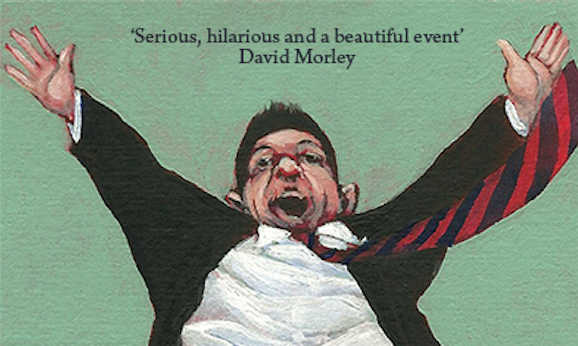
 My Family and Other Superheroes introduces a vibrant and unique new voice from Wales. The superheroes in question are a motley crew. Evel Knievel, Sophia Loren, Ian Rush, Marty McFly, a bicycling nun and a recalcitrant hippo – all leap from these pages and jostle for position, alongside valleys mams, dads and bamps, described with great warmth. Other poems focus on the crammed terraces and abandoned high streets where a working-class and Welsh nationalist politics is hammered out. This is a post-industrial valleys upbringing re-imagined through the prism of pop culture and surrealism.
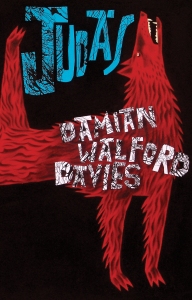 In short-lined, intensely suggestive dramatic monologues, Damian Walford-Davies vividly summons moments of fear and swagger, doubt and passion, despair and nonchalance as an outlaw Judas finds himself haunted by his chequered and extraordinary past. Familiar stories are rendered strange and uncanny as the reader is caught in multiple ironies. As striking as the unnerving images on the news loops of our TV and computer screens, these poems locate us on the hazardous streets of a divided city with a companion-guide who shares with us his own troubling and troubled version of history.