Posted on

Deryn Rees-Jones shares her poetry advice

It was announced earlier today that Deryn Rees-Jones’ new collection Erato has been shortlisted for the T.S. Eliot Prize 2019. It therefore felt only fitting that this week’s poetry advice blog came from her.

Named after the Greek muse of lyric poetry, Erato combines documentary-style prose narratives with the passionate lyric poetry for which Rees-Jones is renowned. Here, however, as she experiments with form, particularly the sonnet, Rees-Jones asks questions about the value of the poet and poetry itself. What is the difference, she asks in one poem, between a sigh and a song? Erato’s themes are manifold but particularly focus on personal loss, desire and recovery, in the context of a world in which wars and displacement of people has become a terrifying norm.


What first drew you to poetry?

As a child in primary school we were expected to write at least a poem a week. Each poem then had to be illustrated. I took these tasks very seriously and wonder if my interest in the relationship between text and image stems from there.

Where do you look to for inspiration?

The origins of that word inspiration are interesting, aren’t they, that idea of inhalation, but one that originated in the idea of bringing something divine into the human body. I have recently been working on an exhibition with the artist Charlotte Hodes. She has made a sequence of four images, now engraved on glass, with my captions – heat, heart, in-breath, unfurls. Glass is one of those transformative materials, which I have become fascinated by. I’m thinking about it a great deal, and in my mind it also connects with something that has also preoccupied me in the past — snow. I’m interested more generally in heat, in the idea of fire as a metaphor for the creative process. Those captions on glass, which evolved from our shared working and thinking, are a shorthand for ideas I have explored a little more relentlessy in Erato. I continue this thinking about creativity in a book length lyric essay – Fires — that will be published in November with Shoestring.


What poets or writers inspire you?

My work as an editor at Pavilion is a huge privilege, seeing books as they develop, working with closely with poets. I learn a lot from seeing that process, and from the close reading that demands. Current poetry books I am reading – Bhanu Kapil’s The Vertical Interrogation of Strangers, Mei-mei Berssenbruge’s Hello, the Roses. I read a lot of books about psychoanalysis as a theory but also as a practice, and I have also just started reading two quite different but enjoyable and wise books, Mary Midgley’s autobiography The Owl of Minvera, and Rosi Braidotti’s new book, Posthuman Knowledge.

What does poetry mean to you?

I have a bit of a bee in my bonnet at the moment about the way poetry sometimes gets claimed as this universal panacea or in some way becomes fetishized. Poetry is a very important and particular process, but it’s deeply connected to other things that its processes allows – thinking in deep ways, feeling, paying attention, engaging with a community of thinkers and readers, being in the world. I honour the process and the pleasures and excitement poetry brings. But I am impatient when poetry somehow becomes separated from those other processes of which it is a part, and then gets reduced to a commodity.

How do you balance writing poetry with working? If you write full time, what made you decide to do so?

I have a full and busy life, and I’m starting to trust a bit more that the method I seem to have developed over the years, of setting other critical writing alongside my creative work, is a useful synergy. I don’t feel the need to separate that process.

Do you have a writing routine? What is it?

I have lots of routines, most of which include the balance of full-time work in the university and childcare. School drop-off and pick up times, walking the dog are all structures built in to the day. I was recently on an extended period of study leave and I tried to work for three intense hours writing every morning in the local café. That time was ringfenced for critical writing and research, but poems inevitably creep in. If you parent small children on your own, life can feel very closed down in terms of the freedom to simply leave the house, take a walk, run out for groceries, have some time alone with friends. That has changed a great deal now and I am valuing the new freedoms but also, as I look back, valuing that enforced quietness and what it asked of me. I don’t have a specific writing routine when it comes to poetry, but the other routines mean there might be space when I need it.

How do you prepare yourself before sitting down to write?

I don’t. It’s more organic than that. You could say that even though I’m not writing, in notebooks, of which I have many, or on screen, that I am writing all the time, because writing is much more than sitting down and putting marks on the page.

What advice would you give to poets looking to get their work published?

Concentrate on the poems, read – what is being published now, but also engage with poems that have come before. Read internationally. Having a sense of what poetry means in cultures that are not your own is really important; understanding a poetic history as well as a context is really important.

Is it important to build a reputation by submitting to competitions, magazines and journals?

For some poets it might be, it’s one route. I’m more interested in that process as a testing ground for readership and the poem than I am in the idea of reputation.

Do you have any tips for submitting poems to publishers or magazines?

Write your best poem in the best way you can. It’s going back to the idea of seeing publication as a testing ground. Not all the poems in a book work on their own, but can be vital when assembling a book. Keep a humble and critical judgement. Leave poems alone for a while. Trust that editors, who are usually poets, have a good sense of what is working or not in a poem.

What methods do you use to overcome feeling disheartened or to keep positive?

We live in an age of soundbites, some of which are directed at least in a superficial way, at improving our mental health. Of course we all have feelings when work is returned or doesn’t appear to have been read after publication. Poets need readers, and it can be painful not to feel heard or relevant or understood, but processing that part of your professional life is also part of life. I’m more interested in the life part  — how to live ethically, and joyfully, than some sense that we can guard against difficulty or pain without seeing that as part of a bigger process.

Do you have any other advice for fellow poets?

I wouldn’t presume!


Erato is available on the Seren website: £9.99

Create your free Seren account and enjoy 20% off every book you buy from us.
 

Posted on

Friday Poem – ‘Bicep to Bicep’ by Mary J. Oliver

This week’s Friday Poem is ‘Bicep to Bicep’ by Mary J. Oliver, from her new book Jim Neat: The Case of a Young Man Down on his Luck.

Jim Neat is a coalescing of prose, poetry, documents and photographs in which Mary J. Oliver uncovers the life of her father. Tinged with the tragedy of his partner’s death and an orphaned daughter, it ranges across the history of 20th century England and Canada.

Gathering documents, following leads, Mary traces Jim’s story full circle. She presents the case for the remarkable life of an ordinary man. His family and the people who knew him are the witnesses in his defence. The verdict is this extraordinary memoir.


Jim Neat is available on the Seren website: £9.99

Create your free Seren account and enjoy 20% off every book you buy from us.


Posted on

Kim Moore Shares her Poetry Advice

This week’s poetry advice blog comes from Kim Moore. Her first collection The Art of Falling won the Geoffrey Faber Memorial Prize in 2016 and was shortlisted for Lakeland Book of the Year.

The Art of Falling Kim MooreIn The Art of Falling, Kim Moore sets out her stall in the opening poems, firmly in the North amongst ‘My People’: “who swear without knowing they are swearing… scaffolders and plasterers and shoemakers and carers…”. The title poem riffs on the many sorts of falling “so close to failing or to falter or to fill”. The poet’s voice is direct, rhythmic, compelling. These are poems that confront the reader, steeped in realism, they are not designed to soothe or beguile. They are not designed with careful overlays of irony and although frequently clever, they are not pretentious but vigorously alive and often quite funny.


What first drew you to poetry?

I think like a lot of people, I came to poetry through reading it.  As a child, I had poetry anthologies which I read in the same way I read novels or stories. I have definite memories of reading Tennyson and not understanding it but enjoying the sound of the words – nobody ever told me I should understand it, or that poetry was ‘difficult’ so I think I approached it with quite an open mind, even as a child.

Where do you look to for inspiration?

I don’t like the word inspiration, but if I don’t have anything to write about, or I don’t feel like writing, I always read, and it often kick starts the desire to write again.

What does poetry mean to you?

This is a hard question! I’ve just had a baby, so my relationship with poetry has changed a little, in that it has been squashed into the edges of my life at the moment.  But I guess poetry is my way of making sense of the world, of finding out what I really think, a way of making connections and these are all things I couldn’t live without doing. Poetry to me is those solitary moments of writing, when there is nobody to see or care whether it is any good or not, but it is also those solitary moments of reading, when you read a poem and put the book down because the poem is so good, because it has articulated something you didn’t know you felt.

How do you balance writing poetry with working? If you write full time, what made you decide to do so?

I’m currently on maternity leave from a full time creative-writing PhD, so prior to my maternity leave I had the luxury of writing full time. Now the baby is here, I have two hour slots to write whilst my husband takes care of the baby. It has to be two hours roughly because I’m breastfeeding and she is very hungry all the time!

Do you have a writing routine? What is it?

I’ve never had a routine.  Before I started my PhD, I worked as a trumpet teacher and writing always fitted around the edges of my job.  Now I work as a freelance writer and do a lot of travelling, so I write quite a lot on the train. I’ve learnt to trust that the poem will emerge when it is ready. My days are never the same, so it’s impossible to have a routine.

How do you prepare yourself before sitting down to write?

I don’t really prepare myself. When I’m writing a first draft or an idea in a notebook, I do this anywhere – trains, cafes, in the car.  Typing it up from the notebook to the laptop I like to be at home, in my office with the door shut.

What advice would you give to poets looking to get their work published?

Read, read and read! Read the magazines that you want to be published in (how will they survive without readers?) Read the books that are published by the presses you want to be published by.

Is it important to build a reputation by submitting to competitions, magazines and journals?

I think most publishers want a track record of publications in these places so I guess it’s important in that sense, if you want to go on and publish a full length collection. I personally think competitions are a bit like a lottery ticket with slightly better odds, and it’s great if you win some money, but I prefer publishing poems in magazines.  I think magazine/journal publication feels more like being part of a conversation.

 Do you have any tips for submitting poems to publishers or magazines?

Create a system – i.e a spreadsheet to keep track and to give you something to do when the poems come back rejected! Instead of feeling depressed about the rejection, you can fill your spreadsheet in and send them out again.   

What methods do you use to overcome feeling disheartened or to keep positive?

I use a spreadsheet to keep track of my submissions which cheers me up as I have a complicated system of colours which takes my mind off rejections. But my main method of keeping positive is reading other great poets, which reminds me of why I like poetry in the first place, which actually has nothing to do with being published or not. 

Do you have any other advice for fellow poets?

Read and if you find some poetry you like, and the poet is still alive, write and tell them! It doesn’t cost anything apart from your time and you’ll make someone’s day.


Kim’s collection The Art of Falling is available on the Seren website: £9.99

Create your free Seren account and enjoy 20% off every book you buy from us.

Posted on

Friday Poem – ‘Windfalls’ by Paul Henry

This week’s Friday Poem is ‘Windfalls’ by Paul Henry, from his collection The Glass Aisle.

The Glass Aisle Paul Henry

The Glass Aisle moves between rage and stillness, past and present, music and silence. Acclaimed poet Paul Henry’s tenth book includes a moving elegy to displaced workhouse residents, set on a stretch of canal in the Brecon Beacons National Park.

‘Here is a rich and comforting voice next to you in the dark. Twenty eight poems so beguiling you know not whether they depict ancient folklore or an everyday occurrence in the next but one village’ – Caught by the River


The Glass Aisle is available on the Seren website: £9.99

Create your free Seren account and enjoy 20% off every book you buy from us.


Posted on

Happy National Poetry Day! – Philip Gross Shares his Poetry Advice

Today is National Poetry Day, which means there are events happening up and down the country celebrating poetry. Not only that, but this year it is National Poetry Day’s 25th Anniversary. We’re joining in the fun by sharing some thoughts and advice from our poets, starting with  Philip Gross. Keep your eyes on the blog over the next few weeks for more interviews like this one. Why limit the sharing to just one day?

What first drew you to poetry?

Words that snagged in my head and kept on echoing, even though I didn’t understand them, in the normal sense.

Where do you look to for inspiration?

The page, the pen, the act of doing it.

What poets or writers inspire you?

Inspire? Not sure that is a useful word for me. But lots of writers – WS Graham, Louise Gluck, Paul Celan, to name a few quite different ones – remind me of the size and scope, the sheer possibility, of the space of poetry.

What does poetry mean to you?

Words in a conversation with, sometimes dancing with, silence.

How do you balance writing poetry with working? If you write full time, what made you decide to do so?

If I’d been a novelist (as opposed to a poet who has sometimes written novels) I might have needed to write full time. As a poet, I seem to need the back and forth, the constant friction, with the world and people. True, a lot of my work has been to do with writing. But it has been the human content I most needed. That and a living wage, of course.

Do you have a writing routine? What is it?

Always have a notebook with me. Be on standby. Grab the moments when they jump up, and I can. That doesn’t sound much like ‘routine’, does it? But it is a kind of discipline.

How do you prepare yourself before sitting down to write?

Far from ‘preparing myself’, catching myself off guard is a good way to start.

What advice would you give to poets looking to get their work published?

Send work to places that publish things you really want to read. And don’t see publication as an end in itself. It’s a means to an end – discovering a space or spaces where your work will be heard, where some people will ‘get’ you. That isn’t the same as praise (though, let’s be honest, praise feels nice. In moderation.)

Is it important to build a reputation by submitting to competitions, magazines and journals?

Yes, unless you’re a performer mainly, in person or through the media. (Including social media…? I know I shouldn’t judge them on their tendency to creepy clannishness and opinioneering, the ruthless celebrity, and the breeding of trolls. I want to see an online poetry world, with publication and performance spaces, new multi-artform opportunities and interactivity with readers, that will prove my misgivings wrong.)

Do you have any tips for submitting poems to publishers or magazines?

Know the magazine or publisher and its culture, so you don’t come at it like a cold call. Do your homework. Many editors have strong aesthetic preferences and opinions, and have ways to make them known. Don’t be obsequious or chummy in your approach. And remember that the way to book publishing tends to be through building a track record of some kind.

What methods do you use to overcome feeling disheartened or to keep positive?

When flattered by success, as much as when dejected by rejection, keep asking: If I was on a desert island, with no way to write except on sand the tide will sweep clean… what would I still write, then?

Do you have any other advice for fellow poets?

We are different. We are meant to be different. Celebrate that. Don’t critique in ways that really mean ‘Well, if I were you, I would…’

There are so many of us, relative to the number of readers, let alone buyers, of poetry. See it as your job to bring new readers in to reading poetry of all kinds… not only your own or your friends’.


Philip’s collection A Fold in the River is available on the Seren website: £12.99

A Fold in the River is the fruit of collaboration between T.S. Eliot prize-winning poet Philip Gross and the visual artist Valerie Coffin Price. Philip Gross once lived on the banks of the River Taff in Wales and his journals are the source for the powerful poems. Valerie Coffin Price revisited the walking route along the river and evolved the beautiful prints and drawings that accompany them.


Posted on

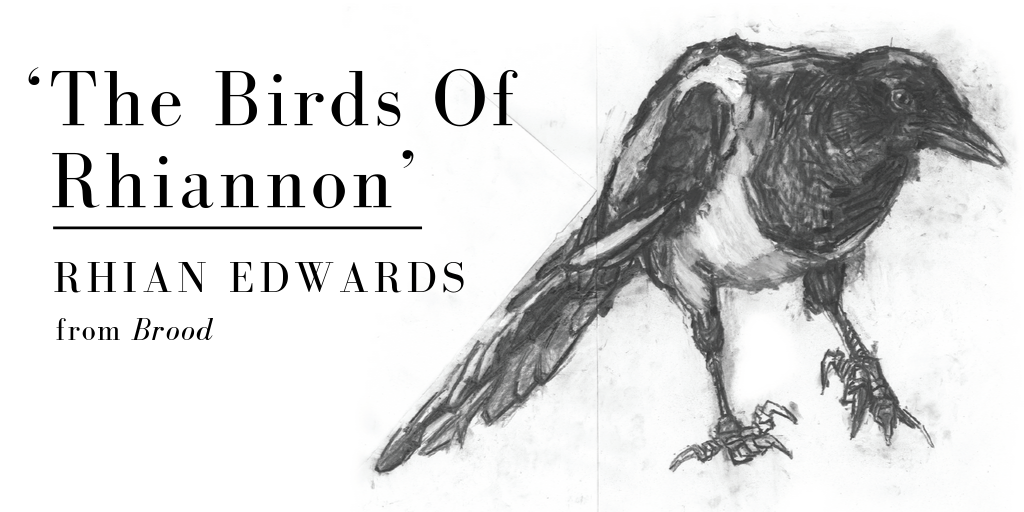
Friday Poem – ‘The Birds of Rhiannon’ by Rhian Edwards

This week’s Friday Poem is ‘The Birds of Rhiannon’ by Rhian Edwards, from her pamphlet Brood.

Brood Rhian Edwards

Inspired by both a fascination with birds as well as intense personal experiences of motherhood and a broken relationship, Brood is a stunning pamphlet by prize-winning poet Rhian Edwards. Also featuring beautiful, original charcoal drawings by Welsh artist Paul Edwards.

The pamphlet opens with ‘Birds of Rhiannon’ introducing us (via a nod to the famous medieval Mabinogion story where magic birds, said to bring people back from the dead, console the heartbroken Celtic princess Rhiannon) to a darkly resonant tone that echoes from the myth.

Brood is available on the Seren website: £6.00

Create your free Seren account and enjoy 20% off every book you buy from us.

Rhian’s debut poetry collection Clueless Dogs won Wales Book of the Year in 2013. It is available from the Seren website: £9.99

Posted on

Friday Poem – ‘Hare’ by Ross Cogan

This week’s Friday Poem is ‘Hare’ by Ross Cogan, from his collection Bragr.

Ross Cogan Bragr

Whether its myth intended to explain the constellations, the secret of eternal life, or the bloodthirsty tale of the mead of poetry, Ross Cogan’s collection Bragr (meaning ‘poetry’ in Old Norse) is a reimagining of Norse mythology for our times. In particular, the collection focuses on environmental concerns. The earth’s incredible beauty seems all the more fragile in the face of habitat loss and global warming.


Bragr is available on the Seren website: £9.99

Catch Ross reading from Bragr at The Hive in Worcester on Thursday 3rd October. Full details and where to book are available here. 

Create your free Seren account and enjoy 20% off every book you buy from us.

Posted on

Friday Poem – ‘Roads Across Europe’ by Martyn Crucefix

This week’s Friday Poem is ‘Roads Across Europe’ by Martyn Crucefix, author of The Lovely Disciplines.

Martyn Crucefix The Lovely Disciplines

Displaying his characteristic flair, craft and intelligence, Crucefix’s poems often begin with the visible, the tangible, the ordinary, yet through each act of attentiveness and the delicate fluidity of the language they re-discover the extraordinary in the everyday.

‘…highly wrought, ambitious, thoughtful – and very good.’ – The Sunday Times


The Lovely Disciplines is available on the Seren website: £9.99

Create your free Seren account and enjoy 20% off every book you buy from us.

Posted on

Friday Poem – ‘Cell’ by Deryn Rees-Jones

This week’s Friday Poem is ‘Cell’ by Deryn Rees-Jones which appears in her collection Erato.

It was announced yesterday that Deryn’s poem ‘Firebird’, also from Erato, is amongst those highly commended by the Judges in the Forward Prizes for Poetry. Other highly commended poets include Carol Ann Duffy, Inua Ellams, Hugo Williams, Ann Wroe and Morgan Parker.

Named after the Greek muse of lyric poetry, Erato combines documentary-style prose narratives with the passionate lyric poetry for which Rees-Jones is renowned. Here, however, as she experiments with form, particularly the sonnet, Rees-Jones asks questions about the value of the poet and poetry itself. What is the difference, she asks in one poem, between a sigh and a song? Erato’s themes are manifold but particularly focus on personal loss, desire and recovery, in the context of a world in which wars and displacement of people has become a terrifying norm.


Erato is is available on the Seren website: £9.99

Create your free Seren account and enjoy 20% off every book you buy from us.

Posted on

Friday Poem – ‘Gifts’ by Damian Walford Davies

This week’s Friday Poem is ‘Gifts’ by Damian Walford Davies which appears in his collection Docklands: A Ghost Story.

A disquieting fin-de-siècle ghost story in verse, Docklands explores grey worlds at the edges of the eye, conjuring late-Victorian Cardiff’s hustling, booming, sullied docks –and the horrors they conceal. A study of the violences perpetrated against wives and daughters, and of patterns of grief and longing, this disturbing sequence summons lost children and dark desires.


Docklands: A Ghost Story is available on the Seren website: £9.99

Create your free Seren account and enjoy 20% off every book you buy from us.