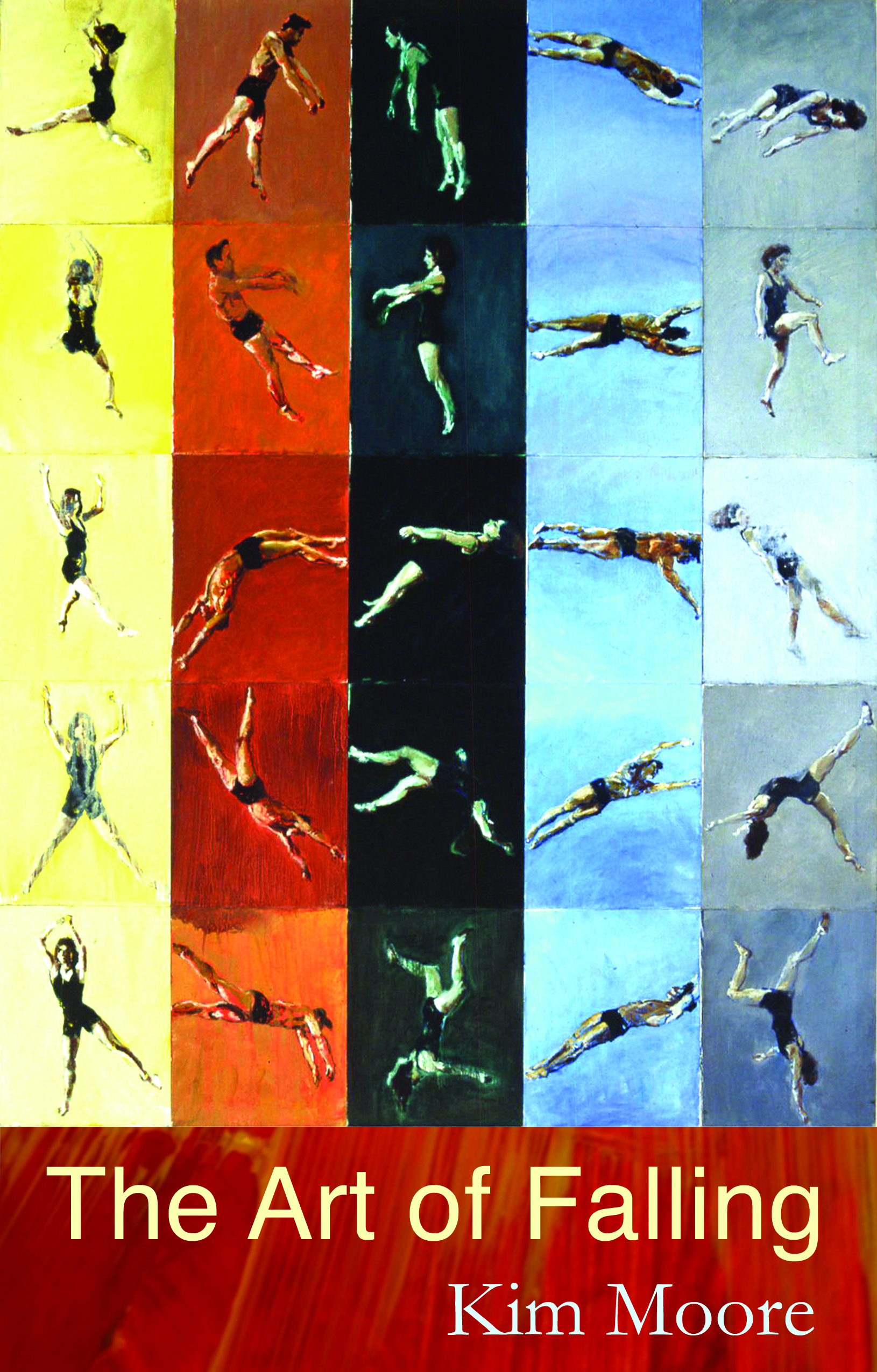
Today we’re talking to poet Kim Moore about her debut collection, The Art of Falling, which you can order from our website here.
Kim Moore lives in Barrow, Cumbria. She has an MA from Manchester Metropolitan University. Her poems have been published in the TLS, Poetry Review, Poetry London, and elsewhere. She regularly appears at festivals and events, her prize-winning pamphlet, If We Could Speak Like Wolves (Smith-Doorstop) was chosen as an Independent Book of the Year in 2012 and was shortlisted for other prizes. Moore won an Eric Gregory Award in 2011 and the Geoffrey Dearmer Prize in 2010. In 2014 she won a Northern Promise award. She writes a thoughtful blog and has a wide social media following. The Art of Falling (Seren 2015) is her debut collection.
Has the idea of falling, be it literally or metaphorically, always fascinated you, or did you find yourself writing about the many ways in which we fall purely for this collection?
The short answer is no, not consciously, but unconsciously. I think the concept of falling must have been something that has always been in the background. My father is a scaffolder and has had two serious falls – once when my twin sister and I were born and then again when I was twenty-one when he fell thirty feet from scaffolding and was lucky to survive. However, I didn’t realise I was writing about falling a lot until I wrote the title poem of the collection – and I only wrote that because David Tait, a good friend and wonderful poet set me a challenge to write a poem about falling. We used to take it in turns to do this – to set each other challenges – I didn’t even think at the time to ask him why, or what type of falling he meant. I actually forgot all about it and didn’t write the poem until six months later but looking back, the seed was definitely planted in that moment. Once I’d written the poem I realised that there were lots of poems about different types of falling throughout the collection – the book was maybe three quarters done by this point, so maybe I was just being very slow on the uptake.
In poems such as ‘My People’ and ‘A Psalm for the Scaffolders’ there’s a real sense of proud, working-class history. Is it fair to say you have a fondness for writing about the ‘every day’ hero?
‘My People’ is one of the poems I feel most guilty about writing because as well as hopefully communicating my pride, love and admiration for the people and background I came from, I’m being quite critical as well. It was an exhilarating poem to write, but it was also quite nerve-wracking. My people are ‘the type of people who would argue with their teacher if the child has detention’. Now I’m a teacher so I see it from both sides, of course. I actually wrote it when my husband started tracing his family tree and got quite far back and I realised I couldn’t. The poem was a way of finding out who my people were.
As for ‘A Psalm for the Scaffolders’ I definitely have a fondness for writing about my poor old dad! I think he likes it though – and to me it is really interesting because his life and the way he has worked, doing the same job since he left school is a way of working that is dying out, I think. I have a lot of admiration for that, for the physical hard graft of doing the same job for forty odd years.
I couldn’t help noticing the recurring animal imagery throughout The Art of Falling. There are plenty of wolves amongst your poems – ‘And the Soul’; ‘If We Could Speak Like Wolves’; ‘How Wolves Change Rivers’ – and also the incredibly powerful poems ‘The Language of Insects’ and ‘When I Was a Thing with Feathers’. In what way do animals help you to explore human nature through your writing?
I have never managed to answer this question about what the wolves mean in my poems, so I will skip over that one. Part of me also wants to duck out of answering it – I don’t really want to know. I like that they wander in and out of my poems when they feel like it though.
Halfway through writing the sequence which makes up the central sequence of this book, I got lost. I couldn’t find a way of saying what I wanted to say. I didn’t want to write a narrative sequence, with a beginning, a middle and an end. I started reading Ovid’s Metamorphoses and that is when everything shifted for me and I was able to carry on writing. The poems have a lot of animals in them, but perhaps more importantly, they have a lot of transformation in them, which was a way I found of writing about violence and the loss of not just identity, but of speech.
You play the trumpet, so I imagine there must be many musicians you admire. What is it about John Lennon and Wallace Hartley that made you want to write about them in particular?
It is actually obsessive people in general that I like writing about – and most musicians are obsessive – you have to be to practice enough to be good.
I actually wrote the John Lennon poem to take part in a competition to write a poem about John Lennon. It is what I call a research poem – I went to the library and read as many books about John Lennon as I could find and then wrote the poem, putting together the things that I read that interested me.
As for Wallace Hartley, I was helping to put together a project as part of my work as a music teacher. I read that he was found with his violin still with him and it was this that made me want to write something about him.
Congratulations on the publication of your debut collection! What are your future plans for your writing?
Thank you! My future plans are pretty simple – just to keep writing, and to always read more than I write. In September, I’ll only be working 2 days as a music teacher so this will hopefully give me a little bit more time. I haven’t written for the last six months – basically since I handed in the final proofs of the book, and then I’ve just started writing again last week, strangely coinciding with the book being delivered. I’ve started writing a few poems about scaffolding and a few poems about running which is my new obsession at the minute so I’m planning on carrying on with those.