Posted on

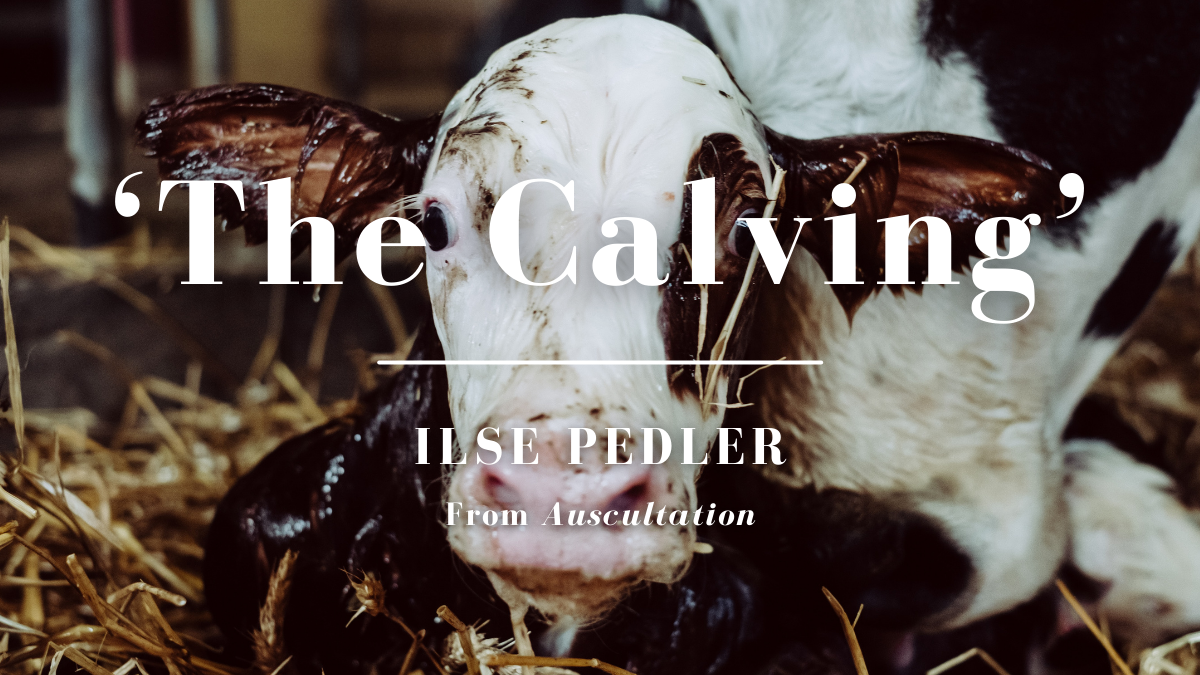
Friday Poem – ‘The Calving’ by Ilse Pedler

This week’s Friday Poem is ‘The Calving’ by Ilse Pedler from her debut poetry collection Auscultation.

This cover shows an image of a stethoscope against a white background with an orange butterfly resting on the cord.

Ilse Pedler is a veterinary surgeon who works in Kendal. Her debut collection is Auscultation, which means listening and specifically, in medicine, listening to sounds that come from the body’s internal organs. If listening is a central theme of this collection, it is also about being heard. There are poems about vets waiting rooms and surgical instruments, about crisis calls, about overhearing farmers and pet owners and colleagues. There are also poems about surviving a stern childhood and a heartbreaking sequence about being a stepmother.

The Calving
Straw hastily spread
crisps under the frost’s force,
a single dusty bulb
explores the darkness.
She stamps a warning,
twists her tethered head,
the whites of her eyes
moons of fear.
The cowman and his lad
stamp their numbing toes,
thick square hands
freezing on the halter’s buckle.
I prepare ropes and a jack,
roll up my sleeves,
take off my watch and ring,
push them deep into my pocket.
I trail cold gel up my arm
like the track of a snail,
pinch my fingers together to ease
the passage and slip inside.
Following the wall of the womb
I touch nose and ear,
inch loops of rope
over knuckles of hooves,
twist the ends over the hooks
on the jack and start to pull.
She bellows her pain,
crushes my bones on hers.
We both strain to birth
this new life - and only she
and I are warm,
and I am at the warmth’s core.

Auscultation is available on the Seren website: £9.99

It’s not too late to order on the Seren website in time for Christmas. If you’re still struggling for inspiration why not look through our Christmas Gift Guide? Or check out the new Seren Gift Subscription.

Create your free Seren account and enjoy 20% off every book you buy from us.

Posted on

Friday Poem – ‘Going to Liverpool’ by Sheenagh Pugh

This week’s Friday Poem is ‘Going to Liverpool’ by Sheenagh Pugh from the anthology Newspaper Taxis: Poetry After The Beatles. Congratulations to Paul McCartney’s The Lyrics which won Waterstones Book of the Year 2021.

Newspaper Taxis: Poetry After the Beatles. Edited by Phil Bowen, Damian Furniss and David Woolley.

January 1963. ‘Please, Please Me’ by The Beatles shoots to number one. So begins a new era, in which one band transforms the face of music, youth and popular culture. Taking in everything from the music, their influence, the way we lived then and the way we live now, Newspaper Taxis is a response to the Beatles’ creativity and capacity to influence successive generations. Beatles fans young and old will want this anthology to add to their collection.

GOING TO LIVERPOOL

I am a middle-aged woman
travelling on business
and I’m going to Liverpool,

where I’ll take time out
to visit Albert Dock
and the museum

where my youth is preserved.
The fashions I followed,
the songs I knew by heart,

the faces that convulsed
my own into screams
and sobs, they’ll all be there.

I’m going to Liverpool,
and it is autumn.
The fields outside Leominster

lie in stubble, the leaves
of Ludlow’s trees are jaundiced
and flushed with the fever

that says they’re finished.
The ticket collector
said Thank you, Madam.

My daughter’s grown up
and my mother’s dead,
and between the pages

of the notebook
where I’m writing this
I keep a yellowed ticket

to a match, a picture
of an actor, Edwin Morgan’s reply
to my fan letter,

and I’m going to Liverpool
because I’m the kind
that always will.

Sheenagh Pugh

Newspaper Taxis is available on the Seren website: £9.99

Create your free Seren account and enjoy 20% off every book you buy from us.

Browse the Seren Christmas Gift Guide for more gift recommendations for your loved ones.

Have you heard about the new Seren Subscription? Buy today and receive three brand-new Seren books in 2022. Find our more on our website www.serenbooks.com/subscription.

Posted on

Friday Poem – ‘Eva’ by Carolyn Jess-Cooke

This week’s Friday Poem is ‘Eva’ by Carolyn Jess-Cooke from her new collection We Have to Leave the Earth.

This cover shows a photo of a balled up piece of blue fishing-twine lying against a pale pink and blue background.

Carolyn Jess-Cooke’s most recent collection We Have to Leave the Earth deftly interweaves the personal and the political. Climate change is confronted in a sequence about the Arctic; poems that are vividly descriptive of an extreme landscape, sensitive to the effects of global warming. A second sequence, The House of Rest, is a history in 9 poems of Josephine Butler, (1828-1906) a pioneering feminist activist. There are also tender poems about family.

Eva

Then you were here
real as a wound.

They placed you in my arms
with such care I thought you a parcel of feathers

that might fly away.
I stroked your face –

your eyes were midnight blue.
Time bended to you,

language re-strung its instruments
to sound your name.

Visitors admired your lace-
ears, your peony fists, but they

could not see you as I did –
you slid from your skin

just as you had slipped out of me
and became a shard

of morning light, turning
cobwebs to crystal thread,

the windowsill a gold bar,
dew on hedges constellations

of delicacy. I knew then
this love was alchemy.

Our bond is not made of that loose
wet rope they cut

but of instruments that show
the unseen and sound the silent,

the heart’s infinite missions
harnessed in flight.

We Have to Leave the Earth is available on the Seren website: £9.99

Create your free Seren account and enjoy 20% off every book you buy direct from us.

Join us online for Virtual First Thursday on 2nd December from 7:30pm GMT where Carolyn will be reading from We Have to Leave the Earth alongside Jeremy Dixon. Tickets are £2 plus Eventbrite admin fee. Buy yours here www.eventbrite.co.uk/e/216146057677.

Posted on

Friday Poem – ‘Bowerbirds’ by Deryn Rees-Jones

This week’s Friday Poem is ‘Bowerbirds’ by Deryn Rees-Jones from her collection Erato which was shortlisted for the T. S. Eliot Prize and Wales Book of the Year.

This cover shows a blurred black and white image of someone dancing.

Named after the Greek muse of lyric poetry, Erato combines documentary-style prose narratives with the passionate lyric poetry for which Rees-Jones is renowned. Here, however, as she experiments with form, particularly the sonnet, Rees-Jones asks questions about the value of the poet and poetry itself. What is the difference, she asks in one poem, between a sigh and a song? Erato’s themes are manifold but particularly focus on personal loss, desire and recovery, in the context of a world in which wars and displacement of people has become a terrifying norm.

Bowerbirds
Start now with the smallest things,
a pile of blackened acorns, glinting beetle wings,
the green fruit and purple flowers of the potato bush.
He trails a path of halts and hesitations
like stations of the cross,
turns colour in his mind, perspective.
Snail shells or the blue of berries?
(Is that a bud of jasmine in his beak?)
His bower, I see, is thatched with orchid stems,
moss laid like a lawn at the entrance to his bivouac,
orange leaves like a pool of restless koi.
This stuff he collects as a small boy might,
adrift on a prayer of football cards and dinosaurs.
All settles as he eyes her. And here now,
like a seal on his heart, a bed of blooms
pulled from a bush.
How carefully he’s considered her.
This pink, he thinks, of roses.

Erato is available on the Seren website: £9.99

Create your free Seren account and enjoy 20% off every book you buy from us.

Looking for Christmas gift inspiration? Browse our Christmas Gift Guide for literary ideas for the whole family.

Posted on

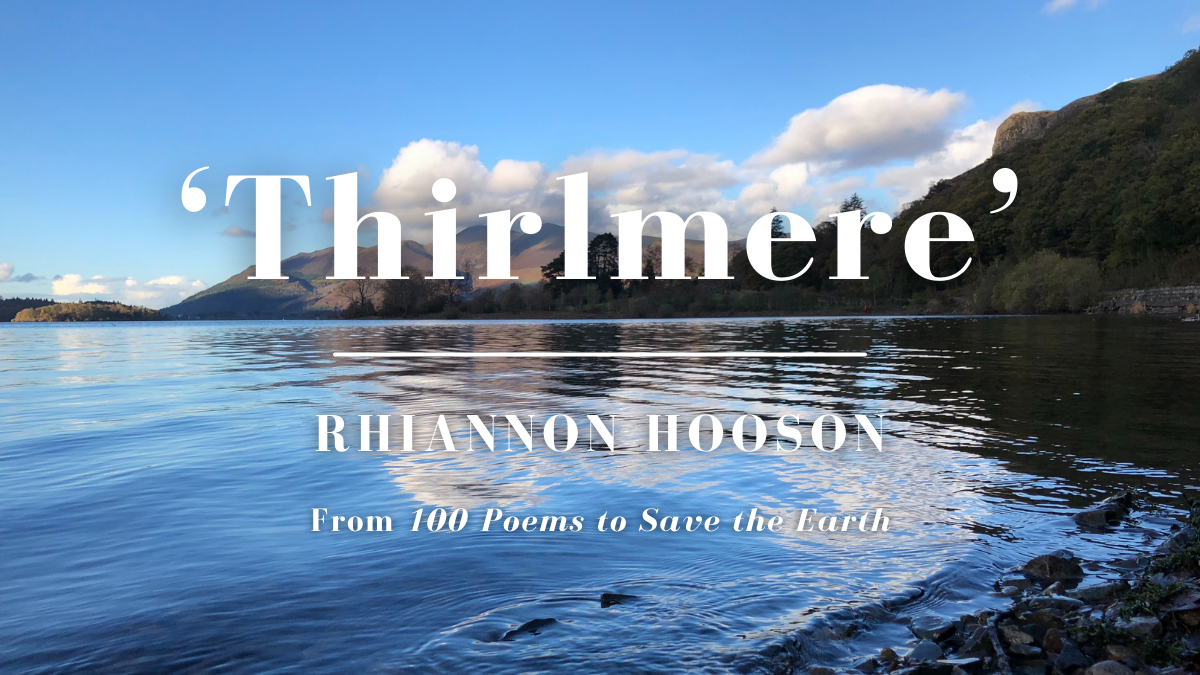
Friday Poem ­– ‘Thirlmere’ by Rhiannon Hooson

This week’s Friday Poem is ‘Thirlmere’ by Rhiannon Hooson from 100 Poems to Save the Earth.

100 Poems to Save the Earth edited by Zoe Brigley and Kristian Evans.

Our climate is on the brink of catastrophic change. 100 Poems to Save the Earth invites us to fine-tune our senses, to listen to the world around us, pay attention to what we have been missing. The defining crisis of our time is revealed to be fundamentally a crisis of perception. For too long, the earth has been exploited. With its incisive Foreword from editors Zoë Brigley and Kristian Evans, this landmark anthology is a call to action to fight the threat facing the only planet we have. 

Thirlmere
After we lit the last candle
the gales couldn't hold us any more.
Along the lane the walls had begin
to slump, water sluicing through them 
green as grass, but we drove
through anyway and out into the valley.
The fields were polished flat.
Trees were hung with drooping ropes
of fleece that caught in the breeze like kudzu.
Banks of shale sprawled
draining across the roads, and the sky
was open, dizzying and blue, tall into the air
above the crowns of our heads, 
and the slate face of the lake
was the same as always. Lakes survive
any flood, lie oblique in their hollows,
streaked with the half-truths of glimpsed reflections. 
The birds were only then beginning to sound.
All across the fields the fallen trees were burning.

100 Poems to Save the Earth is available on the Seren website: £12.99

Rhiannon Hooson’s collection The Other City is available on the Seren website: £9.99

Create your free Seren account and enjoy 20% off every book you buy from us.

Posted on

Friday Poem – ‘For a Coming Extinction’ by Pascale Petit

As COP26 continues in Glasgow, this week’s Friday Poem is ‘For a Coming Extinction’ by Pascale Petit which features in the anthology 100 Poems to Save the Earth.

100 Poems to Save the Earth Edited by Zoë Brigley and Kristian Evans

Our climate is on the brink of catastrophic change. 100 Poems to Save the Earth invites us to fine-tune our senses, to listen to the world around us, pay attention to what we have been missing. The defining crisis of our time is revealed to be fundamentally a crisis of perception. For too long, the earth has been exploited. With its incisive Foreword from editors Zoë Brigley and Kristian Evans, this landmark anthology is a call to action to fight the threat facing the only planet we have. 

For a Coming Extinction
(after W. S. Merwin)
You whom we have named Charger, Challenger,
Great King, and Noor the shining one,
now that you are at the brink of extinction,
I am writing to those of you
who have reached the black groves of the sky,
where you glide beneath branches of galaxies,
your fur damasked with constellations,
tell him who sits at the centre of the mystery,
that we did all we could.
That we kept some of you alive
in the prisons we built for you.
You tigers of Amur and Sumatra,
of Turkey and Iran, Java and Borneo,
and you — Royal Bengals, who lingered last.
Tell the one who would judge
that we are innocent of your slaughter.
That we kiss each pugmark,
the water trembling inside
as if you had just passed.
Masters of ambush and camouflage,
hiding behind astral trees,
invisible as always,
when we gaze up at the night,
when we look lightyears into the past —
we see your eyes staring down at us.

100 Poems to Save the Earth is available on the Seren website: £12.99

Create your free Seren account and enjoy 20% off every book you buy from us.

Read our COP26 guest post from 100 Poems to Save the Earth co-editor Kristian Evans.

Posted on

Friday Poem – ‘Beware Welsh Learners’ by Katherine Stansfield

This week’s Friday Poem is ‘Beware Welsh Learners’ by Katherine Stansfield from her collection We Could Be Anywhere By Now.

This cover shows a painting of a woman looking out at an abstract landscape.

In her second collection, We Could Be Anywhere by Now, Katherine Stansfield brings us poems about placement and displacement full of both wry comedy and uneasy tension. Stints in Wales, Italy and Canada, plus return trips to her native Cornwall all spark poems delighting in the off-key, the overheard, the comedy and pathos of everyday life.

‘multi-layered and full of surprising transitions’ – Patrick McGuiness

Beware Welsh learners
Welsh learners are self-obsessed.
Everything is I with them.
Welsh learners are amnesiacs.
They forget the past in the classroom’s constant present.
They can’t commit to the future.
Welsh learners are liars.
They claim they work as civil servants, as teachers.
They say they work for Swalec.
They have exams in these falsehoods.
Welsh learners are cunning.
They ask how you are but they don’t really care.
They only want you for your vowels.
Welsh learners make poor friends.
They invite you for coffee and when you confide
you’ve been fired, that your wife left you and the doctors
think it’s cancer, all they do is smile, nod and say
bore da, and then, bore da bore da, again.

We Could Be Anywhere By Now is available on the Seren website: £9.99

Create your free Seren account and enjoy 20% off every book you buy from us.

Posted on

Friday Poem – ‘What We Found in the Arctic, or, the Geopolitics of New Natural Resources Uncovered by Melted Ice’ by Carolyn Jess-Cooke

This week’s Friday Poem is ‘What We Found in the Arctic, or, the Geopolitics of New Natural Resources Uncovered by Melted Ice’ by Carolyn Jess-Cooke from her new collection We Have To Leave The Earth.

This cover shows a photo of a ball of tangled fishing twine resting against a pink and blue background.

Carolyn Jess-Cooke’s new poetry collection is both keenly political and deeply personal. The opening poem ‘now’ features a seemingly peaceful domestic scene of a family lounging at home as the starting point for meditation on history, time, mortality and the fate of the planet. There are hints of a struggle with depression stemming from a difficult childhood. There is a cherished child diagnosed with autism. There are two sequences: Songs for the Arctic, inspired by field work done for the Arctic at the Thought Foundation, poems that are vividly descriptive of an extreme landscape, aware of the fraught history of exploration and sensitive to the way changes in the pack ice are the most significant indicators of man-made global warming. The other sequence, The House of Rest, is a history in nine poems of Josephine Butler (1828-1906), who pioneered feminist activism, and helped to repeal the Contagious Diseases Act 1869, which facilitated sexual violence in the name of disease prevention. Jess-Cooke is unafraid of dark material but is also ultimately hopeful and full of creative strategies to meet challenging times. 

What We Found in the Arctic, or, the Geopolitics of New Natural Resources Uncovered by Melted Ice
Mme and M. Dumoulin, missing since 1942
Nickel
Rubber ducks
A Russian flag pronged on the seafloor
Copper
Three Incan children, sacrificed
Anthrax
Bird fossils from the Cretaceous period
Gold
Prehistoric skis
Saami, Nenets, Khanty, Evenk, Chukchi, Aleut, Yupik, Dolgan, and Inuit
Natural Gas
1700 species of plants
Record levels of microplastics
Diamonds
A hunter from 3000 B.C.
Oil
A horse from the Iron Age, with perfectly preserved manure
Territorial claims for the Arctic Continental Shelf
Polar bears, starving
Coal
Disputations concerning territorial waters
45,000 Russian troops
3,400 Russian military vehicles
41 Russian ships
15 Russian submarines
110 Russian planes
The albedo effect, claimed by no one

We Have To Leave The Earth is available on the Seren website: £9.99

Create your free Seren account and enjoy 20% off every book you buy direct from us.

Join us online for the virtual launch of We Have To Leave The Earth on Tuesday 16th November from 7pm. Carolyn will be reading from the collection alongside guest readers Liz Berry and Jen Hadfield. Register for free via Eventbrite here https://www.eventbrite.co.uk/e/193473353007.

Posted on

Friday Poem – ‘Lakeclean’ by Polly Atkin

This week’s Friday Poem is ‘Lakeclean’ by Polly Atkin from her latest collection Much With Body which is a Poetry Book Society Winter Choice.

This cover shows a painting of a swimmer floating on her back in a blue green lake.

Much With Body is the startlingly original second collection by poet Polly Atkin. The beauty of the Lake District is both balm and mirror, refracting pain and also soothing it with distraction. Much of the landscape is lakescape, giving the book a watery feel, the author’s wild swimming being just one kind of immersion. There is also a distinct link with the past in a central section of found poems taken from transcripts of the journals of Dorothy Wordsworth, from a period late in her life when she was often ill. In common with the works of the Wordsworths, these poems share a quality of the metaphysical sublime. Their reverence for the natural world is an uneasy awe, contingent upon knowledge of our fragility and mortality.

Lakeclean

Still damp hours after I sank myself under the surface my hair
smells like violets when I run my hand through it

not the ones crushed at the edge of the path through the wood,
yesterday’s shampoo. My skin smells of heat and mud.

I don’t swim because it’s challenging I swim because I can. For the body
released from the tyranny of gravity, resistance of air. Land

is the enemy. We are comfortable here, suspended, above,
in, and under. We dwell in transparency.

We sweep mountains aside with our arms without wincing.
We move with something like ease.

Much With Body is available on the Seren website: £9.99

Create your free Seren account and enjoy 20% off every book you buy direct from us.

Join us online for the virtual launch of Much With Body on Wednesday 20th October from 7pm. Polly will be reading from the collection alongside guest readers Hannah Hodgson, Éireann Lorsung and Claudine Toutoungi. Register for free via Eventbrite www.eventbrite.co.uk/e/186887905757.

Posted on

Friday Poem – ‘6. That a man approached you in a nightclub’ by Kim Moore

This week’s Friday Poem is ‘6. That a man approached you in a nightclub’ by Kim Moore from her new collection All The Men I Never Married.

This cover shows a collage of small nature images to make up the pink body of a man again a black background.

All The Men I Never Married, Kim Moore’s eagerly awaited second collection, is pointedly feminist, challenging and keenly aware of the contradictions and complexities of desire. The 48 numbered poems take us through a gallery of exes and significant others where we encounter rage, pain, guilt, and love.

6.

That a man approached you in a nightclub.
That you were polite at first, then turned your back.
That he insisted on giving you his number.
That you put it in your pocket.
That you danced with your friend all night.
That he stood and watched.
That you were drinking tequila.
That you licked salt from the back of your hand.
That he was waiting outside.
That he grabbed your arm and spun you round.
That you snapped.
That you’ve always had a temper.
That you were not afraid.
That you swung your fist and clipped his jaw.
That he kicked you between the legs.
That he shouted I will end you.
That you fell to the pavement.
That he tried to kick you again.
That a bouncer came and held him back.
That he shouted I will end you, I will end you, I will end you. 
That the police were called.
That he vanished into the night.
That you were taken to the station.
That he turned up with his lawyer.
That he turned up with his father.
That you still hadn’t sobered up.
That he was smirking.
That it was fresher’s week.
That you were in pain.
That it was hard to explain about his number in your pocket. That now you were afraid.
That you were advised not to press charges.
That you hit him first.
That this all happened many years ago.
That you laugh about it now.
That you say well, I shouldn’t have hit him.
That I both agree and disagree with this statement.
That being our bodies in public is a dangerous thing.
That being in public is a dangerous thing.
That our bodies are dangerous things.

All The Men I Never Married is available on the Seren website: £9.99

Join us for the hybrid launch of All The Men I Never Married on Friday 15th October. The in person event at Castle Green Hotel in Kendal will be streamed live online. Register through Eventbrite here https://www.eventbrite.co.uk/e/172062632967. Registration for in person tickets closes at 4pm today (8 Oct).

Create your free Seren account and enjoy 20% off every book you buy direct from us.