
Read Kim Moore’s ‘When Someone is Singing’, along with excellent commentary, on Louisa Campbell’s blog.
Read Kim Moore’s ‘When Someone is Singing’, along with excellent commentary, on Louisa Campbell’s blog.

Forget the January blues – in recent years this cold and gloomy month has instead brought cooking inspiration and healthy eating ideas as ‘Veganuary’ has taken off.
What is Veganuary? Whether you’re new to the vegan diet or you’ve dabbled before, the idea is to cut out meat and dairy throughout January – and if you find you like it, then continue for as long as you’d like! To help kickstart your vegan journey, vegan cook Sarah Philpott, author of The Occasional Vegan, has some tips, tricks and recipes:
 Getting started
Eating and cooking as a vegan might seem like a minefield but it’s simple once you know
how. Despite what your mother says, you’d be surprised by how little protein you actually
need and it can be found in a number of vegetables, beans and pulses. The same goes for iron, calcium and healthy fats.
Where to shop & what to buy – Can eating vegan be budget-friendly?
You might think that veganism is only for well-off lefties but it’s not a middle-class fad; it’s actually really accessible for those of us on a tight budget. Seasonal fruit and vegetables are cheap and plentiful, and beans, pulses, rice and other grains cost pennies. Meals like chilli, dhal and curry are tasty tummy fillers which, armed with a well-stocked cupboard, will cost you next nothing to make. You can buy big bags and tins of pulses for next to nothing from supermarkets and international stores, and pound or bargain shops often sell quinoa, nuts, seeds and dried fruit at a fraction of the price you’d pay elsewhere. Most supermarkets sell everything from plant milk to vegan cheese, as well as a variety of ready meals, and if you fancy a treat, there are plenty available, including vegan Magnums and Ben and Jerry’s. Most restaurants now offer a vegan menu and you can even enjoy a vegan sausage roll at Greggs.
The healthy meal:
Beat the Blues Salad
This vibrant and filling salad pairs smoky tofu with beetroot, orange and salty black olives.
The mid-week treat:
‘KFC’ – Kentucky Fried Cauliflower
This spiced, fried cauliflower tastes amazing and is surprisingly easy to make.
The decadent dessert:
Vegan Chocolate Mousse
This gorgeously light and creamy mousse has just four ingredients and comes together as if by magic.
We hope you feel inspired and ready to begin your voyage into veganism. Hungry for more great recipes? Get your copy of The Occasional Vegan from our website: £12.99
Create your free Seren account and enjoy 20% off every book you buy direct from us.
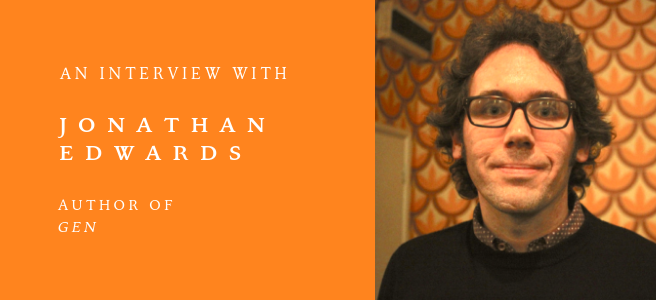
 Jonathan Edwards’ debut collection, My Family and Other Superheroes, was a triumph: shortlisted for the Fenton Aldeburgh First Collection Prize and winner of the Costa Poetry Award 2014.
Jonathan now returns with his wonderful second collection, Gen. How did the writing process differ this time, and what can we expect to see in the new poems? In this interview, we find out more about Jonathan and his new work.
How did the process of writing Gen differ from putting together your debut collection, My Family and Other Superheroes?
I think, like most people’s second collections, it was swifter, and I had more of a sense of what I was doing. I grew up at a time when the struggles of bands like The La’s to produce a follow-up to successful work were legendary, and the voice of those experiences sits on your shoulder. I wanted to maintain in this collection the strengths of the first book, writing about famous people and their interactions with the ordinary, focusing on Kurt Cobain’s mythical visit to the Newport nightclub TJs, or the impact on a young boy of watching the disgraced Olympic sprinter Ben Johnson racing in 1988. I also wanted to continue looking at a Valleys village life in surreal ways, constructing narratives about a village which is inundated by tourists, and another where a street is locked down for a day, and the residents decide to spend the time having a massive party. It was also important, though, to reach out in new directions. One of these was about incorporating other voices in the book. The collection includes a range of monologues, working with the voices of lions and servants, trees and cities, and I wanted to work with real voices too, interviewing some of the figures at the heart of the Welsh historical events which feature in the poems. I was also interested in echoing the collection’s central interest, of being young, through a wide range of experiences, looking at my own youth and the youth of my parents, but also considering youth through a range of events in Welsh history. What was it like for my grandfather to be young at the turn of the twentieth century in Newport? What was it like to be a child at Capel Celyn?
Gen includes poems that provide glimpses into pin-prick moments from the distant and not-so-distant past – for instance, ‘Servant Minding a Seat for his Master Before a Performance of The Rivals, Covent Garden Theatre, 1775’, and ‘Welsh Flag on the Wall of Richard Burton’s Dressing Room, Broadway, 1983’ – told from the perspective of the flag. Is it more challenging getting into the head of an inanimate flag than, say, a family member?
Writing more monologues was one difference with this collection – I see the book as a boxful of voices you can open, and they all come out, some shouting in your face, some whispering in your ear, some sulking or stuttering, some jibber-jabbering on. I’d been lucky enough to be asked to teach a number of workshops, to all sorts of different groups, since the publication of the first book, and writing monologues is a great workshop activity – I use the great Carol Ann Duffy poem, ‘A Week as my Home Town’ as a way into writing about place. So it became inevitable that I would want to push my usual concerns – class, Wales, animals – through monologue. I say ‘would want to’ but this isn’t quite right. The truth is that the voices of these poems wrote them for me, and I sat there like a sort of court reporter or secretary, trying to keep up. Monologue is great for a writer because it allows you to go into other worlds and see and feel other things, all while sitting at a desk, clutching a pen. It can take you much farther than Easyjet, and it’s cheaper. You can open your eyes as a lion, see your reflection on the inside of the glass of your zoo enclosure, feel your lion-breath against the glass. Or you can rub your eyes again and open them in the eighteenth century, smell the stink of the streets, hear the bloke next to you, gossiping about your master, spot someone in a doorway over there, looking furtive, saying your name. Or you can wake up and be a whole city, think everything you think, explore all your nooks and crannies, your hilltops and waterways, feel how you feel for your rush-hour commuters and your lost-hearted rough sleepers. It’s magic that poems can do this. Charles Bukowski used to talk about writing a poem having to compete with a night out at the movies as an alternative form of entertainment for the writer. Monologue, and the promise of finding out in intimate and fascinating ways about completely alien experiences, is one way of getting yourself onto a chair to write.
Family is once again a central theme, and the small and unnoticed actions of family members often overshadow larger, less personal histories – for instance, the image of your grandfather tying people’s shoelaces together in ‘Harry Houdini on Newport Bridge, May 1905’. It’s obvious you take great joy in recounting these anecdotes – who can you thank for this interest in family history, and will we be hearing more wild tales of the Edwardses in future collections?
As with everything in life, really, I thank my mother and father for the existence of these poems. Also the South Wales Argus: the stories it features always have a decent chance of making it into my poems, and I would politely thank its writers and editors to remember this, when writing up their copy. My family has always been interested in its own history, partly because our history is so mysterious and obscure – World War One, for example, and the way my family seemed to roll down this valley, generation by generation, until I emerged, at the bottom, blinking, headachey and literate. In a framed black-and-white photo on the mantelpiece, my grandfather is the image of me, Brylcreem’d and watch-chained, blinking out of a black-and-white photo, yet I never met him. What was it like to wake up and be him? What were the smells and tragedies of his life? Writing about him can help bridge the gap between what I share deeply with him and what I know nothing of.
In terms of more tales of the Edwardses, they’re always on the go. Sinéad Morrissey’s On Balance is a magisterial, holy collection for me, and I especially love the ‘Collier’ sequence, about her grandfather. My maternal grandfather was a will-o-the-wisp character, all pinstripe suits and Woodbines, a rickety, backfiring Volkswagen Beetle and a grin from here to the end of the street. His experience, my nan’s experience, is something I want to shout and sing about – I don’t know what writing is for, really, if it isn’t to re-discover and celebrate their Workingmen’s Club and bay-windowed, permed or eye-sparkling lives.
How do you think your poetic style has evolved since the publication of the first book?
I often say, jokingly, at readings, that my poetry shows enormous evolution between books one and two: the first collection is made up of poems about my family, which often focus on famous people, while my second collection is made up of poems about famous people, which often focus on family. One thing I wanted to do in this collection was explore more fully the ground I’d sketched out in the first book, to approach those themes from different directions and travel into them farther. In my first collection, I was interested in the history of Wales, writing about Chartism and the North Wales village of Capel Celyn, drowned in the 1960s in order to create a water source for Liverpool. Capel Celyn is a resonant, echoing subject in all sorts of ways – the human experience of losing your home, the relationships which people would have sustained and developed, as well as the political implications of this episode, and the way it drove Devolution. Additionally, as someone who lives in a tight-knit village community, my heart is in this place and in its loss. One thing I was keen to do, then, was to get the voices and the real experience of Capel Celyn into the writing. It turned out that David Walters, who was arrested for one of the first attacks on the dam site at Tryweryn, is from just up the road from me in Bargoed, and I am really grateful to him for the interview which resulted in the ‘Cofiwch Dryweryn’ sequence. Equally, these poems are indebted to a number of important books which serve this subject, including Einion Thomas’s Capel Celyn: Ten Years of Destruction and Owain Williams’s first-person account, Tryweryn: A Nation Awakes. The poems in Gen which mourn this experience are a baby step towards the book of poems which is needed on this subject.
Your poetry displays a deep and constant affection for the Welsh landscape and experiences of your youth – even down to the mess and madness of an illicit party: ‘there / was chaos, carnage, every pot plant / an ashtray, every ashtray a sick bag.’ (‘House Party at Tanya’s, 1995’). Your poems certainly aren’t rose-tinted, and yet they hold onto a sense of celebration. Do you hope readers will share that sense of fondness and familiarity?
One of the reasons I write is that it makes time travel possible. Once I get the notebook and the biro up to 88mph, I can get there. Time is clearly a concern across both collections, and I love that I can step into a room, scribble a line, and be in another time. Some of these are times before I was born – I like hanging out with my parents in the years before I knew them, and seeing what they were like, or spending time in a poem with a grandfather I never met. I love that poetry can be a way of talking to people who aren’t there anymore, because they aren’t themselves any more, and some of these people are past selves. Either poetry is a loudspeaker shouting across time, or else it’s a box you put yearning in to store under the stairs. Like lots of people, I guess, I know exactly the second of my life I would go back to if I could, and what I would do differently. The poems in this collection about house parties and school days, my father crashing a car in 1965, my mother cutting her arm in 1955, my uncle smoking a pipe in 1986 – it’s all a way, I suspect, of addressing that.
Anyone lucky enough to have seen you perform will know that you are as entertaining in person as you are through your poems. What events and projects do you have lined up?
From now until August, I seem to be reading everywhere that will have me, and several places that won’t, from Cardiff to Cork, from Merthyr to Mitcheldean. This is one of the best things about poetry – hitting the road and seeing what happens to you, meeting the artists, the enthusiasts, the personalities who keep poetry going up and down the country. This time round, it will be about re-connecting with people who are now friends, and I love that poetry has made that happen. As my sinister mega-global marketing campaign has it, all events will be advertised on the Seren website. I love teaching poetry and working with other writers to help them develop, and am really excited about my upcoming courses for The Poetry School and Tŷ Newydd. This month, the Poetry Society will be launching a film of a poem I wrote in celebration of the Monmouth and Brecon canal, made by Chris Morris of Falmouth University. I’m really proud of this work and really excited about the opportunity to sing for a place that has always been really important to me, a place I splashed and grew up in. There are some other exciting things coming up which I’m not allowed to talk about yet and other crazier, wilder projects, including zoo animals and Valleys school children, installations and chaos, I hope can happen, if I can talk the right people into it. Most important will be finding the time to scribble new poems. Whatever else the future holds, whether it’s time travel or history, voices or narrative, I very much hope there’s a lot more writing to be done.
Local to Cardiff? Catch Jonathan at the Seren Cornerstone Poetry Festival – he will be in conversation with Christopher Meredith and Archbishop George Stack in the ‘Afternoon Tea: Generations’ event, 9 February. Tickets include a generous selection of cakes, pastries and sandwiches. Book now.
Gen is available from the Seren website: £9.99
Enjoy 20% off every book you buy from us when you create your free Seren account.
This week our Friday Poem is a new work by Katherine Stansfield, ‘Telling the bees’.
‘Telling the bees’ is a touching memorial to Christian Brown OBE, co-founder of the Seren Cornerstone Poetry Festival. The poem weaves together memories with the imagery of a garden in which ‘everything has bloomed’: a legacy of colour and life, conjured by Christian even after his passing.
Christian was the driving force behind the first Seren Cornerstone Poetry Festival in 2018 and as we approach 2019’s festival we are reminded of his extraordinary energy and vision. Cornerstone’s Poet in Residence, Katherine Stansfield will be opening the festival alongside Kim Moore and Emily Blewitt in the Opening Buffet event: tickets available now. All That Was Wood, a pamphlet of poems written during Katherine’s residency, will be published to coincide with the festival.

All That Was Wood will be available in February 2019 from our website, and at the Seren Cornerstone Poetry Festival (8-10 February 2019).

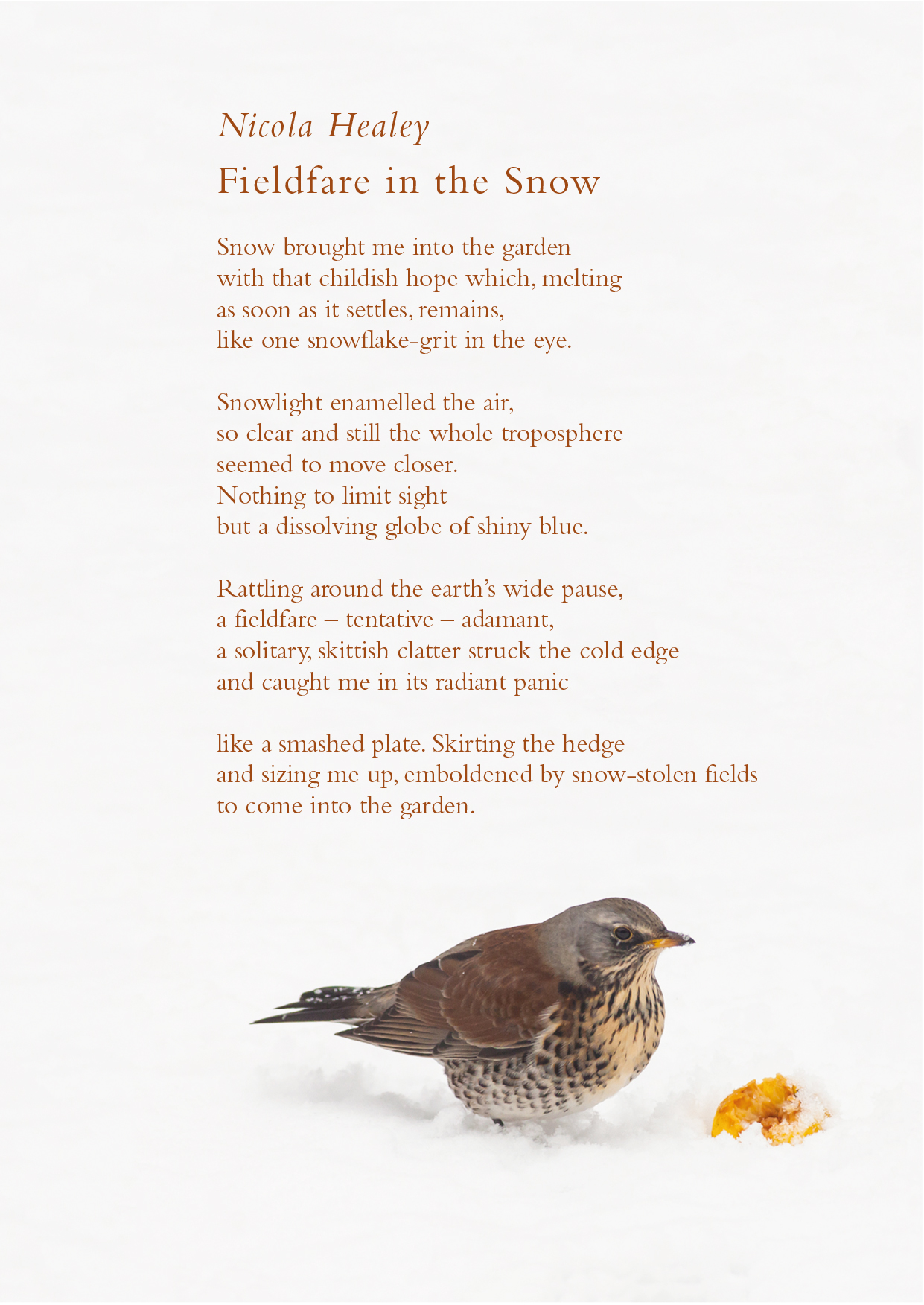
For this week’s Friday Poem we have the wonderfully festive ‘Fieldfare in the Snow’ by Nicola Healey.
 ‘Fieldfare in the Snow’ is the winner of this year’s Christmas Poetry Competition. The poem stood out from the other entries with its “beautifully observed and exquisite echoing lines”, and became Seren’s 2018 Christmas Card which we have joyfully sent out to literary friends.
The cards are available to purchase on our website – Christmas is almost upon us now, but you can always stock up for next year!

‘Fieldfare in the Snow’ Christmas cards are available on the Seren website: £2.50 for five
Create your free Seren account and enjoy 20% off every book you buy from us.

Our Friday Poem this week, as we enter the final month of 2018, is ‘December’ by Paul Deaton.
 ‘December’ is taken from Paul Deaton’s Poetry Book Society-recommended debut, A Watchful Astronomy. Deaton is a realist and a formalist, preferring simple, accurate language and use of formal meter. This makes for unusually clear and accessible work. A powerful underlying current of emotion also drives these poems and is contained and restrained by the more austere formal qualities.
‘Each poem in this collection is like a little torchlight … I felt like it totally wrapped me up as a reader, and I really couldn’t put it down.’ – Jen Campbell

A Watchful Astronomy is available from the Seren website: £9.99
Create your free Seren account and enjoy 20% off every book you buy from us.

Our Friday Poem this week is ‘Clean’ by Elizabeth Parker, from her debut collection, In Her Shambles.
 Parker’s first full collection of poems, In Her Shambles, showcases her style with poems that are verb-rich, observational and uncanny portraits of things-seen-aslant.
‘Clean’ is no different: this frank portrait of a house post-breakup gives us dead insects ‘like crossed cutlery’ and ‘dark sediment’ on areas now untouched and unfamiliar. Instead of well-worn clichés we measure the speaker’s sorrow through the odd and unexpected mementos that remain – ‘scents’, ‘dust’ and ‘that sticky shape on the radiator’.
You can catch Elizabeth Parker reading alongside fellow ‘Spoke’ poets Claire Williamson, Robert Walton and Paul Deaton at Spike Island Café-bar, Tuesday 4 December.

In Her Shambles is available from the Seren website: £9.99
Create your free Seren account and enjoy 20% off every book you buy from us.
We received a huge number of excellently crafted poems for this year’s Christmas Poetry Competition, and it was a difficult task for our judge, Amy Wack, to decide on a winner.
In the end, Nicola Healey’s poem ‘Fieldfare in the Snow’ stood out with its “beautifully observed and exquisite echoing lines”, and we are thrilled to announce Nicola as our winning poet. ‘Fieldfare in the Snow’ is our official Seren Christmas Card 2018, which we will share with all our literary friends.
There were several excellent poems that stood out and deserve an honourary mention: ‘Christmas on the Beacons’ by Kate Noakes, a stunningly atmospheric portrait of Wales; ‘Damien’s Tears’ by Kirby Wright, with its lovely unusual patois; and ‘Opening’ by Alison Binney, which reads like a novel in miniature, the first triplet setting out a scene of conflict which you need to learn the conclusion of.
Thank you to all who entered our competition.

It’s a dark day – some might say black – and so our Friday Poem is one that celebrates the simple joys of reading and speech. We hope you find the time to experience them for yourself today.
 ‘Reader’ by Robert Walton is taken from his latest collection, Sax Burglar Blues. This jazzed-up book is ripe with complexity and wit, its subjects ranging from the insectoid ‘Man with a Double Bass on His Back’ to a canary with high political ambitions and a dock-dwelling crocodile. The poems demonstrate the artful, expansive range of this newly-revived author.
Sax Burglar Blues is half price until midnight this Sunday, as part of our celebration of books with black covers. We have a great selection of books included – have a browse on our Black Books page.

See all the half price books in our Black Books Friday promotion here.

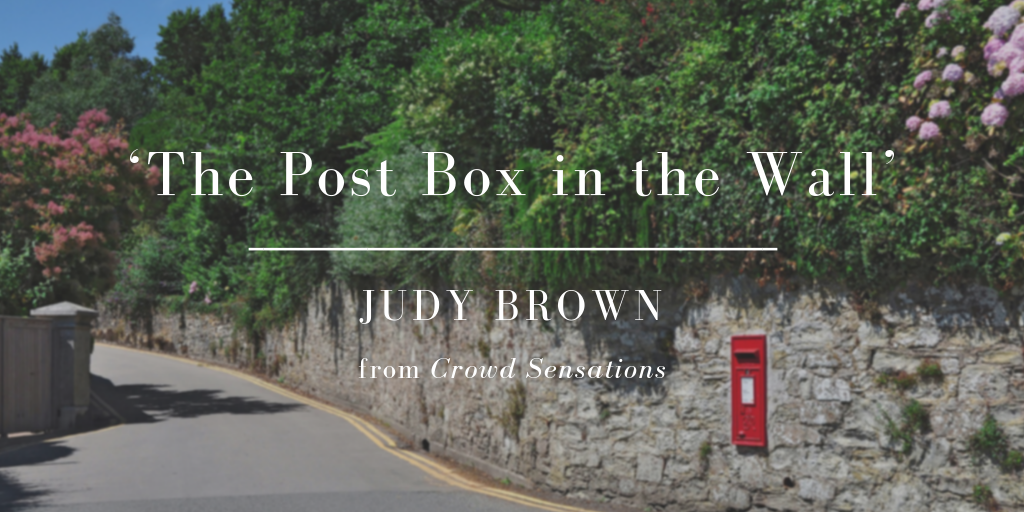
Our Friday Poem this week is ‘The Post Box in the Wall’ from Crowd Sensations by Judy Brown.
 Crowd Sensations is Judy’s latest collection, and was shortlisted for the Ledbury Forte Prize. Judy is a poet of dazzling contrasts, of thoughtful paradox, intimate confidences and precise evocations. Her titles and first lines both draw you right into a poem and then quite often surprise you with a narrative that you hadn’t quite expected. This is true of ‘The Post Box in the Wall’, which takes this mundane object and paints it as ‘absolution’, as ‘that mouth’, as a place to deposit snakes and curses.
Hear Judy talk to Julia Copus about changing career from lawyer to poet, writers’ residencies, and how certain places can live on in the mind long after they’ve been left in this interview, newly released on the Royal Literary Fund website.

Crowd Sensations is available from the Seren website: £9.99
Create your free Seren account and enjoy 20% off every book you buy from us.

This September, you’re invited to explore the unseen and the unsettling. From dark and menacing landscapes to the everyday terrors of domestic settings disturbingly close to home, these stories will horrify and delight in equal measure. Be prepared, for ‘this is a land of ancient power, and even more ancient beings...’ Pre-order the latest addition to our Welsh Gothic series, ‘Giving the Darkness Life’ on our website now.
.
Stories by @markblayney1, Mary-Ann Constantine, @damianwalforddavies, Caradoc Evans, Dorothy K. Haynes, @lucie_mckhardy Arthur Machen, Elinor Mordaunt, John Llewellyn Probert, L.T.C. Rolt, @priyasharma1000, Edward Thomas, Elizabeth Walter and D.P. Watt
.
@inpressbooks @books.wales #WelshGothic #SerenBooks #NationalYearOfReading2026 #SpookySeason #AutumnBooks

We had a wonderful time listening to @megan.c.hayes talking about her memoir ‘Glimmering’ with Kath Little from @bardic_books at St Illtud’s church in Llantwit Major on Saturday. Diolch yn fawr to everyone who joined us and to Kath for hosting! Copies of ‘Glimmering’ are available now in your local bookshop.
.
#Glimmering #Memoir #SerenBooks #IndependentBookshop #NationalYearOfReading2026
Ebooks available now! ‘In Search of Sea Dragons’, ‘Muslim Wales’ and ‘The Waters That Raised Us’ are now available from all major ebook retailers meaning you can take them with you on the go 🎉 Do you prefer reading ebooks, print books or both?
.
@severn.sea.fossils @azimwales @tayloredmonds #Ebooks #Kindle #SerenBooks #BooksFromWales #LoveReading
🏆@maggiepoet continues her winning streak having won the Guyana Prize for Literature Poetry Award with her collection ‘I Sing to the Greenhearts’! Available now in bookshops nationwide and on our website!
.
#AwardWinning #GuyanaPrize #Poetry #PoetryBooks #SerenBooks


