Posted on

Short Story of the Month | ‘Flowers’, Emma Timpany

Flowers Short Story Emma Timpany

It’s World Book Day today and we have a new story for you to enjoy – Emma Timpany’s ‘Flowers’ is our Short Story of the Month.

‘This is the place: four fields in the shape of a rough parallelogram…’

Searching for a space to plant the seeds of her flowers and, indirectly, her future, a woman forges a subtle bond with a man undergoing his own struggle.

Emma Timpany grew up in Dunedin, in the far south of New Zealand, and now lives in Cornwall. She has a lifelong love of short story form. Her first collection, The Lost of Syros, was published in 2015. Her short stories have won three awards, including the Society of Authors’ Tom-Gallon Trust Award, and have been published in literary journals in England, New Zealand and Australia. She is co-editor of Cornish Short Stories: A Collection of Contemporary Cornish Writing and author of the novella Travelling in the Dark.


Flowers

This is the place: four fields in the shape of a rough parallelogram. On her left, one part of the closest field is enclosed behind wire mesh. A path runs through long, wet grass towards a gate in the fence. Ahead of her is an open-fronted barn with a caravan parked inside it, a chimney rising from its roof.
She cannot see anyone. She is about to leave when, looking again, she notices a figure kneeling inside the fencing.
She walks over but he does not seem to know she is there. He wears a suit, some kind of woollen weave, not tweed.
Hello.
Hello.
He is young, younger than her. He stands and wipes his hands on his clothes. His hair is flat and yellowish. Despite his smile, his face is the wrong kind of white. He has been ill. Is still ill, perhaps.
Rachel said you wanted someone to grow flowers.
Yes. He shakes his head as if confused. I only just woke up. I still have to sleep a lot. But I remember now.
She doesn’t know what to say. She doesn’t know what she was expecting but it was not this.
Are you cold? he says. It’s cold today.
And bleak, she does not say, this place is bleak.
Let’s have some tea.
The barn smells of dirt and straw, the caravan of damp. His bed is a heap of sleeping bags and blankets; the cups are stained with a thick layer of tannin. Roll-up butts huddle, crushed together in a jar lid.
Sit down. Here. He moves a pile of books from a seat. Rachel said you were a florist.
Well, yes. Sort of. I never meant to be. It wasn’t what I wanted.
He lights the camp stove, rolls a cigarette.
My family were. Florists, I mean. My grandfather lost his job in the Great Depression. Five kids and nothing to eat. So my grandmother started growing flowers. She doesn’t know why she is telling him this. She doesn’t tell anyone this. She shakes her head.
I don’t have any biscuits.
It doesn’t matter.
I only have goat’s milk. Is that okay?
Yes. She has never drunk goat’s milk. That’s okay.


It is raining. In her mind the earth has a red tint but now she sees that, under the rain, the soil is deep brown, black, almost. He has laid out some beds within the wire mesh, six rectangles of soil. The fence is to keep out the rabbits which will otherwise eat everything.
Look. He points to a line of feathery green leaves. I planted them in December and they’re up already.
Are they a type that grows in winter?
No. I was late putting them in because I was in hospital. All this should have been done earlier, in the autumn. This soil must be good soil.
It looks like good soil but she will not know until she starts to work it. The rain is heavy now, too heavy for her to begin.
In the shelter of the barn, he shows her rows of tools. Most are old but some are new, their dull, silver light an oddity amongst the rest, the well-used and the worn.


The next time, there is no sign of him, though she scans the field for a crouched figure in suit. Inside the barn, still air that could mistakenly be called warm but is only the cessation of wind. Through the caravan window, she sees him curled up on his side, blankets heaped around him, holes in the bottom of his socks.
She climbs over the rabbit fence and puts a bin bag, filled with bags of bulbs and packets of seeds, down by the side of the bed of freshly dug earth he indicated, last time, that she could plant. Returns to the barn for tools along the path of beaten grass. Begins to mark out a row.
The rows of vegetables in the neighbouring beds are all perfectly straight. By contrast, the trench she has made wavers. She goes back to her row and tries to even it up, mentally making a list of the things she will need – bamboo poles, string.
The soil smells slightly of iron, of leaves. Small stones appear occasionally but it has a lightness to it. She opens a packet of bulbs – tulips – and looks at them in the dim light. It is three months past the optimum time to plant them. She bought them cheaply from a local discount store but they look in good condition, a bright brown, shiny sheath on the outside of the pure white bulb. Plant at twice the depth of bulb. She lays them out fifteen centimetres apart then covers them.
The beds are larger than she thought. She adds sawdust to the list in her head. The last seeds she plants are poppies. Light, tiny, they are indistinguishable from the soil as soon as she sows them.
You’ve been busy. He is wearing an old oilskin over his suit.
Yes.
What have you been planting?
Bulbs, she says. Seeds. She fumbles for the packets and hands them to him. Her jeans are soaked from where she has been kneeling.
These are nice. He holds the empty poppy packet.
They were free. I wouldn’t have bought them. Because the flowers only last a day or so. Still, I can use the seed heads.
That’s a shame. About the flowers.
It’s often the way. The most beautiful don’t last.
He is looking at her rows.
I should have made them straight. Next time I’ll bring some string.
I’ve got some. Poles and string. Didn’t you see them in the barn?
No.
Before he got ill, he tells her, he was a set designer. Now he works on the field. The quiet here, the growing things. It is his way of making himself better.
Look, peregrine.
She does not want to look but, raising her head, she follows his finger to where the bird flies through veils of rain.
We should go in. Shelter from this. Do you want tea?
No, thanks. I’m soaked. She is cold now, having been still for so long. The thought of sitting in the caravan is not a pleasant one. I’ll be back next week.
She knocks mud off the spade and fork and carries them back to the barn. He opens the caravan door; warmth from the camp stove drifts out. Condensation fogs the windows. He is smiling at her, and she wonders what he is going to say.
Could you bring some milk when you come next time? I can’t have dairy. Goat’s milk. Or soya.
Sure, she says.
Back at the car she takes off her gumboots, her soaking coat, and loads them in the boot. Strips off her jeans and wraps her lower half in a blanket. Drives home that way.


From the highest point, where she now stands, and the high point opposite her, the land creases down, as if it has been folded on the diagonal, into the corner farthest from her. Because he is working near the bottom of the crease, it is hard to make out what he is doing.
She has forgotten the milk.
It has already started to bother her that it is his soil, his earth, his rules. That she is merely scratching, borrowing a few centimetres of surface. And yet she cannot imagine belonging to this place, it being hers. It is not what she would choose for herself. It is too high, too exposed. The jumbled boulders of the carn seem, at times, a reflection of her confusion. And then there is the cold, a deep earth-and-stone cold, the kind that gets in your bones. She wonders again what is wrong with him, what was wrong with him.
The quiet, though, also has a way of its own. In the way her life is away from this place, it feels like nourishment. Every action she initiates proceeds, un-thwarted, until it is complete. No-one else to consider except for the too-thin man she sees out of the corner of her eye.
She is planting Liatris spicata. The bulbs are dark, knobbly, a light hair of old, dried roots on their bases. Their hairiness reminds her of sea potatoes, found on the nearby beaches at low-tide. When she looks up she notices two parallel rows of bamboo canes, joined at their apex, stand in one of the beds.  Supports for beans, perhaps, or peas. Everything he does out here, in the beds, is so neat. But it is not neat in the barn or in the caravan.
No rain today but it is cold. Smoky-yellow light crouches at the edges of the sky. Next, she plants a row of Camassia leicthinii, a cultivar of quamash. The bulbs are white and smooth, small green shoots already sprouting from their apical points. It is far too late to be planting them. She tries to think of May, when these bulbs will produce long, straight, green stems, and then star-shaped flowers, blue and cream.
She hears the soft sound of his boots on the grass.  As she turns, reluctant to stop her work, she briefly wonders what he thinks of her. Her neck aches, so she rubs it.
More bulbs.
Yes. Look at these. She lifts an Eremurus stenophyllus tuber from brown paper, holding towards him the flat disc with leggy roots, like the dried limbs of a once fleshy spider.
And they’ll stay in the soil? Or will you lift them?
No. They’ll stay. They form clumps. Bulbs like these, perennials, reproduce themselves asexually. Clone themselves, basically. So you get more flowers year on year.
This seems to surprise him. She has no idea what he knows or doesn’t know about flowers.


The next time there are lots of people at the field. It takes her a while to find him. People talk to her, seem interested in what she is doing. They tell her things about the man who owns the field, assuming she knows more than she does. Without her prompting, his secrets spill out on the grass. They all seem excited by the fact that their friend has this surfeit of space. Many of them live on boats, in vans and caravans squeezed into corners of fields, fringes of towns and villages.
She sees him in the distance, reassesses his age down a notch and then down again. How aged he is by illness, by the experience of illness. It makes him more like her; it is the bridge that links her on one side and his friends on the other.
She has found out, quite recently, that her brother has been lying to her. For years, he has stolen from her, from the joint assets left to them by their parents. He calls what he did an act of love. It is not love. There is a chance that she will lose her house, lose everything she has worked for.
The friends start dragging dead wood into a circle. Some-one sets light to it. Bottles appear and a keg of beer. She plants Nectaroscordum siculum, an onion-paper fine sheath over its bulbs, which will one day be a handful of purple and green striped bells dangling from a wiggly stem. By the time she finishes, darkness is come. She looks over to the circle of light. The flames give his face the colour it normally lacks. She catches a glimpse of how he must have looked and how he might, perhaps, look again one day.


In the weak sunlight, the green tips of the first bulbs she planted poke through the earth, cast tiny purple shadows on the soil, and she sees what he has described to her but she has never really believed. There is a view of the sea. Distant, complex with lines of trees and land in the foreground and further back a skewed triangle of mint green water, a violet horizon.
Tomorrow, February tips into March. In the soil she finds a lime green grub, curled and sleeping. More seeds have broken through the earth; tiny as watercress, they tremble as if exhausted by the division of their first leaf into two. In the hearts of the hyacinths, flower spikes push upwards.
She knocks on the caravan door. No reply. She opens it, pulls a pint of goat’s milk from her pocket, leaving it on the floor where she hopes he will see it.
The goat’s milk was fresh today 28/2. See you next week?
She is annoyed that she brought him milk and he isn’t here. But she is also pleased. Words have stopped, are trapped inside her. She does not want to talk. She wants to plant flowers, row and rows of flowers, and wait and watch and tend them as they grow.


Thank you for the milk.
I didn’t bring any today.
What are you planting?
Lavender. She has bought plug plants and potted them on, hardened them off in her courtyard garden; against the vastness of the field, they seem tiny. She plants them through a layer of weed matting, cutting crosses and slotting one plant into each gap.
How long will they last for?
They’ll grow and get bigger for about ten years or so. And then they’ll die off.
As the day ends, she hears the sound of cars, footsteps and voices echoing down the track, the clink of bottles. The friends build a fire with new, dry boughs. They distract him, keep him busy, talking. In the fading light, he shifts from old to young, young to old.
Her back aches. She tidies her things and looks at what she has achieved. There is little to see; the bulk of her labour lies beneath the surface of the soil.
The sky is a serious blue, which means darkness is not far away. Through the still air she hears the sharp crackle of flames and smells dry wood burning.


Today she plants the last of the bulbs, some alliums, the Triteleia laxa, and the sweet pea seeds, pre-scored. The poppies and the cornflowers are through. The love-lies-bleeding. The soil is warming. The irises have produced grey, strap-fine leaves. A violet ground beetle scuttles away under her hand. An idea, a question, a friend of a friend – all of these things have led her here. Now, the hyacinths are opening. As she cuts through their thick, sappy stems, washes the dirt off the leaves and lower flowers, the few open bells release a clean, sweet scent.
He has also been planning and planting. She has helped him to lift off turf and peel it back, in preparation for a second row of beds.
The weeds have started to grow; the perennial buttercup, its net-like roots spread horizontally, is particularly hard to shift. She tracks the white roots of dandelions, zigzags of light in the dark soil, their wounds leaking a milky sap.


He digs for a while and then he stops and coughs. Whatever is wrong with him is taking its time to give up its hold.
He has gone to drink water, hand resting on the tap until the coughing eases. His clothes still hang on him like the clothes on a scarecrow. When was he last well? When did he last live in a house? She considers this coldness, rising from the earth, his enemy. She thinks he does not do enough to protect himself against it. How can he become better if he is not warm?
How will he get better if he drinks from filthy mugs?
He has seen her looking at him and now he beckons her. She climbs over the fence, her shoulders tense.
He points to a new ridge of earth by the side of the barn. From here she can see thin sticks are planted in it.
Willows, he says.
They’ll grow big.
I know.
Why here?
Because this is where the house will go.
You’re building a house?
One day.
To live in?
Isn’t that why most people build houses?
I thought…But she doesn’t know what she had thought.
He begins talking about dwelling rights, planning permission. The house will be built out of straw bales, with wool as insulation.


She cuts the Camassia leicthinii ‘Alba’, secures five stems with a rubber band and drops them in a bucket. The alliums are ready, tall Gladiator and the squat lavender starburst of Allium christophii. Once they are all cut and bunched, she moves them into the shade. Dahlia tubers lie in the trench. She covers them with soil, then plants sedum around the edges of the bed, a type with purple-black leaves and, come September, small, hard, ruby flowers.
She is beginning to realise that he did not think she would plant anything permanent. He expected that she would grow flowers from seed and harvest them, an annual crop. There has been this miscommunication right from the beginning, probably the result of her reluctance to talk, his assumption that flowers were grown in the same way as vegetables.
She tells herself it does not matter. Everything she plants, with a couple of exceptions, can be dug up again and moved. Like people, flowers travel: transplanted with care, they usually manage to re-establish themselves, to put down new roots.
Twice in her life she has tried to run away from flowers, the first time from her family’s floristry business, the second time when, out of necessity, she worked as a florist in London. Yet here she is, back among them. They follow her, it seems. Or she, unwittingly, unwillingly, follows them. They present themselves to her as opportunities, the only options.
She knows their common and Latin names. Some have been her companions since earliest childhood, their names learnt alongside her own; they have always been amongst the most important inhabitants of her world. The flowers she grows, that line up wonkily behind her back like a beautiful army, are not as delicate as they look. They are survivors.
She is ready to go. She walks over to where he is working, beside the willow bank.
Goodbye, she says.
I’m going to get a digger in, to grade the earth flat for the house, he says. I’ll get them to scoop out a pond while they’re here.


I brought you some milk, she says.
Come and see the pond, he says.
A shallow basin has been scraped out below the flower beds, the excess soil tipped at the southerly edge, building it up into a bank; the effect is pleasing, as if the far lip of the pond were somehow floating above the lower parts of the field.
In her childhood garden, there was a stream, dividing the formal beds around the house from the secret spaces of a stand of native bush. A simple bridge, arch-backed, connected the two worlds. She remembers what it was to paddle in that stream, the little beach of pale gold gravel it left before it exited the property, edged by a rustling screen of bamboo.
So water, yes.
Nothing exists without water.


So many things are flowering: Liatris spicata, Eryngium planum, nigella, cornflowers, sweet peas. She comes early to cut the flowers, weeds a little, covers the soil in mulch to stop it losing moisture to the sun and is ready to leave by midday.
When she hears the caravan door open she looks up, expecting to see him, but a woman emerges and walks towards the standpipe to fill the kettle.
Hello.
Who are you? the woman says.
I’m the one who grows the flowers.
He comes out of the caravan, rubbing his hair.
When you’re finished, can you give Jo a lift back to town? he says. Are you finished?
Yes. Pretty much. Just tidying up.
We haven’t had breakfast yet, Jo says. We haven’t even had a cup of tea.
You can have breakfast when you get home.
Are you trying to get rid of me, Jo says, before I’ve had a cup of tea?
Of course not, he says. I’ll make you some tea. Would you like tea?
No, thanks, she says. I’m going soon. But I brought some milk.
As she carries the flowers to the edge of the track, Jo sits on one of the benches by the fire circle and talks to her. The things Jo says are funny in a pithy kind of way. She’s pretty, too.
He brings out two mugs of tea.
I’m off now.
Do you mind giving Jo a lift?
Not at all.
I think I’ll spend the day here, Jo says, stretching and looking around. It’s going to be a beautiful day.
Do what you like, he says. But you should know I’ve got work to do.
Don’t mind me. Jo lies back on the boards, folding her hands over her ribs, shutting her eyes. I’ll be just fine.


The pond water is pale bronze, the suspended particles of soil in it yet to settle. He is wading, thigh deep, forearms immersed, planting marginals below the surface. The scent of water is softly mineral, a note of freshness amongst the dry grass and the dust.
Flower buds form on the tiny lavender bushes; the leaves of the sedum are dark as wine. What is winter? Its memory lies in the earth, beneath the bark of the shrubs, the trees. It lies in leaves which tremble in the light. It lies in pollen, gold and grey, the bees collect and carry with them from flower to flower.
When she looks over to the pond again she sees him floating on his back, arms and legs splayed out, five-pointed as a fallen star.


Years later, on the day she comes to dig up the last of the flowers, he is not there. He has gone to work in Greece for a while, Jo tells her. On a sustainable building project.
Jo stands in the doorway of the house made of straw. I’ve got a flat in a proper house again, she says. I’m moving on, too.
The wool they’d used as insulation had been full of moth larvae. They’d had a massive infestation, as well as trouble with mice.
What sort of trouble with mice?
They were falling out of the ceiling onto my face, Jo says, while I was asleep.
What can be done?
Jo shrugs. Perhaps the moths have got into the straw. Perhaps the house will have to be torn down, and they’ll start again somehow. He’s gone away to have time to think things through.
Time to think. She had had it, in the hours that she spent here on her knees, eyes on the ground, hands in the good earth.
The willows he grew from sticks reach above her head. The lavenders have filled out from tiny plugs to dense, thick pads. They will remain, along with some other plants that are difficult to shift. Though she tries to lift them carefully, she is bound to miss some bulbs. After she is gone, they will put up their heads each spring, aiming for the light.
Will he think of them as a nuisance?
Or a gift?
Five years on she has managed to reclaim most of what was lost. Now she is moving to a new house with a garden big enough to hold all these flowers.
She walks over to the pond. On its green-grey surface, water lilies float, white and cream and copper-red,  stands of sedge and flag iris softening its edges, and she feels it, as she felt it when she was a child, flowers all around her: a sense of dissolution between here and now and whatever lies just out of reach.
Here.
All that has filtered down into the darkness has given life to flowers that open like a hand; in the centre of each a deepening of colour, which she can hear as if it were a sound.

Nothing exists without water.

She thinks of him and knows that he is well.


View the Short Story of the Month archive here


Posted on

Short Story of the Month | ‘The Walk’, Jonathan Page

Jonathan Page The Walk short story

Our new Short Story of the Month is ‘The Walk’ by Jonathan Page.

After the anniversary of his lover’s death, a man walks purposefully along a familiar hillside path and ruminates on the relationship that has come to define his life.

Ten years have passed since he bid farewell to the woman, the artist, he loved so dearly – and as her life and the last of her works become public property, he finds himself resisting calls to give up what little he has left of her.

Jonathan Page lives in Bronllys, close to the Black Mountains. He works as a senior technical author and writes literary fiction in his spare time. Jonathan was the winner of the Earlyworks Press Short Story Competition 2015 and the Earlyworks Press Flash Fiction competition 2017. His story, ‘The Hill Farm’, took second prize in the ShortStory.net Competition 2016. His stories have appeared in five anthologies between 2016 and 2017. His current project is Century, a novel of closely connected stories that spans a hundred years in a Welsh border town.


The Walk

This is an extract. Read the full short story for free on the Seren website.

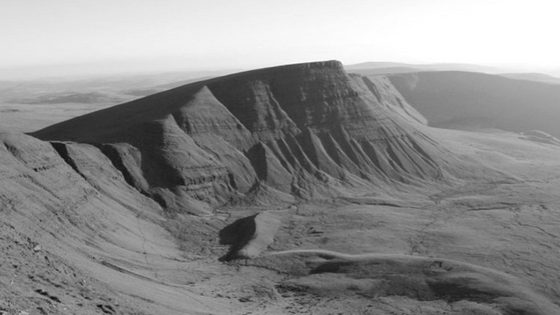
John walks a path in the sky. The world falls green away, severe and pleasing in its scale. The soft dissolved fields are as far away as the sky. Cairns stand at intervals on the ridge.

He is full of love for this place. A skylark sews the air over the long drop, like a message to him, like something he should carry home for translation. The light blooms in the long grass and rocks cascade down the steep sides of the hills in suspended glittering motion. The rocks look like coal dust pitched from the end of a spade.

Every time he comes up top it feels new to him. The lark singing in plain sight. The way a rock carries the light on its back. But what do you tell people when you come down again, what can you say. You talk about a rock and a bird and you drift over your pint into more solid matter about the state of your legs or the path or the weather. Your pictures go unseen by others, as they must, as is their nature.

Pictures. His pictures began here.

His longing for Rose overtakes him and he sits on the ground with his hands about his knees. His first paintings were muddy things. He ridged the paint like he planted potatoes and cut paths with his palette knife. There was nothing wrong with them, they sold, but they were wrong. They hid what he wanted seen.

That was when, seventy-six? Rose had been painting a long time. Her pictures were sparse, a few lines and she was done. She smiled at his piles of unvaried muddy panels. Then she took him up here to walk and draw, though there was no intention to change him. He had lived in Llanandred all his life and never come up.

After those first walks he made simpler paintings using reds and golds and blues, the colours and strong architecture of the high moor. They came from his experience of a place and he was no longer so ashamed to draw from it. He had been a teller in a Bank the year before and it was hard to believe he was any good. His father did not think pictures proper work. He thought he shirked. He thought it a phase. He thought it sex.

John closes his eyes and sees Rose’s hand  – the skin thin and soft over the bones in her hand – cover his. The tickle of the air is the hover of her hand over his, about to rest upon it. Maybe the old bastard was right about the sex.

He goes on all fours, his bottom in the air, to help himself get up again. Part of him wants to stay where he is, sheltered by the small cairn and warmed by the sun. His bones are getting old. For a moment the path ahead intimidates like stairs in early childhood.

Come on you lazy sod.

Critics and dealers were always coming to the chapel to see Rose. He saw something switch off in their eyes when they learned the paintings at the back were his. She was the One they came for, the famous Rose Hartwood. If they praised his work it was to please her. If they asked him what he did and what he thought and what he liked it was to please her. They were not unkind, not unperceptive. He was her lover and her assistant, an anteroom they must pass through.

He did not mind. He did not begrudge. Without Rose he would never have left the bank.  Without Rose he would not have found love. Her work besides was extraordinary. She reinvented her work constantly and whatever she did worked. Besides he was still young – youngish – and assumed there would be more for him. He took his hunger to succeed for satisfaction. He took the dead eyes of the critics as proof that his work was truthful.

Later he found himself a footnote in articles and books. The writers and academics milked him for stories of their life together. The age-gap titillated and repulsed and sex was always on their minds when they talked to him. He was a means to an end, an aspect of Rose’s psyche.

A Rose by any other name.

When did he stop painting? Eighty-four or eighty-five, whenever Ted Brentwood’s biography came out.  Rose hated that book. It was a fiction, lies. She hated what he had made of her, what he had made of both of them. Still it secured her legend. It got her commissions and kept her in the public eye. It was glamour of a kind, to be Rose’s lover.

He could not make paintings nobody saw. They were props for his walk-on role. When he looked at one of his paintings his saw a shut door.

John stands on a peninsula jutting out into the flat below. The cairn he uses to shield him from the wind is spiky with slants of greenish rock and the light burns low on the opposing hill. The sun pulls reddish browns and slate and three or more kinds of green out of its rounded forms. One minute the hills are as severe as a vast falling wave, the next all curves.

He sees another walker on the slope opposite, a miniature red upright on the zig-zag path. John raises his hand and he sees the red figure pause and raise its hand to him.

John is nobody without Rose. The figure – a man or woman he can’t tell from here – may be the last person he ever sees.

Continue reading ‘The Walk’ for free here.


Posted on

Short Story of the Month | ‘Dolls’ Hospital’, Christopher Morley

Our new Short Story of the Month is ‘Dolls’ Hospital’ by Christopher Morley.

A young boy’s persistent curiosity sets him on an adventure to the mysterious Doll’s Hospital, in which he learns that not only dolls need mending.

Christopher Morley was born in Nottingham in 1946.

He is a retired primary school teacher, a fine artist and short story writer.


Dolls’ Hospital

This is an extract. Read the full short story for free on the Seren website.

The Dolls’ Hospital was at the top of Alfreton Road near to Canning Circus. I had been aware of it ever since we had taken to visiting friends at Bobber’s Mill. It was necessary to catch a trolley bus, and the stop was almost outside the Dolls’ Hospital. Waiting for the trolley bus gave me enough time to gaze at the window display. The Hospital was a shop front of one large window, a recessed entrance and a much smaller window. Boards obscured the interior of the premises but afforded shallow display areas. On display were mostly dolls and teddy bears. Some were bandaged or had an arm in a sling. One teddy with a leg in plaster was propped up on a crutch. Some dolls wore old fashioned nurses’ outfits and tended patients in shoe-box beds. The main fascination for me was the small group of lead soldiers that represented the Army Medical Service. A wounded redcoat was being carried by blue tunic stretcher bearers towards a Florence Nightingale figure waiting at the entrance to a white medical tent. I wondered if there were more soldiers to be seen inside, but the Hospital was never open when I was there. There was a notice on the drawn down door blind that said that the hours were 9:30am to 5pm, with a lunch break between 12:30 and 1:30. Also the Hospital was open only Tuesday, Wednesday and Thursday. We visited our family friends on Saturdays. Anyway I didn’t have an excuse to go inside because I had no dolls that needed treatment, and I would never dare just go in for a look.

~o~

Mrs Hilton said that it would be nice to hear some diary entries read out. I shrank down hoping I wasn’t chosen, not because I couldn’t write or because I was nervous of reading aloud. I never seemed to have anything suitable to write about. Playing at soldiers and going to the cinema with my parents seemed so commonplace. Julia Billington was eager to read her diary. It was a sad account of her pet Chow-Chow who chewed off an arm belonging to her favourite doll. I sat up. I resolved to speak with her on the way home.

I caught up with Julia and Lorraine. Lorraine glared at me when I broke the rules and spoke to Julia. Julia beamed and listened.

‘You can get your doll’s arm mended at the Doll’s Hospital.’

When I told her where it was her ready smile faded. She had no idea where Alfreton Road was, and her parents wouldn’t let her go far without a suitable escort.

‘I could take you next week, it’s the holiday.’

Lorraine’s eyes bored into me. Julia resumed her smile and agreed to meet me at the bus terminus opposite her house on Tuesday to catch the 9:40 into town.

~o~

I fretted about this adventure all weekend, but was reassured when I saw Julia waiting beside the Number 19 with a parcel under arm. We sat downstairs on the left so as to be ready to get off. She peeled back the brown paper enough to show where the missing arm should be.

‘I told my Mother I was going to play with Mickey Hazeldine. What did you say?’

‘Oh, I said I was going to look at new dolls in Beeston with Lorraine. I’m allowed to go to Beeston if I’m with a friend. Lorraine’s really gone to her cousin’s.’

‘Tickets, please.’

The conductor was looming with his ticket machine. It was the one that my Mother said was lairy. He certainly was full of himself.

‘Two halves to Canning Circus, please.’

He grinned as he wound out the tickets, ‘Family outing is it?’

‘Yes,’ replied Julia, ‘We are taking baby to the hospital. She’s got polio.’

The conductor backed off. Julia was quick. Being a redhead she had had plenty of practice batting off silly remarks.

We got off just after the Drill Hall where the Territorial Soldiers met. It was only a couple of minutes’ walk around Canning Circus to get onto Alfreton Road. As soon as we turned the corner we could see the sign for the Dolls’ Hospital standing out from the wall. It was just about ten o’clock. There was a light on in the Hospital, much to my relief. The door pinged when I pushed it open.

Continue reading ‘Dolls’ Hospital’ for free here.


Posted on

Short Story of the Month | ‘The Visit’, Jaki McCarrick

The Visit Jaki McCarrick Short Story of the Month

May’s Short Story of the Month is ‘The Visit’ by Jaki McCarrick, an award-winning writer of plays, poetry and fiction.

the scatteringMcCarrick won the 2010 Papatango New Writing Prize for her play, Leopoldville, and her play Belfast Girls, developed at the National Theatre London, was shortlisted for the Susan Smith Blackburn Prize and the 2014 BBC Tony Doyle Award. The Scattering, from which ‘The Visit’ is taken, was shortlisted for the Edge Hill Prize.

‘The Visit’ takes place against the backdrop of Bill Clinton’s visit to the border town of Dundalk in Ireland – a visit that was very much a part of the Peace Process. 


The Visit

This is an extract. Read the full short story for free on the Seren website.

It had been a day of weather: snow and wind, sunshine and rain.
Water dripped from the overhanging hedges in the drive and
the path was thick with pine needles. Brendan made a mental
note to sweep them up once Pat had gone. He stopped before
the gates and pulled his trousers up by their creases to check
his shoes and thought that maybe he should’ve worn his boots.
He walked on. Pat would make him forget. Pat could make you
forget all kinds of silly woes. He glanced over at Coogan’s and
noticed the stars and stripes flag, still and wet on the pole.
After McCaughey’s he looked over at Joy Callan’s neat line of
laundry crowning her raised side lawn: a small satin-rimmed
blanket, black stockings, two blue ballroom gowns, a pair of
orange nylon pillowcases. As he approached her house he saw
her in the yard, bright and chic in pink slacks and a tight white
jumper. She was raking up leaves. He watched her part the
dresses then yank the wet leaves into a pile. It made him smile;
she might have hung the gowns out after she’d raked, but Joy
always seemed to do things differently from others. And anyway,
he was glad, because she made the task so mesmerising. He
recalled how after her husband had gone she had kept body and
soul together by moonlighting, rather originally he thought, as
a mushroom picker in Clones. Otherwise, as a relief teacher
she had taught both his children in the Friary, though she had
not been popular. He waved and wondered would she be at
the Square tomorrow. He made a mental note to call in one
of these evenings with the picture of Sean’s wedding in the
paper.
Walking on, his thoughts returned to Pat. He looked forward
to seeing him. There would be much talk of the ‘great
adventures’ as Brendan called them, the London times, the days
of the Black Lion where he had been manager for nearly a
decade and where Pat had been its most notorious barfly. He
was proud to think he’d organised some of London’s most
celebrated lock-ins, booked musicians from Dublin and Doolin
and Donegal, and had the likes of David Bailey and Donovan
in attendance. Soon he and Pat would be reminiscing about
those times, about the dog races at Hackney and White City,
the times they’d played poker in Holland Park with Jack Doyle.
He walked up the cobbled lane towards the station. He could
see clearly on the cold day the sprawl of the town towards the
hills. The trees by the church were draped in ropes of white
lights, and a flurry of flags hung from Carroll’s Apartments. He
was amazed to think that here, in this small dot on the face of
the globe, he and Pat would stand together tomorrow evening
and see the President of America.
The big station clock said ten to three. He had a few minutes
yet to gather his thoughts, stare over at the glass wall of the
brewery. He sat outside on the iron seat. The gulls hovered
above him, filling the air with their cries. The sweet wort’s more
pungent today, he thought, as his gaze fixed on the huge copper
kettle glistening through the glass. It had been his first job in
the brewery to wash the kettle out once the sweet wort had been
siphoned off. He would then prepare it for the following
morning’s shipment of hops and grain. He had spent the best
part of five years inside that copper drum, up to his ankles in
the remnants of fresh hops, proteins and sticky clumps of
caramelised sugar. It had given him time to think; to put into
perspective all that had happened in ’74.
There was a rumble on the tracks. He turned and saw the
sleek green body of the Enterprise stack up like a metallic snake
along platform two. He walked over and watched from the
ticket office. The doors of the carriages swung open. Women
with pull-up trolleys, young men in dishevelled suits, Mrs Little
and her daughter, Edel. As the crowds dispersed he saw a ghost,
the tall, hulking frame of Pat Coleman standing stock-still on
the busy platform. The springy hair was all white, the once firm
chest now visibly lax. Brendan watched his friend remove a
cigarette from behind his ear, ask a girl for a light, then take
three or four concentrated puffs before flicking the stub behind
him onto the tracks. Pat’s short-sleeved shirt seemed frowsy
and unironed; the thick brown arms with their blue tattoos
recalled to Brendan Pat’s nickname on the sites: Popeye. Popeye
Pat had had the strength of ten men, and once, in a drunken
rage, Brendan had seen him flatten as many.
He followed Pat’s gaze. Up to the pale, elusive sky of the
North; out to the striking sweep of the white-capped hills, the
green spire of the Protestant church peeping up against them.
He began to feel unfamiliar pangs of pride for the town, as if
through Pat’s languorous impression, he, too, was glimpsing
it for the first time. The town was his wife’s town, and he had
always found it hard to appreciate its people with their
wariness, their industrious, practical approach to things. His
wife had been right; he had put up a resistance. She had
accused him often of hiding away in the brewery kettle like a
genie. But the friendships he had formed here had been
without the closeness of his London bonds. The men he knew
from the town were nothing like that famous man on platform
two.

Continue reading ‘The Visit’ for free here.


Posted on

Short Story of the Month | ‘Beginning Again’, Candy Neubert

Short Story Beginning Again Candy Neubert

Our Short Story of the Month for March is ‘Beginning Again’ by Candy Neubert.

Cornish Short Stories

The story will shortly be published in Cornish Short Stories: A Collection of Contemporary Cornish Writing (The History Press).

Candy Neubert lives in Cornwall but maintains strong ties with South Africa where she lived from 1990–1996. She has received numerous literary awards, including the Bridport Prize. She is the author of Foreign Bodies (Seren, 2009) and Big Low Tide (Seren, 2012).


Beginning Again

This is an extract. Read the full short story for free on our website.


She was coming straight up the beach towards him.
Through half-closed eyes, his head propped up against his rucksack, he watched her come. In silhouette at first, the kind of shape you just knew wasn’t English, couldn’t be English, but you couldn’t say why. Hair plastered back slick and wet off her face.
She came right up and stood over him, flicking water over his hot skin. Hey, he laughed. She lifted her towel, shaking it out like a sheet over a bed, lying down with a grunt.
He felt the cool coming from her, saw tiny droplets drying on her neck—Sonya, his mate, his life’s woman.
“Mm … now I’m hungry,” she said, not opening her eyes. He was, too. He sat up slowly, sun dizzy, and reached into the rucksack. Here it was, the container she always filled to the brim—he raised a corner of the lid and out came the smell of food, olives and onion and … just then he woke up, as the small figure of the boy crossed his line of vision, still quite far off, heading his way.

        The path went straight up from Porthcurno and he took it two steps at a time. Not really steps but boulders and cliff straight up from the car park, just the way to get going on a cool morning. They’d soon be warm and the mist would clear; it was only a sea mist. He positively sprang all the way, pretty fit for a business man, an office chap.

        When the path levelled out, he waited for Daniel. It was an inviting path, gorse on either side, beaten earth sprinkled with rabbit droppings, gulls laughing overhead. But he kept still and waited patiently. He was so effing patient. But Daniel wasn’t in sight.

        Finally.

        If shoulders could talk.

        If shoulders could talk, the rucksack on Daniel’s back would shrivel up and die. As if towels were heavy. Bulky, yes, but not heavy. He should try the picnic, if he wanted heavy.

        Also, Fuller had the surfboard, which was fair enough; his arms were longer. But Daniel was young and strong. They did sports training at school, didn’t they?

        The boy climbed the last bit and came to a halt five yards away, his eyes fixed on his shoes.

        Patience, mind. Fuller held his tongue and set off again. A fresh scent came from the pink flowers in the grass under the gorse, while the mist ripped back off the cliffs before his eyes—what luck, when it might have come in thick and spoiled everything.

        They did sports training and next year Mandarin, of all things. He asked Daniel about it yesterday, about the new school. The boy made a face, sticking his tongue over his front teeth. They’re all tossers, he said. He’d wanted to go to a school in Devon where they taught tractor driving.

        But they were going to have a day today, a great day. They were here, damn it. The sun was coming out and everything was sorted.

        A kestrel rose and hung in the air, over to the right. Fuller put his fingers in his mouth and whistled, and the boy raised his head.

        ‘What?’ he yelled.

        ‘Kestrel!’

        ‘Uh.’

        Now, five hundred yards ahead, a gate—it had to be the right place, the path veering off towards the cliff edge, dipping at the end, there! He stood, breathing hard. Sheer drop on one side and at his feet, far down, two perfect golden discs of sand divided by a bar of pale green water, just like the photo in the brochure. He’d found it. His chest was big and warm and happy. Daniel came up behind him.

        ‘There it is—great, eh? Looks like the Caribbean. And the sun’s out. Got all my cards in one shoe, boy.’

        ‘What?’

        ‘Y’know—got everything I want, all in one place.’

        ‘Whatever.’

        He was twelve.

        ‘Go careful now. Very careful. Watch it.’

        They did have to be careful; it was a real rabbit path, hard on the knees. Fuller couldn’t be sure that this sluggish figure was truly his son; maybe he’d dart ahead the way he always had. He put out a warning arm. Sheer drop. Careful.

        The body board was a nuisance. Glancing at the sand below, he saw people down there already. Damn. Not to worry, live and let live, hey.

        ‘I’ll let the board drop,’ he called. Please let it not break, he said to himself as it slithered from his hand, pivoted on one edge and shot out of sight. Fuller turned around to take the last slope of rock backwards.

        ‘Turn around,’ he called up.

        The boy would figure it out. Let him find out for himself, let him learn from something a bit tough.

        All the nooks and crannies and shady spots were taken. Fuller walked the whole beach and back to where the boy had stopped, his bag dumped on the sand. Every cleft and shadow already occupied. A middle-aged couple were sauntering from one of these nooks, and something about them had the boy transfixed. Fuller looked. Not a stitch. Starkers. Perfect mahogany tans all over, their buttocks going concave as they walked, the brown flesh in shallow folds. The man had a hat on.

        ‘Well, what is the world coming to?’

        ‘Where are we going?’ asked Daniel.

        ‘Here’s as good as anywhere, I guess.’

        Fuller began to unpack the stuff. He was sure he’d brought everything: shorts, food, sun lotion, you name it, he’d got it. He flipped a ball in the boy’s direction, and it rolled a way off.

        ‘Bring your water bottle?’

        Daniel looked at him.

        ‘You didn’t, did you? You forgot, didn’t you? Didn’t I say: bring your water bottle?’

        ‘Well I didn’t, did I?’

        ‘We’ll be short. Good job I brought mine, but we’ll be short.’

        ‘What you doing?’

        ‘Getting the towels out.’

        ‘That’s my bag.’

        ‘I’m getting the towels out of your bag, okay? Please Daniel, may I get the towels out?’

        No reply. The boy sat down, yanked his cap further over his eyes, and looked at the sea. Fuller pulled his own shirt off and wrapped a towel tight around his waist. Still warm and happy; that sea was calling.

        ‘Coming?’

        He and his son, racing down the sand.

        ‘Coming?’

Continue reading ‘Beginning Again’ for free here.


Posted on

Short Story of the Month | ‘The Pheasant’, Glenda Palmer Vibert

The Pheasant Short Story of the Month

December’s Short Story of the Month, ‘The Pheasant’, is published in memory of the author, Glenda Palmer Vibert, and is based on a true account of one of her grandfather’s experiences as a poacher in Llanelli.

A man faces harsh justice for stealing a bird – but will the law prevail?


The Pheasant

This is an extract. Read the full short story for free on our website.


Elizabeth Francis made no concessions to the twentieth century. As far as she was concerned, Victoria was still very firmly planted on the throne of England. The calendar may say nineteen twenty, but that was ignored by Elizabeth. She was a tiny woman, small and finely boned, but having a strength that belied her apparent delicacy. Her dark, Indian-straight hair was hardly streaked with white, while her black eyes looked boldly on life.
The burly police constable hesitated, foot on step, nervously fingering his note book and pencil. Elizabeth Francis’ sharp tongue was well known in the small, fiercely Welsh industrial town. Many a would-be complaining customer had been shrivelled by Elizabeth as she stood, hands on hips, barely visible behind the mound of home grown vegetables on the market stall. This was the stance that met Constable Parry’s wilting gaze now.
“Who says that my Richard was poaching?”
“Well, er- that is…”
David Parry grew more nervous.
“Witnesses you must have, not some old gossip.”
‘Wil Toplis saw him, he did, with that old pheasant in his–”
Elizabeth Francis cut him short.
“Wil Toplis?” she spat sneeringly.  “He couldn’t see a cow in a field!”
David Parry backed away.  He had delivered his message, he had done his duty.
Elizabeth Francis went in and slammed the front door shut. She stood for a few seconds in the long dark passage of the house. The grandfather clock with its silly swan face ticked with a comfortable velvet tick. Poaching again, she thought. Why can’t that wife of his control him?
She made her way into the cramped kitchen with its glowering range and its high-backed settle, upon which a small, red-haired child was curled reading a comic.
“Come here child. Take a message to your idle father.”
The child stood before her grandmother. Their eyes met, the same dark, deep eyes, the grandmother’s hard, the child’s wide and questioning.
“Yes Mamgu?”
“Tell your father that I want to see him – and not when he feels like it, but now.”
“But he’ll be in work now.”
“Nonsense!  He’ll be in the West End; your father never wastes good drinking time by working.”
The child slammed the little gate of the house shut and set off down Sandy Road. “Always me,” she grumbled to herself, “always me running messages.” Her small hands were red from helping Mamgu with the washing and her arms ached from working the washing dolly.
A car swooshed past her going all of twenty miles an hour, mud splattering the hem of her too big dress.
The pub was crowded with noise and smoke as the child pushed her way past sweating, furnace-begrimed men, slaking the thirst of red hot ingots with the strong, thick ale brewed locally.
“Have you seen my father?” she asked no one in particular. A furnace blasted face looked down at her above a white sweat-cloth.
“Draw fana,” he said to her in Welsh, “over there bach.”
He pointed to a corner of the bar where a tall, red-haired man was holding court, talking in rapid Welsh to a spell-bound audience of three or four tin-plate workers in their metal-soled clogs. Dick Francis saw his youngest daughter and, mellowed by beer, lifted her in his arms and swung her above his head.
“Fy merch I,” he announced proudly, “my daughter.”
“No need to say that man. With that red hair she couldn’t be anyone else’s child.”
The men laughed and made a fuss of the girl, who was oblivious to their laughter and teasing.
“Mamgu wants you,” said the child breathlessly and a little afraid.
“Tell her I’ll come at stop-tap,” said Dick, placing the child on the bar counter.
“But she said now,” said the child urgently.
Something in her tone convinced him this was not a request from Elizabeth, but a command.
Dick swore softly to himself. What right had his mother to treat him like a child? After all, he was married now with four daughters of his own, and a wife that had much the same spitfire quality as his mother – far too much he sometimes thought.
Nevertheless, he bade farewell to his mates and walked unsteadily towards his maternal home, the child trotting at his side.
Mother and son faced each other in the little parlour.
“Well?” said Elizabeth, questioningly.
“Well what?” answered her son sullenly.
“You know very well what. I’ve just had a visit from David Parry – it’s poaching you’ve been again!”
“Who says I’ve been poaching?”
“Wil Toplis, you fool, he’s been after you for years, swore he’d see you behind bars and this is his chance.”
“Damn Mam, he’s always saying that but he’s not done it yet.”

Continue reading ‘The Pheasant’ for free here.


Posted on

Short Story of the Month | ‘Let Her Go’ by Maggie Ling

Let Her Go Maggie Ling Short Story

October’s Short Story of the Month is ‘Let Her Go’ by Maggie Ling. Previously an illustrator and cartoonist, Maggie now writes short stories. Her writing has been commended and longlisted by a number of prizes, and published in Unthology, and the Asham Award-winning ghost story collection, Something Was There (Virago 2011).

In ‘Let Her Go’, illusory boundaries, previously respected by a holidaying couple, begin to break down when, watching her husband emerging from the sea, the wife picks up an urgent call on his mobile phone and looks back over the years of misplaced love.


Let Her Go

This is an extract. Read the full short story for free on our website.


Your head is just breaking the water when I hear that tedious new ring tone of yours – mercifully muffled by your beach towel. Do you have to bring your phone to the beach? I moaned that morning, We are supposed to be on holiday. You know what it’s like, you’d said, Someone might need a quick comment, a quotable line. I can never be totally out of touch.
What liars we are.
I let that awful, tinkly, tinny tune go through several more ring cycles – less painful, less drawn out than Wagner at least – watch your sea-slicked seal head rise up, watch you turn to look back to the vast expanse of ocean, unwilling to leave this element that is so much your own. Torso fully exposed, now, you wade a few steps, stop once more, turn once more, hands on hips, back to me, looking back. Reluctant to face the deserted beach, no doubt. Your ‘flipper’ feet unwilling to make contact with the desiccated land, unwilling to rejoin the landlubber lying here waiting for you. Although, looking back myself, haven’t I always been the fish out of water.
The caller persistent, I decide to do the unthinkable. Rules, they say, are made to be broken. Though you and I have always prided ourselves on our mindfulness of rules. The concern we have for each other. The boundaries we respect. We have, you could say, made it a rule: a stick with which to measure our so-called easy-going, independent spirits; one we need not beat ourselves up with, since we do stick to the rules. No wishy-washy one-for all, all-for-one sentimentality for us. Oh no. We respect each other’s privacy, each other’s bank accounts, each other’s digital interactions. We two of the Me/Myself/I generation honour each other’s individuality. We are good at holding on while letting go. It was you who coined that arsehole, oxymoron of a phrase. Except, I seem to remember, you said You are good at holding on while letting go. It was back in the days when I was fool enough to take this as some kind of compliment.
I am unmuffling your smothered Blackberry from its multi-coloured cocoon when it comes to me: Who would bother to call, rather than to text you? No one calls you now – except me. And you and I both know I don’t count. All manner of correspondence done, arrangements made with all and sundry, without a single word said by you, heard by me. Who, I ask myself, would be this persistent?  Who would feel a need for such urgency? And, suddenly, in spite of having no warning signs, no reason to expect it, I know who is making the call, know why she is making it.
Meanwhile you are, quite literally, dragging your feet across the sand. Dry land already tiring, already tiresome to you. So much effort a body must make just to stay afloat on boring old dry land.
​           Yes, Izzy, Louise is saying, She’s gone. Too late to do anything. Can I speak to him? Is he there?
​           He’s here now, I say. Louise! I tell you, as droplets of seawater drip from your hair to dot my oily thighs. Lingering there, they remind me of those little golden domes of plastic that keep dropping off the insides of our kitchen unit doors. And I notice several extraneous pubic hairs have escaped my home-waxing treatment. Notice pink pinprick spots left by my home-waxing treatment. While you demand details from Louise: time, place, time before the ambulance arrived. Ask what more might have been done, say what should have been done, who could, should be blamed, sued, shouted at. You appear to almost blame Louise for not being there earlier – she who is there every Saturday afternoon. You exercise your phenomenal powers of outrage, while showing not one smidgen of sorrow.
​           He’s in shock, I tell myself.
​           Bye then, sweetheart, you say, Chin up!
​           And dropping the phone, you reach for the towel and energetically rub your hair with it…


Continue reading ‘Let Her Go’ for free here.


Posted on

Short Story of the Month | ‘Swimming’ by Katie Munnik

Katie Munnik Swimming Short Story

July’s featured Short Story of the Month is ‘Swimming’ by Katie Munnik. Katie is a Canadian writer living in Cardiff whose prose, poetry, creative non-fiction and reviews have appeared in several magazines and anthologies; her first collection of short fiction will be published by Wild Goose this autumn. In ‘Swimming’ she paints a vivid picture of a hot day on the beach, a suggestion of something sinister hidden by the calmness of the sea.


Swimming

This is an extract. Read the full short story for free on our website.


Light and water and sand and warmth. Peace on the way here, too, which can’t be guaranteed these days. Seems of late we’re getting slammed doors and tears every day, and then I stand in the kitchen, taking long, deep breaths. It’s not as if I can’t remember what it’s like to be her age, but try convincing her of that. In such a rush to grow up. She doesn’t see how soon it will all be coming her way; how few years we have left before she’ll be leaving. We could almost count it out in months.

But not today.

Today, she is relaxed. Stretched out on a beach towel, her pale skin courting that perfect, golden glow and her nose already freckling. Long-limbed and lovely. She’s lying on her belly, reading a paperback from the library and chewing on a pencil. From time to time, she underlines something or scribbles in the margin. I’m only watching out the corner of my eye and I wonder what she’s adding to the story, but I don’t ask.

We left her dad at home, working on the new cedar deck. He’ll be sunburnt and spent when we get home, his skin covered in sawdust. He’ll be happy.

This beach is a favourite of mine. It’s not far from the city – only half an hour in the car – and we usually have the place to ourselves. My mum loved it here and used to bring us along on the bus, with a travelling rug and a thermos in the tote bag and her long hair tied back in a scarf. I’d steal her sunglasses and pull faces, pretending to be a bug, and she’d take them back and set them on top of her head, then straighten my pigtails and tell me to go collect some shells. She looked like a movie star, my mum. She’d like to be here now, I’m sure. I’d like that, too.

The sun is already hot on the sand and my skin feels tight. ‘You okay here?’ I ask, ‘I was thinking of going in for a swim.’

‘Fine, Mum.’ She doesn’t look up from the page and her voice is soft and distracted.

The sand is warm and dry under my feet. A breeze blows gently. Not enough to turn the pages of a book. The horizon looks hazy, and I wonder if it’s the heat. Does heat do that over water? I’m wondering about this when I hear a call from the dunes, so I turn to look back and there’s my daughter looking up from her book. Then I hear the crow call again. I smile, catching my mistake, and my daughter waves her hand and lets out an echoing caw. I wave back and turn again to the sea.

The water is cold, but it always is and I don’t hesitate. Step after step after step until I can lower myself in and let the water catch my weight. Long strokes pushing out, the water deepens under me. Further along the coast, there are rocky stretches and cliffs, too, but this bay is gentle and so is the sea. Everything is quiet. The birds must be further out, fishing where the water is deeper or tucked away on their cliffs to watch the world. All I can hear is the sea’s song, lapping and rippling around me.

I swim out a hundred strokes, counting with each breath.

A wave catches me with my eyes closed, mouth open, and I flip onto my back, full of sea. I spit out my breath and taste my heart in my mouth, wondering how a wave caught me unaware like that. I’m blinking now and everything shatters into reflected light as I find the surface again and try to balance, but another wave is coming, so I take a breath and tuck myself safely under the surface. The strength of the running water somersaults me and I can’t fight it. Surfacing again, I look for the next wave, but there isn’t one. The sea is flat…


Continue reading ‘Swimming’ for free here.


Posted on

Short Story of the Month | ‘Spoiled’ by Jaki McCarrick

Short Story Spoiled by Jaki McCarrick

January’s Short Story of the Month is ‘Spoiled’ by Jaki McCarrick, an award-winning writer of plays, poetry and fiction – including The Scattering, one of our best-selling short story collections. ‘Spoiled’ takes us to Paris, where we see a troubled woman adrift, and an enigmatic priest whose sermons she attends.


Spoiled

This is an extract. Read the full short story for free on our website.


He had quoted from one of the Narnia chronicles, something she could clearly remember reading once, from Prince Caspian, in which Lucy, faced with a difficult river journey, asks Aslan to promise she will be safe and Aslan cannot promise. The priest had said that this was the meaning of faith: to go forth without a promise of anything. Mary had been astonished by him and by what she was listening to in the small bright chapel in Paris. During the week she had thought of his sermon often. And of how she had been encouraged by it not to dwell on the thing she had done, that ‘sin’ for which she knew she was truly sorry. She had cried in the church, but was somehow able to choke back the tears so that Susan and Yves and the children would not see. Though Tristan, Susan’s oldest, had seen.
Mary had not wanted to go to the service at all. For what kind of Catholic was she? Beyond lapsed, that was certain. Nonetheless, she went again with Susan and family on the following Sunday. This time she did not like the homily: something about St. Paul and the Jews which she hated because it smacked of anti-Semitism and she felt uncomfortable listening to it and had wanted to walk out. Tristan also saw this reaction in her, her face reddening with rage at the words spoken by the pompous-sounding reader who’d come up to the altar, and her nephew had nudged her, playfully. But then when he began to speak, Father Cal astonished her again. It was not what he said, but how. A couple and their children had been making noise in the front row and though people were openly telling them to hush, they continued. Rather than raise his voice above the rattle of the children and their equally distracted parents, Father Cal did the opposite: his voice quietened, so that Mary began to hear birdsong from outside in the courtyard, and it became the job of those amassed in the chapel to hear Father Cal and not his to reach out to them.
But then, Father Calum O’Neil had been always astonishing. A brilliant student, he shocked his family in his late-teens by declaring his vocation to God. The journey from seminary to curate in a small town in Tyrone to this Paris posting had taken him a mere fifteen years. Fluent in several languages, he had almost completed a PhD at Aberystwyth University and had published several papers, two books. He pursued brilliance and it, seemingly, had pursued him. He would only be in the city for a few months, had broken off his PhD studies to cover for the elderly chaplain whose brethren were this group of mostly Irish ex-pats, some of whom lived in the suburbs but who travelled all the way in by car or train each Sunday to attend the English-language mass in Trinite d’Estienne d’Orvres in the 9th arrondissement.
On the third Sunday, Susan decided they should all stay for the after-service tea and cake. The tea was from home and the cake was a freshly baked tea-brack. (Each Sunday an army of mostly middle-aged women – African, Irish, French – who worked voluntarily for the Church, would swan into the courtyard at the commencement of the service and silently dress and set the table, so that when the worshippers emerged a glorious spread would be ready for them as if by magic.)
Tristan nudged Mary as the priest finally appeared, his white and golden robes now gone in favour of a pale-blue short-sleeved shirt and dog-collar. He walked purposefully towards the congregation of thirty or so people gathered about the long table beneath the metal and glass awning of the chapel. Mary was about to chastise her nephew for teasing her yet again when Father Cal sidled up to them and stuck out his hand. She met Father Cal’s hand with hers and flashed a look up at him. She quietened the nervous movement of her mouth by biting her teeth together, even though she knew this action made her look old.
‘Susan’s sister?’ Father Cal said.
‘Yes,’ Mary answered.
‘Bonjour, Père Cal,’ Tristan said.
‘Bonjour, Tristan,’ the priest said, and smiled. He ran his hand through the boy’s hair in a rough but playful manner. Tristan laughed and ran towards another boy who was kicking a white football by a large pink-flowered chestnut tree at the back of the courtyard.
‘I’m Mary,’ Mary said.
‘How long are you in Paris for?’ he asked. She shuffled uncomfortably as she was not sure for how long she would continue to be in the city – but knew her sister’s invitation to have a change, forget about what had happened at home, was certainly not an open one. At most, Mary thought, they will only be able to stick me another month.

Continue reading ‘Spoiled’ for free here


Posted on

Short Story of the Month | ‘Intervals in making lace’ by Diana Powell

short story intervals in making lace diana powell

Our new short story of the month is ‘Intervals in Making Lace’ by Diana Powell. This is one of a collection of stories set in the Black Mountains, where a group of women artists gather to work. As they do so, they spin tales of their childhoods, coloured by the folklore and landscape of their surroundings. But what do they really remember?

Diana Powell Intervals in making laceDiana Powell was born and brought up in Llanelli, and studied English at Aberystwyth University. She writes mainly short stories and novels. She won the last PENfro short story prize, and the 2013 Allen Raine Award. This year, she was a runner-up in the Cinnamon competition, and was longlisted for the Sean O Faolain, and the Over the Edge. Her work has appeared in a number of print publications, including The Lonely Crowd and Brittle Star.


Intervals in making lace

This is an extract. Read the full short story for free on our website.


………

………………..

…………………………

How do you describe a gap? It is, after all, a place with nothing there. You could say ‘an opening with two clear ends’ perhaps – like a break in a fence or a mountain pass (both easily found in our hilly, farm-shod landscape). Or holes in a fishing net; a clearing in a wood …  to let water out; to let light, animals, people, gather.

All these are gaps. All physical entities (although there is nothing there). There are plenty of examples both natural and man-made, difficult, but not impossible, to explain.

But how do you make sense of the other kind of gap – the less substantial, belonging to the mind, or the spirit?

Recently, I have been enduring such a gap in my life: a break in its normal proceedings. An accident. It was an accident: all my own fault, of my own making. There is no one else to blame.

Just like then, whatever they may have said.

‘Foolish Bron! Daydreaming again!’ Words from the past echo down to me. The voices of my mother and father, or sisters, fondly scolding. ‘Off in cloud-cuckoo-land, Bron? Again?’ True, then; true, now. For yes, I was daydreaming. You’d think I would have learnt … I had learnt! For a long time, I had! But no, my thoughts wandered away, and my body followed, leaving the stove on, and the towel draped too close. Easily done; it could happen to anyone! Though there are, no doubt, those who whisper about my fondness for a glass of whisky; a second glass. Those such as the old women in the Square, who tutt behind me as the till girl in Mace slips the bottle into a brown paper bag; all the while dismissing and excusing, somehow, their own favoured tipples – as if sherry and gin do not count as the devil’s potions, brewed to steal your wits and lead you to Hell.

But there was no whisky that night, though I am happy to admit to it on other occasions. After all, it is a quick, easy way of making gaps in your existence, if that is what you are after.

So … there was a fire, as testified by those who pulled me from it, and by the charred detritus of my worldly goods – and of my body. Yes, my body bears witness, but not my mind. Not my consciousness, for I remember nothing. Even the knowledge of the stove and tea towel were presented to me later. Lucky, some say. Better that way – to have been pushed into such dense oblivion by the fumes, and to fall from that into an even deeper chasm of unconsciousness (the greatest depth of my gap), so that I did not know the worst of the pain, or the prodding, patching and finishing that was needed to put me back together again, into some reasonable fashion. Did not know … until I finally woke and had to face the torment, and battle through it (such floundering, such darkness, then!) Making tentative steps forward into painful reality, interspersed with welcome lapses back into insensibility … one step forward, two steps back. Onwards, upwards, until…

Until I am here. Now. Again. Yes, I have come through on the other side. For there is always this about gaps – the suggestion that they can be bridged or crossed; that they are something to emerge from. It may take time, and much effort. But, with some luck, and hope, you can make it. Maybe.

That is how it seems to me now – now that I am trying to put my life back together, and make sense of it all. Yet, in truth, none of what happened should have been strange to me. I should have been prepared. I should have known all about absences from consciousness; lapses from reality. I should have remembered. But back then we called such things by different names. We wrapped them in strange words, or wove them into magical imaginings, all meant to cloak, disguise or simply hide them. And so the truth was left unsaid, replaced by uncertainty and bewilderment. Another kind of gap; a deep, churning river that you struggled through, leaving you reaching for understanding like a drowning man gasping for air. But since I came back here, amongst you, memories have been returning – not from the accident, but from my earliest years, as if they are needed now. Like the echoing words, they flash into my mind, clear, not clouded. And beyond them, something else is taking shape – something not fixed, yet, not fully revealed, but which, if I start with what is definite, will also, perhaps, become more clear, so that I, too, will have some kind of story…


Continue reading ‘Intervals in making lace’ for free here.