This week’s Friday Poem is ‘Or With Open Window’ by Rosalind Hudis from her most recent collection Restorations. Rosalind was recently shortlisted for the Gladstone’s Writers in Residence Award 2022. Judging will take place in October.
Inspired by the art restorer’s keen eye and by a vivid empathy for people and events, Restorations, is a journey through memory. Suffused with colour, inspired by thoughts of people and places, by artefacts and how the passage of time shifts perspectives and erodes surfaces, these poems are beautifully complex explorations, full of curiosity and the adventure of seeing and listening.
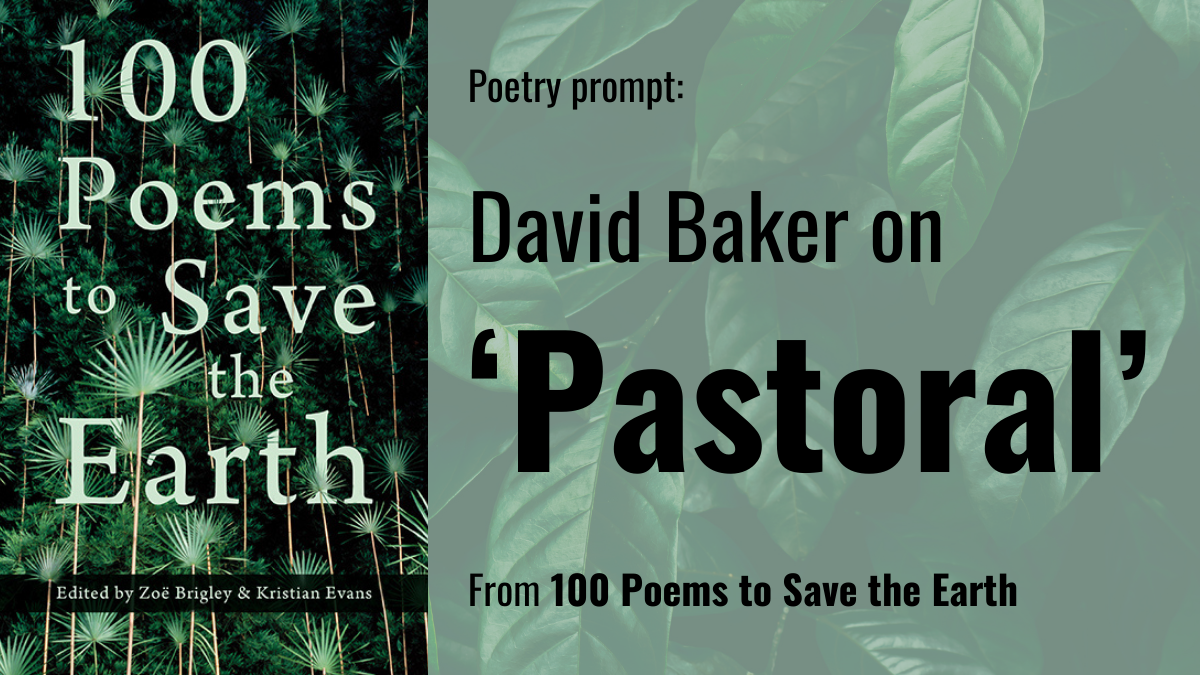
In this video, David Baker reads his poem ‘Pastoral’ which is featured in the anthology 100 Poems to Save the Earth. At the end of the video he suggests two prompts to inspire your own responses to the poem and the topics of the anthology. Share your responses with us on social media – @SerenBooks on Twitter, Instagram or Facebook – using the hashtag #100PoemsPrompts.
David Baker on ‘Pastoral‘
Poems happen for me–when they happen–not in the writing but in the rewriting. They emerge. This little poem, “Pastoral,” began as a sonnet, as a section of a long poem, “Scavenger Loop,” which I was writing about Midwestern landscapes and in memory of my mother.
Soon enough I pried this piece out of the big poem and began the work of rediscovery. It became an elegy, and I knew it should be outdoors–at first in a woodland, but then, as here, in a field, wind-swept, expansive, more empty than not.
The sonnet became half a sonnet. I drew open the blank verse line, with double caesuras–more space, more speechlessness, a wider field–and I abbreviated the final line by a few syllables. There’s more hush than sound, I think, more wind than substance. Someone said, it’s a love poem. Someone told me it was a pastoral elegy for the earth. Someone said, it’s all of those.
Prompt 1
Write a poem that floats among the forms, more ghost than substance. Let your ode grieve, say, where it might more conventionally extol; let your love poem think about a political conundrum. Let your reader discover those forms you have tucked away–like intimate messages, bits of song within a song–inside the apparent body of your poem.
Prompt 2
Go somewhere and stand still. Listen. Sniff the air. Feel your heartbeat. Let the whole universe of being revolve around that stillness for a moment, for two moments. Now write it down, and make it sing. That’s what I tried to do in “Pastoral.”
Our climate is on the brink of catastrophic change. 100 Poems to Save the Earth invites us to fine-tune our senses, to listen to the world around us, pay attention to what we have been missing. The defining crisis of our time is revealed to be fundamentally a crisis of perception. For too long, the earth has been exploited. With its incisive Foreword, this landmark anthology is a call to action to fight the threat facing the only planet we have.
“These achingly beautiful poems… remind us how to refind ourselves amid the landscape we call home.” – Sonya Huber
A Last Respect is a selection of contemporary Welsh poetry by winners of the Roland Mathias Prize. The poems included are wide ranging in style and subject. They contemplate relationships, nature, the environment, mortality, time, art and politics, and take place in a range of locations, from Aberystwyth to Baghdad, from war-torn landscapes to parents’ evenings. Featuring Dannie Abse, Tiffany Atkinson, Ruth Bidgood, Ailbhe Darcy, Rhian Edwards, Christine Evans, John Freeman, Philip Gross, Gwyneth Lewis, Robert Minhinnick, and Owen Sheers, it is a must-have anthology of poetry from Wales.
This week’s Friday Poem is ‘Boasting Sonnet’ by Katrina Naomi from her collection Wild Persistence.
Wild Persistence by Katrina Naomi is a confident and persuasive collection of poems. Written following her move from London to Cornwall, it considers distance and closeness, and questions how to live. She dissects ‘dualism’ and arrival, sex and dance, a trip to Japan. The collection also includes a moving sequence of poems about the aftermath of an attempted rape.
“Funny, moving, surprising, unflinching and, above all else… joyous.” – Helen Mort
This week’s Friday Poem is ‘Chorus’ by David Morley from the anthology 100 Poems to Save the Earth, edited by Zoë Brigley and Kristian Evans.
Our climate is on the brink of catastrophic change. 100 Poems to Save the Earth invites us to fine-tune our senses, to listen to the world around us, pay attention to what we have been missing. The defining crisis of our time is revealed to be fundamentally a crisis of perception. For too long, the earth has been exploited. With its incisive Foreword, this landmark anthology is a call to action to fight the threat facing the only planet we have.
Writing from rural and urban perspectives, linking issues of social injustice with the need to protect the environment, this selection of renowned contemporary poets from Britain, Ireland, America and beyond attend carefully to the new evidence, redraw the maps and, full of trust, keep going, proving that in fact, poetry is exactly what we need to save the earth.
“These achingly beautiful poems… remind us how to refind ourselves amid the landscape we call home.” – Sonya Huber
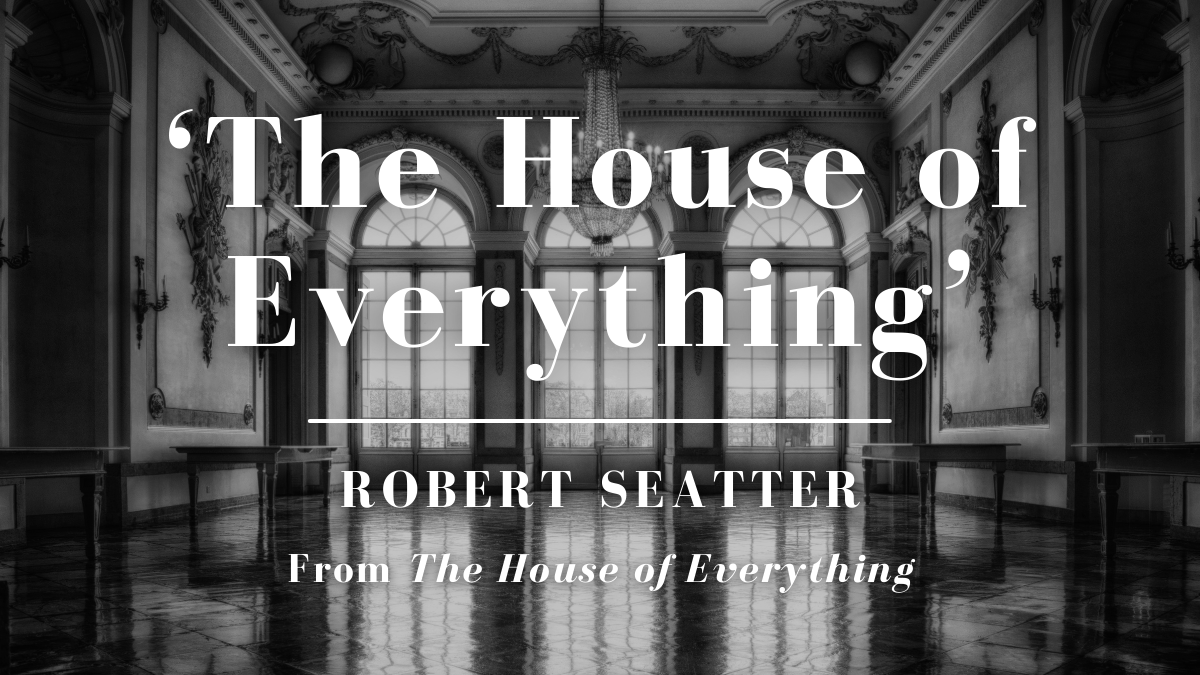
This week’s Friday Poem is ‘The House of Everything’ the title poem from Robert Seatter’s new collection of the same name which is inspired by the collection of Sir John Soane’s Museum in London.
Sir John Soane’s Museum in central London is a unique and idiosyncratic ‘house museum’, designed and built in the early 19th century by its obsessive architect/collector owner. The House of Everything takes the reader on a personal and poetic trail, capturing the tragic story of the man who created it, the eclectic collection he gathered within its walls, and most importantly what it says about our universal desire to leave a mark in space and time. No matter if you have never visited the place before – the texts are intercut with a series of striking collages made by the poet himself. They mix archive imagery of the house with contemporary visuals and help locate the reader in his/her passage through the house. They also help conjure the unique message of this book: how to make material our elusive dreams and imaginings.
Find out more about Sir John Soane’s Museum on their website www.soane.org
Create your free Seren account and enjoy 20% off every book you buy direct from us.
Join us on Wednesday 14th July from 7pm for the online launch of The House of Everything. Register for free via Eventbrite here https://www.eventbrite.co.uk/e/161494704007. Please note registration will close at 6:30pm on the 14th to ensure everyone receives the link.
This week’s Friday Poem is ‘Unseen Island’ by Christine Evans from our new anthology A Last Respect.
A Last Respect is a selection of contemporary Welsh poetry by winners of the Roland Mathias Prize. The poems included are wide ranging in style and subject. They contemplate relationships, nature, the environment, mortality, time, art and politics, and take place in a range of locations, from Aberystwyth to Baghdad, from war-torn landscapes to parents’ evenings. Two accompanying essays provide the context in which the poets work. In her Introduction, Jane Aaron writes about Roland Mathias: a poet himself, but also an influential editor and cultural commentator who did much to foster and develop poetry in Wales.A Last Respect is a continuation of his legacy. Daniel G. Williams’ Afterword is an incisive discussion about poetry in Wales over the past sixty years: where it started from and how it changed. A must-have anthology of poetry from Wales.
Featuring Dannie Abse, Tiffany Atkinson, Ruth Bidgood, Ailbhe Darcy, Rhian Edwards, Christine Evans, John Freeman, Philip Gross, Gwyneth Lewis, Robert Minhinnick, and Owen Sheers.
This week’s Friday Poem is ‘Roadblock’ by Ilse Pelder from her newly published debut collection Auscultation.
Ilse Pedler is a veterinary surgeon who works in Kendal. Her debut collection is Auscultation, which means listening and specifically, in medicine, listening to sounds that come from the body’s internal organs. If listening is a central theme of this collection, it is also about being heard. There are poems about vets waiting rooms and surgical instruments, about crisis calls, about overhearing farmers and pet owners and colleagues. There are also poems about surviving a stern childhood and a heartbreaking sequence about being a stepmother.
To celebrate publication of his new collection Karaoke King, Dai George has created a playlist of songs which tie in with the collection. Read on to find out what he chose and why.
This confident second collection by Dai George addresses the contentious nature of the times. Always deeply thoughtful but also alternately ebullient, angry, curious, ashamed, the poet moves through urban and digital spaces feeling both uneasy and exhilarated. As with the Auden of the inter-war period, there is a feeling of history shifting, as a younger generation confronts its ethical obligations, its sense of complicity and disappointment. Ecological crisis hovers in the background, glimpsed in the ‘Fooled Evening’ of a world whose seasonal rhythms have fallen out of joint. Karaoke King also contains numerous reflections on popular culture, culminating in ‘A History of Jamaican Music’, a sequence at the heart of the volume speaking to urgent contemporary questions of ownership and privilege, pain and celebration.
Karaoke King – A Playlist
The Lumineers – ‘Ho Hey’
The Platters – ‘The Glory of Love’
Teddy Pendergrass – ‘I Don’t Love You Anymore’
McFadden and Whitehead – ‘Ain’t No Stopping Us Now’
Frank Sinatra – ‘New York, New York’
Big Star – ‘Nightime’
David Bowie – ‘Station to Station’
Treorchy Male Voice Choir – ‘Myfanwy’
Lord Laro – ‘Jamaican Referendum Calypso’
The Ethiopians – ‘Train to Skaville’
The Skatalites – ‘Guns of Navarone’
The Uniques – ‘People Rocksteady’
Alton Ellis – ‘Rocksteady’
Derrick Harriott – ‘The Loser’
The Paragons – ‘On the Beach’
The Techniques – ‘Love Is Not a Gamble’
Lee ‘Scratch’ Perry – ‘Croaking Lizard’
The Congos – ‘Nicodemus’
Bob Marley & the Wailers – ‘No Woman, No Cry’
The Uniques – ‘My Conversation’
Gregory Isaacs – ‘Soon Forward’
Sister Nancy – ‘Only Woman DJ with Degree’
Yellowman – ‘Zungguzungguguzungguzeng’
Sizzla – ‘Babylon A Use Dem Brain’
Count Machuki – ‘More Scorcha’
The Heptones – ‘Party Time’
I-Wayne – ‘Living in Love’
The Maytals / Sister Nancy – ‘Bam Bam’
Charles Trenet – ‘La Mer’
Bruce Springsteen – ‘Thunder Road’
Dusty Springfield – ‘Wishin’ and Hopin’’
Bob Dylan – ‘Just Like Tom Thumb’s Blues’
In another lifetime, I tried to be a music journalist. A teenage pop nerd, I grew up reading too many issues of Mojo and the NME, and built my identity in large part around the songs that gave me solace, joy, a sense of difference. One way or another the journalism thing didn’t happen, but my new collection of poems, Karaoke King, maybe represents an attempt to grapple with the legacy of that obsession.
Poetry, of course, can’t offer what journalism can: it can’t give you facts, analysis, coherent narrative, or if it tried to do that it would be very bad at it. What it can do, though – maybe – is capture how songs hit the mind. It can sift significance, and work towards some understanding of how an individual stands in relation to these musical artefacts that are at once fixed, specific, culturally determined, and yet endlessly transmissible from radio to radio, mouth to mouth, ear to ear. From the liturgical prayers I heard being sung at Canton Uniting, my childhood church, to the Neighbours theme tune, Karaoke King is full of songs overheard, half-remembered, reapproached, transposed – hauntings and visitations. I thought it would be fun, and maybe interesting, to put together a playlist for the collection, with a set of ‘sleeve notes’ fleshing out the story of how these songs came to be there.
The first four tracks all come from ‘Poem on 27th Birthday’. Set in a hilltop bar in Italy, and written more or less in situ in September 2013, it was the first poem I finished after wrapping on my debut collection, The Claims Office. I tried to be more open and porous in writing than I’d allowed myself to be till that point, and for me that meant tuning into the ambient sounds, letting them bleed into a collage. The dominant tune is an earworm blaring from a nearby car stereo, a sweet-natured, folky track I recognised but couldn’t place – later I found out it was called ‘Ho Hey’ by the Lumineers. It’s the sort of song that Adolescent Me would have scorned, but in a charmed moment it came across, in the words of the poem, ‘as nothing less than the Glory of Love’, a nod to the great doo-wop song of that name by The Platters.
The other songs filter in from a compilation of ’70s funk and Philadelphia soul that the barman switched on to replace the slick elevator jazz that had been playing till then. So we have a singer I recognised, Teddy Pendergrass, singing a song I didn’t know in the moment but later tracked down as ‘I Don’t Love You Anymore’ – one of his first solo singles, a four-to-the-floor disco ripper about breaking somebody’s heart – and this soon flows into ‘Ain’t No Stopping Us Now’ by McFadden and Whitehead. Songs touching songs, overlapping, building resonances. I most certainly did love the addressee of the poem, so it’s the McFadden and Whitehead song that takes over, its message of empowerment modulating through the speaker into gratitude for love.
More earworms, next, with Frank Sinatra’s‘New York, New York’, overheard on one of my many circuits of Clissold Park in Stoke Newington over recent years. The poem it’s taken from is called ‘The Park in the Afternoon’, which unsurprisingly is about parks in the afternoon, but also the neoliberal cult of productivity that turns people into a political problem if they have nothing to do at that time of day. I loved the weird euphoria of this song, with its glitzy promise of inclusion – I wanna be a part of it! – being reclaimed as an anthem of solidarity or defiance.
‘Night Time’ by Big Star is one of the darker songs on this playlist, a theme tune for a run of poems in the first section of Karaoke King which map a hard time in my life – a dark night of the soul. The song itself is quoted in a poem called ‘Rock vs Pop’, an elegy to Roddy Lumsden. Roddy and I bonded originally over music, meeting on an internet forum called Black Cat Bone where debates like ‘Rock vs Pop’ could become seriously heated. Big Star were the sort of group that exposed how hollow that dichotomy is, and I know Roddy was a big fan of their legendary, troubled third album, Sister Lovers. It’s another song about wanting to be a part of it – At night time I go out and see the people – only this time there’s no Sinatra-esque bravado: the irony of that desire is painfully apparent the moment you hear Alex Chilton’s fragile, haunted vocal.
David Bowie’s ‘Station to Station’ is more literally about a long night of the soul – a long and disoriented journey. The poem I wrote about it for Alex Bell and John Canfield’s ‘Bowieoke’ night (and subsequent anthology Cold Fire) tries to capture the sense of blackout and damage on that record, but also to deconstruct the iconography of the Thin White Duke, his persona of the time. Whiteness is of course a part of that formulation, and it’s one of the tacit themes of this book that white pop music culture must grapple honestly with its numerous, often unspoken debts to Black musicians and Black musical idioms.
The place in the book where I’ve tried to confront this legacy, as openly as possible, is ‘A History of Jamaican Music’. The reggae songs on this playlist all offer up quotations and allusions from that sequence, and taken together I think they make for a great, roughly chronological listen. I’ve written about the genesis of this sequence before, so don’t want to belabour the point. All I’ll say here is that, just as these musical selections offer one, partial journey through the rich heritage of reggae, so too do the poems, from my own, very subjective perspective. I wanted to reflect honestly on my relationship to a music and a culture that is too often enjoyed in a passive or exploitative way by British people. These are indeed songs of joy – and songs that can, and should, be enjoyed widely, I believe – but also struggle and complexity; songs, moreover, that could never wholly belong to me, or anyone in my position.
Before we get to them, though, we pass through a song from a culture that is indisputably my own. ‘Myfanwy’ is beautiful, of course, and probably familiar to many people. The title poem of the collection remixes it as a death fugue, a mouldering totem for a certain dubious, romantic myth of Welshness – so I’m glad to pay tribute to it here as God, or the Treorchy Male Voice Choir, intended it. Reading that poem, the eagle-eyed might spot a few references to Twin Town, a film I still love despite its ridiculous, shallow, very unromantic vision of Welshness. (The title of the collection itself, Karaoke King, is a moniker given to the film’s hapless Elvis wannabe, Dai Rhys.) The film’s final scene of a sea burial serenaded by a suited and booted male voice choir crooning ‘Myfanwy’ sums up much of what is funny and pathetic about those old myths and their modern revivals. Maybe one day we’ll be able to hear ‘Myfanwy’ differently again, stripped of all the pageantry.
There’s a wistful turn to the final few songs on the playlist. Charles Trenet’s ‘La Mer’ wafts in like the last day of summer or the first of autumn, a mood I wanted to channel for a poem called ‘September’s Child’. That in-between, nostalgic cusp state more or less represents the situation with my hair right now. ‘Poem in which my hairline recedes’ is the vessel for those (rather trivial) anxieties, and Bruce Springsteen’s ‘Thunder Road’ is the sonic foil – another yearning cusp song, only this time one that stands on the brink of impossible self-realisation and success.
After that, yet more ‘Wishin’ and Hopin’’ from Dusty Springfield, one of my favourite singers. From my teens I’ve always been drawn to classic girl group pop and its soft-soul, adult-oriented offshoots – Dusty, Dionne Warwick, the songs of Bacharach and David, Goffin and King. I saw in this music a model for my own hopelessness in love: solace and fellow feeling in a woman’s voice, when it was women that I yearned for. The poem ‘Obsolete Heartbreak Suite’ is a type of farewell to all that, and an attempt to reckon with the gendered dynamics of the art form, with its unequal distribution of male and female creative labour. I still love all those Brill Building songs but the drama and intensity is second-hand now, thankfully.
Finally, we come to ‘Just Like Tom Thumb’s Blues’ by Bob Dylan. After listening to the glorious official version from Highway 61 Revisited, do seek out the alternate takes that are collected on The Cutting Edge, a box set covering Dylan’s time in the studio during the famous ‘Thin Wild Mercury’ years of 1965-66. It’s the sound of those false starts and early drafts that I wanted to capture in ‘The Mercury Mine’ – Dylan’s painstaking, instinctive graft as he toys with a phrase until he gets it right, rearranging speech parts, nudging them into better arrangements. It’s something of a cliché to talk about ‘pop perfection’, and I’ve loved enough brilliant, three-minute pocket symphonies to understand what people might mean by it. But I think a space for poetry opens up whenever we encounter pop imperfection – hesitance, provisionality, the formation of ideas. That’s one way into it, anyway. Another might be to follow what happens when we encounter perfect music amid the mess and imperfection of our lives.
This week’s Friday Poem is ‘September’s Child’ by Dai George from his new collection Karaoke Kingwhich was published this week.
Dai George’s confident second collection Karaoke King, addresses the contentious nature of the times. Always deeply thoughtful but also alternately ebullient, angry, curious, ashamed, the poet moves through urban and digital spaces feeling both uneasy and exhilarated. As with the Auden of the inter-war period, there is a feeling of history shifting, as a younger generation confronts its ethical obligations, its sense of complicity and disappointment. Ecological crisis hovers in the background, glimpsed in the ‘Fooled Evening’ of a world whose seasonal rhythms have fallen out of joint. Karaoke King also contains numerous reflections on popular culture, culminating in ‘A History of Jamaican Music’, a sequence at the heart of the volume speaking to urgent contemporary questions of ownership and privilege, pain and celebration.