Our January Short Story of the Month, still available to read, is ‘A Bird Becomes A Stone’ by Jo Mazelis, which features in her beautiful new collection Ritual, 1969, due to be published April 2016.
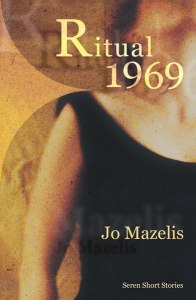
This, her third collection, welcomes you to a darkly disquieting world of make-believe and performance, where nothing is quite as it seems and first impressions may only lead to further disguises and false trails. Twins, circus acts, playground games and play-acting, the path from the schoolyard to adulthood is beset with misunderstandings, missed dates and traps for the unwary.
Awarded a Jerwood Fiction Uncovered Prize for her debut novel Significance, Jo has also had numerous short stories in anthologies and listed for awards, including five short-listings for the Rhys Davies short-story prize. Several of her stories have been broadcast on Radio 4.
A Bird Becomes A Stone
This is an extract. Read the full short story for free on our website.
The film Sarah had volunteered to act in was written and directed by a Welsh girl called Catrin, who was at college in Bristol. She’d brought a crew of other students to Wales, one to do sound, another was a cameraman. There was also a sulky girl with bad skin called Morgana whose role was not explained. They drove in a grubby white VW van up to the Brecon Beacons, careering and bumping along narrow tracks in search of good locations. The cameraman drove and the girl with bad skin sat up front because she claimed she’d get carsick otherwise. So the other three had to suffer in the back, wedged in among the film equipment and two plastic sacks of what seemed to be dirty laundry but turned out to be props and costume.
Sarah played the main role. According to the storyboard a lot of footage would consist of her running through woods, along a shoreline (brooding clouds and crashing waves in the background) and along treacherous mountain paths. The schedule demanded that they shoot with her for three days, then on the fourth and fifth days another actor would join them. He was to play a man who had molested her as a child. The chief premise of the film was that every impression in the early sequences led the audience to believe she was being chased, but actually it emerged that her character was the pursuer. The hunted becomes the hunter.
They parked at a lay-by above a stream. The day was still and unusually warm, white puffs of cumulus clouds moved lazily across a yawning blue sky.
‘This weather is crap,’ Catrin said.
The girl with the bad skin sat on a rock and stared hatefully at the rest of them as they unloaded the van.
From eleven o’clock until almost two, Sarah helped Catrin and the sound man scatter torn white sheets along the side of the stream while the cameraman shouted directions at them. At two they stopped for a lunch made by Catrin’s mother. Sandwiches with cheap white bread, some sort of meat that might have been pork or possibly turkey, hard-boiled eggs, crisps and an assortment of chocolate-covered biscuits which were warm and sticky and reminded her too much of long journeys in the back of her parents’ car; of her loneliness as an only child.
After lunch Sarah climbed into the back of the van and struggled into the costume they had brought for her; a grubby, ivory-coloured floor length dress. It had a plunging front and tied behind her neck leaving her back bare. It was made of artificial satin and the rough skin on her hands caught on it like tiny barbs.
In this scene she was meant to wander along by the stream charting a course between one discarded rag and another. Catrin showed Sarah some photographs taken after a battle; women searching for their menfolk in a field littered with the corpses of soldiers, explaining that this was the atmosphere she wanted to convey.
Sarah set off barefoot; in places mud oozed between her toes. The dress was thin, she shivered as the sun began to drop behind the mountains, but she persevered.
That night Sarah dreamt that she was filming the scene over and over, but her dream was invaded by the war photograph and as she stared at each flung-down rag, the torn scraps came to life turning into dreadful ghosts with scarred and half-flayed skin who moaned and tried to touch her.
The next day Catrin was overjoyed as weighty blue-grey cumulonimbus began to gather behind the mountains threatening an approaching storm.
‘We’re going further north today, then as far as Dolgellau on Thursday.’
There was little time wasted on the second day; they parked on a bleak mountain with a ribbon-like road running through it. Plynlimon hunkered under dark skies to the north.
‘Now just run towards the camera but look beyond it, not directly at it.’
She ran. Barefoot in wet grass peppered with shiny black sheep droppings, her long dress saturated up to her thighs. A few times she fell but pulled herself up and stumbled on.
‘That was brilliant! It looks so real when you fall,’ Catrin said.
‘Hey,’ the sound guy said, touching her arm gently. ‘Is that blood? Did you hurt yourself?’
She looked down; the dress was torn over her right knee, bright crimson blood mixed with muddy grey stains. She lifted her dress, her knee was grazed and in one place a small cut sent a trickle of red coursing down her leg and over the arch of her foot.
…
Continue reading ‘A Bird Becomes A Stone’ here.
Jo Mazelis’ new collection, Ritual, 1969, will be published by Seren in April 2016. More information coming soon to the Seren website.

 You can buy The Road to Zagora from our website. Sign up to the Seren Book Club for 20% off.


