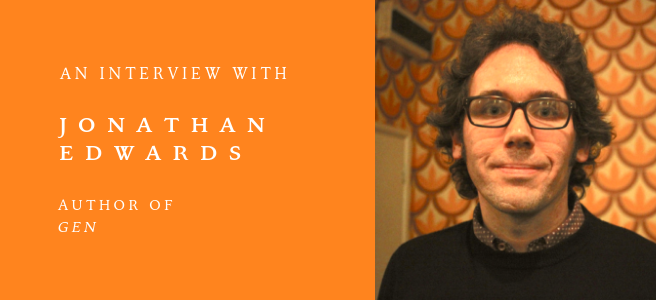
 Jonathan Edwards’ debut collection, My Family and Other Superheroes, was a triumph: shortlisted for the Fenton Aldeburgh First Collection Prize and winner of the Costa Poetry Award 2014.
Jonathan now returns with his wonderful second collection, Gen. How did the writing process differ this time, and what can we expect to see in the new poems? In this interview, we find out more about Jonathan and his new work.
How did the process of writing Gen differ from putting together your debut collection, My Family and Other Superheroes?
I think, like most people’s second collections, it was swifter, and I had more of a sense of what I was doing. I grew up at a time when the struggles of bands like The La’s to produce a follow-up to successful work were legendary, and the voice of those experiences sits on your shoulder. I wanted to maintain in this collection the strengths of the first book, writing about famous people and their interactions with the ordinary, focusing on Kurt Cobain’s mythical visit to the Newport nightclub TJs, or the impact on a young boy of watching the disgraced Olympic sprinter Ben Johnson racing in 1988. I also wanted to continue looking at a Valleys village life in surreal ways, constructing narratives about a village which is inundated by tourists, and another where a street is locked down for a day, and the residents decide to spend the time having a massive party. It was also important, though, to reach out in new directions. One of these was about incorporating other voices in the book. The collection includes a range of monologues, working with the voices of lions and servants, trees and cities, and I wanted to work with real voices too, interviewing some of the figures at the heart of the Welsh historical events which feature in the poems. I was also interested in echoing the collection’s central interest, of being young, through a wide range of experiences, looking at my own youth and the youth of my parents, but also considering youth through a range of events in Welsh history. What was it like for my grandfather to be young at the turn of the twentieth century in Newport? What was it like to be a child at Capel Celyn?
Gen includes poems that provide glimpses into pin-prick moments from the distant and not-so-distant past – for instance, ‘Servant Minding a Seat for his Master Before a Performance of The Rivals, Covent Garden Theatre, 1775’, and ‘Welsh Flag on the Wall of Richard Burton’s Dressing Room, Broadway, 1983’ – told from the perspective of the flag. Is it more challenging getting into the head of an inanimate flag than, say, a family member?
Writing more monologues was one difference with this collection – I see the book as a boxful of voices you can open, and they all come out, some shouting in your face, some whispering in your ear, some sulking or stuttering, some jibber-jabbering on. I’d been lucky enough to be asked to teach a number of workshops, to all sorts of different groups, since the publication of the first book, and writing monologues is a great workshop activity – I use the great Carol Ann Duffy poem, ‘A Week as my Home Town’ as a way into writing about place. So it became inevitable that I would want to push my usual concerns – class, Wales, animals – through monologue. I say ‘would want to’ but this isn’t quite right. The truth is that the voices of these poems wrote them for me, and I sat there like a sort of court reporter or secretary, trying to keep up. Monologue is great for a writer because it allows you to go into other worlds and see and feel other things, all while sitting at a desk, clutching a pen. It can take you much farther than Easyjet, and it’s cheaper. You can open your eyes as a lion, see your reflection on the inside of the glass of your zoo enclosure, feel your lion-breath against the glass. Or you can rub your eyes again and open them in the eighteenth century, smell the stink of the streets, hear the bloke next to you, gossiping about your master, spot someone in a doorway over there, looking furtive, saying your name. Or you can wake up and be a whole city, think everything you think, explore all your nooks and crannies, your hilltops and waterways, feel how you feel for your rush-hour commuters and your lost-hearted rough sleepers. It’s magic that poems can do this. Charles Bukowski used to talk about writing a poem having to compete with a night out at the movies as an alternative form of entertainment for the writer. Monologue, and the promise of finding out in intimate and fascinating ways about completely alien experiences, is one way of getting yourself onto a chair to write.
Family is once again a central theme, and the small and unnoticed actions of family members often overshadow larger, less personal histories – for instance, the image of your grandfather tying people’s shoelaces together in ‘Harry Houdini on Newport Bridge, May 1905’. It’s obvious you take great joy in recounting these anecdotes – who can you thank for this interest in family history, and will we be hearing more wild tales of the Edwardses in future collections?
As with everything in life, really, I thank my mother and father for the existence of these poems. Also the South Wales Argus: the stories it features always have a decent chance of making it into my poems, and I would politely thank its writers and editors to remember this, when writing up their copy. My family has always been interested in its own history, partly because our history is so mysterious and obscure – World War One, for example, and the way my family seemed to roll down this valley, generation by generation, until I emerged, at the bottom, blinking, headachey and literate. In a framed black-and-white photo on the mantelpiece, my grandfather is the image of me, Brylcreem’d and watch-chained, blinking out of a black-and-white photo, yet I never met him. What was it like to wake up and be him? What were the smells and tragedies of his life? Writing about him can help bridge the gap between what I share deeply with him and what I know nothing of.
In terms of more tales of the Edwardses, they’re always on the go. Sinéad Morrissey’s On Balance is a magisterial, holy collection for me, and I especially love the ‘Collier’ sequence, about her grandfather. My maternal grandfather was a will-o-the-wisp character, all pinstripe suits and Woodbines, a rickety, backfiring Volkswagen Beetle and a grin from here to the end of the street. His experience, my nan’s experience, is something I want to shout and sing about – I don’t know what writing is for, really, if it isn’t to re-discover and celebrate their Workingmen’s Club and bay-windowed, permed or eye-sparkling lives.
How do you think your poetic style has evolved since the publication of the first book?
I often say, jokingly, at readings, that my poetry shows enormous evolution between books one and two: the first collection is made up of poems about my family, which often focus on famous people, while my second collection is made up of poems about famous people, which often focus on family. One thing I wanted to do in this collection was explore more fully the ground I’d sketched out in the first book, to approach those themes from different directions and travel into them farther. In my first collection, I was interested in the history of Wales, writing about Chartism and the North Wales village of Capel Celyn, drowned in the 1960s in order to create a water source for Liverpool. Capel Celyn is a resonant, echoing subject in all sorts of ways – the human experience of losing your home, the relationships which people would have sustained and developed, as well as the political implications of this episode, and the way it drove Devolution. Additionally, as someone who lives in a tight-knit village community, my heart is in this place and in its loss. One thing I was keen to do, then, was to get the voices and the real experience of Capel Celyn into the writing. It turned out that David Walters, who was arrested for one of the first attacks on the dam site at Tryweryn, is from just up the road from me in Bargoed, and I am really grateful to him for the interview which resulted in the ‘Cofiwch Dryweryn’ sequence. Equally, these poems are indebted to a number of important books which serve this subject, including Einion Thomas’s Capel Celyn: Ten Years of Destruction and Owain Williams’s first-person account, Tryweryn: A Nation Awakes. The poems in Gen which mourn this experience are a baby step towards the book of poems which is needed on this subject.
Your poetry displays a deep and constant affection for the Welsh landscape and experiences of your youth – even down to the mess and madness of an illicit party: ‘there / was chaos, carnage, every pot plant / an ashtray, every ashtray a sick bag.’ (‘House Party at Tanya’s, 1995’). Your poems certainly aren’t rose-tinted, and yet they hold onto a sense of celebration. Do you hope readers will share that sense of fondness and familiarity?
One of the reasons I write is that it makes time travel possible. Once I get the notebook and the biro up to 88mph, I can get there. Time is clearly a concern across both collections, and I love that I can step into a room, scribble a line, and be in another time. Some of these are times before I was born – I like hanging out with my parents in the years before I knew them, and seeing what they were like, or spending time in a poem with a grandfather I never met. I love that poetry can be a way of talking to people who aren’t there anymore, because they aren’t themselves any more, and some of these people are past selves. Either poetry is a loudspeaker shouting across time, or else it’s a box you put yearning in to store under the stairs. Like lots of people, I guess, I know exactly the second of my life I would go back to if I could, and what I would do differently. The poems in this collection about house parties and school days, my father crashing a car in 1965, my mother cutting her arm in 1955, my uncle smoking a pipe in 1986 – it’s all a way, I suspect, of addressing that.
Anyone lucky enough to have seen you perform will know that you are as entertaining in person as you are through your poems. What events and projects do you have lined up?
From now until August, I seem to be reading everywhere that will have me, and several places that won’t, from Cardiff to Cork, from Merthyr to Mitcheldean. This is one of the best things about poetry – hitting the road and seeing what happens to you, meeting the artists, the enthusiasts, the personalities who keep poetry going up and down the country. This time round, it will be about re-connecting with people who are now friends, and I love that poetry has made that happen. As my sinister mega-global marketing campaign has it, all events will be advertised on the Seren website. I love teaching poetry and working with other writers to help them develop, and am really excited about my upcoming courses for The Poetry School and Tŷ Newydd. This month, the Poetry Society will be launching a film of a poem I wrote in celebration of the Monmouth and Brecon canal, made by Chris Morris of Falmouth University. I’m really proud of this work and really excited about the opportunity to sing for a place that has always been really important to me, a place I splashed and grew up in. There are some other exciting things coming up which I’m not allowed to talk about yet and other crazier, wilder projects, including zoo animals and Valleys school children, installations and chaos, I hope can happen, if I can talk the right people into it. Most important will be finding the time to scribble new poems. Whatever else the future holds, whether it’s time travel or history, voices or narrative, I very much hope there’s a lot more writing to be done.
Local to Cardiff? Catch Jonathan at the Seren Cornerstone Poetry Festival – he will be in conversation with Christopher Meredith and Archbishop George Stack in the ‘Afternoon Tea: Generations’ event, 9 February. Tickets include a generous selection of cakes, pastries and sandwiches. Book now.
Gen is available from the Seren website: £9.99
Enjoy 20% off every book you buy from us when you create your free Seren account.



 Getting started