Posted on

Friday Poem – ‘What’s the Welsh for ‘Fire-Cracker’?’ by Marc Evans

This week’s Friday Poem is ‘What’s the Welsh for ‘Fire-Cracker’?’ by Marc Evans. Marc is a regular attendee of our First Thursday evenings which happen once a month at Chapter Arts Centre in Cardiff. He read this poem in the open mic session a few months ago and we thought it was perfect to share with you this week just after bonfire night.


Thinking about Christmas already? Browse our book pages and find someone the perfect gift this Christmas. 20% off online when you create your free Seren account

Posted on

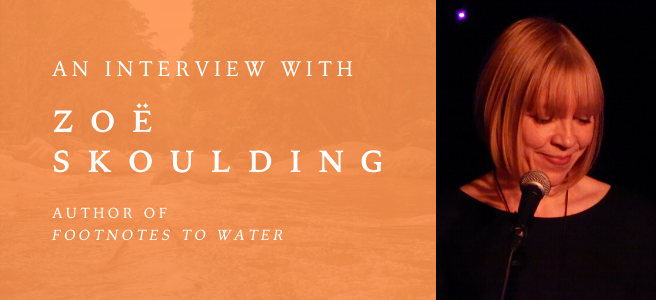
‘Footnotes to Water’: An Interview with Zoë Skoulding

Zoë Skoulding is a poet, critic and translator who has lived in north Wales since 1991. She is the author of a number of poetry collections including The Museum of Disappearing Sounds (Seren), which was shortlisted for the Ted Hughes Award, and Remains of a Future City (Seren), which was long-listed for Wales Book of the Year. In 2018 she was a recipient of the Cholmondeley Award from the Society of Authors for her contribution to poetry.

Her new collection Footnotes to Water follows two forgotten rivers and tracks the literary hoofprints of sheep through Welsh mountains. In these journeys she reveals urban and rural locales as sites of lively interconnection, exploring the ways in which place shapes and is shaped by language. In this interview she gives us a deeper insight into these connections and tells us about some of the processes behind her poetry.

Water can quite literally reflect us, and the symbol of the river features heavily throughout the collection. Why do you think water is so expressive of identity?

I’m more interested in water that is hidden, or that has disappeared, than in reflective surfaces. I don’t think water necessarily expresses identity at all, though it does tend to be a central concern of Welsh writing – there’s Tryweryn, of course, with the idea of loss of language and identity. I was drawn to the Adda in Bangor because it seemed to be the shape of a void I noticed in the city, but it’s not just about language – it’s also about an economic logic that destroys a community’s relationship with itself and its non-human surroundings. On the other hand, water is what connects us to each other and to the rest of the physical world, so it’s a way of thinking about new kinds of belonging.

You use the Welsh language throughout certain poems, although you write primarily in English. Why is that?

I can’t write in Welsh, but in writing about Bangor I wanted to reflect my experience of hearing the city, which is that Welsh is a constant, if fragmentary presence, and one I value. The occasional Welsh phrases are all quotation because my relationship to Welsh is that it lives in my ears, but not in my mouth. One day that may be different, but for now this is the best way I can respond to where I am.

Is this a collection to be read aloud? How could speaking the poems affect our understanding of them?

For me, reading and writing poetry is very much about the sound and weight of words, whether they are sounded aloud or voiced in the head, so sound and meaning are always intricately connected.

The collection brims with varying experimental forms. Can breaking form challenge our conceptions of the world around us?

I like having a constraint to work against, so the book begins and ends with sonnet sequences, although they might not be immediately recognisable as such. In both cases, I was thinking about the form of a river, and the shape that gives it pressure and movement. In the first poem there’s a seven-syllable line, which is more common in Welsh poetry than in English, and it has the effect of wrong-footing the expected rhythm. In many of the forms I used I was trying to find ways of tripping up my expectations of a very familiar city.

In the collection, you seem inspired by the landscape, letters, news reports, and the literature and voices of others. What inspired you the most? Is there somewhere you often look to for inspiration when beginning to write?

I walk and I read, and in some ways these can be quite similar kinds of exploration. ‘Heft’ is about both of those things at once, a journey though text and landscape.

In the poem, ‘Walking the Adda: A Collaboration’ you incorporate ‘comments made on and after public walks’. How did you approach incorporating the voices of others into your work? Would you say the role of voice is particularly important to this collection?

This was a joint project with the artist Ben Stammers in which we walked the route of the underground river with anyone who wanted to join us. At the end, people added their comments anonymously to a giant map he’d drawn, and these are what I have quoted – so although there are a few spoken comments there as well, most were written down. I arranged them as a prose poem, continuous but with multiple voices. The sense of listening to a place composed of many voices is central to my understanding of cities.

How would you describe the poems’ function as footnotes alongside Ben Stammers’ visual art?

I don’t think they really work in this way as I was not interpreting his photographs. Most of the time we made parallel, separate explorations of the route of the river and what we could discover about it. We did have some very useful conversations though, and Ben’s expert knowledge of birds certainly informs ‘Gull Song’.

You play with the idea of bodies, whether the ceaseless flow of the body of water reflected in the form, the female body in ‘Teint’, or the physical body threatened by flood, disease or pollution. Would you say the collection aims to subvert the boundaries between the human body and the elemental world?

Given the current ecological crisis it’s important to challenge the belief that humans are somehow separate or aloof from the material world. What if we could imagine human existence as a footnote to water, a co-incidental life form existing alongside many others? At the same time, of course I can’t completely sustain this view because my perspective is human, and I’m also concerned that human bodies are not all treated equally, as is revealed by the story of any city. When I write I try to make new paths of connection in language so that different relationships might be possible.


Footnotes to Water is available on the Seren website: £9.99

Create your free Seren account and enjoy 20% off every book you buy from us.

Don’t miss the launch of Footnotes to Water taking place at 8pm on Thursday 14th November at the Aulkland Arms in Menai Bridge. Zoë will be joined by guest readers Fiona Cameron, Peter Hughes, Rhys Trimble and Lee Duggan plus there will be music from The Groceries (Alan Holmes). Find the full details on our website.

Posted on

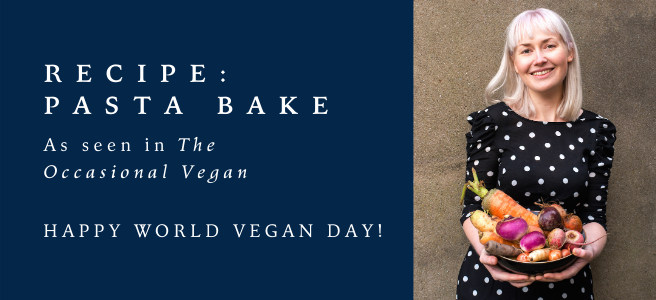
Happy World Vegan Day!

Today marks the beginning of World Vegan Month and we couldn’t think of a better time to tell you that the re-print of The Occasional Vegan by Sarah Philpott is now in stock!

The Occasional Vegan Sarah PhilpottTo celebrate we’re giving you a sneak peak at the deliciousness that waits inside with this tasty recipe for pasta bake. Not only does it taste amazing it is also healthy and a great way to use up any pumpkins you may have left over from Halloween. It may not be the quickest recipe, but it’s well worth the wait.


1 hour 30 minutes | Serves 4-6

Ingredients

– One large pumpkin or butternut squash
– Half a head of cauliflower broken into florets, and its leaves, chopped coarsely
– 250g wholewheat pasta
– 1 x 400g can tomatoes, chopped or plum
– 2 garlic cloves in their skins
– 3-4 sage leaves, chopped coarsely
– Nutmeg, grated
–Two big handfuls of walnuts, crushed
– Salt and pepper

Preheat the oven to 200C. Slice the pumpkin or squash into wedges (keep the skin and seeds on until later) and place onto a baking sheet (you may need two), then add a little water and season. Place onto the top shelf of the oven and after 20-25 minutes, put the cauliflower onto a separate baking sheet (again, add water and salt and pepper), move the pumpkin to the bottom shelf of the oven, and cook for another 25-30 minutes. In the last ten minutes of cooking, place the whole garlic cloves in with the cauliflower. Remove from the oven and allow to cool.

Cook the pasta in salted water for 8-10 minutes, drain and spread evenly across the base of a large oven dish. Once the pumpkin or squash has cooled, remove the skin and seeds and place in a large bowl with the cauliflower and its leaves. Stir in the tomatoes, half fill the empty can with water then add to the bowl. Stir through the sage and garlic (skins removed) and a generous grating of nutmeg, and blend the mixture in batches. If you don’t have a blender, simply put the sauce on a low heat for about 10 minutes and use a wooden spoon to gently crush the cauliflower and pumpkin/squash.

Spread the sauce evenly on top of the pasta. Crush the walnuts and scatter evenly on top of the sauce. Add more nutmeg and salt and pepper, then bake on the top shelf of the oven for 25-30 minutes. Serve with green vegetables – or on its own.


The Occasional Vegan is available on the Seren website for £12.99

Create your free Seren account and enjoy 20% off every book you buy from us.


Sarah Philpott is a freelance writer and food enthusiast who lives in Swansea. Her first cookery book, The Occasional Vegan, was published in 2018 by Seren Books and her food blog (https://veggingit.wordpress.com/) shares her passion for eating and cooking the vegan way. Sarah’s hearty, home-cooked recipes prove that being vegan isn’t all about kale and nut roasts and her writing takes a common-sense approach to eating to suit your lifestyle and budget, while debunking the myth that eating well comes at a cost.

Posted on

Friday Poem – ‘A Second Whisper’ by Lynne Hjelmgaard

This week’s Friday Poem is ‘A Second Whisper’ by Lynne Hjelmgaard from her new collection A Second Whisper. You can see videos of Lynne reading more poems from the collection on our Youtube channel.

A Second Whisper is Lynne Hjelmgaard’s moving new collection in which she looks back upon her life in New York, Demark, The Caribbean, and London. There are elegies to her late husband as well as to her mentor and partner, the renowned Welsh poet Dannie Abse, who died in 2014. Her lyrics are precise, warm in tone, and suffused with optimism for the future.


A Second Whisper is available on the Seren website: £9.99

Create your free Seren account and enjoy 20% off every book you buy from us.

Don’t miss Lynne reading alongside Mary J. Oliver at their joint launch tomorrow, 7pm at Broc Mor shop in Aberystwyth. Find the full details here

Posted on

Friday Poem – ‘Gull Song’ by Zoë Skoulding

This week’s Friday Poem is ‘Gull Song’ by Zoë Skoulding from her new collection Footnotes to Water which is a Poetry  Book Society Winter Recommendation.

In Footnotes to Water poet Zoë Skoulding follows two forgotten rivers, the Adda in Bangor and the Bièvre in Paris, and tracks the literary hoofprints of sheep through Welsh mountains. In these journeys she reveals urban and rural locales as sites of lively interconnection, exploring different senses of community, and the ways in which place shapes and is shaped by language.


Footnotes to Water is available on the Seren website: £9.99

Create your free Seren account and enjoy 20% off every book you buy from us.

Posted on

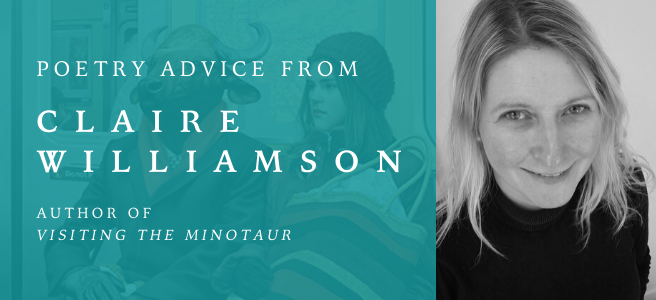
Claire Williamson shares her poetry advice

This week’s poetry advice blog comes from Claire Williamson author of Visiting the Minotaur. Claire specialises in nurturing creative writing, both as craft and for wellbeing. She is also a member of Bristol based poetry group The Spoke.

Visiting the Minotaur Claire WilliamsonClaire’s collection Visiting the Minotaur was published by Seren in 2018. In this inventive and intensely felt collection, the poet enters a labyrinth of her own complicated family history, a history beset with secrets and lies, in order to come to terms with her own identity.  She borrows from myths, histories, careful observations of nature, and of city life, in order to fashion her artful meditations on experience and mortality.


What first drew you to poetry? 

Foraging in my grandmother’s bookshelves and finding an illustrated anthology of children’s poems. I memorised ‘Three Ducks on a Pond’ and used to enjoy reciting it to myself. 

Where do you look to for inspiration? 

Inside – thoughts and feelings – and outside – the natural and built environment. An emotion or idea usually catches an image or a concept. I’m lucky that I don’t struggle for inspiration.  

What poets or writers inspire you? 

T.S.Eliot was one of my first loves and continues to bring energy, so many years later. I read a lot of contemporary poets. I enjoy Poetry Wales; it’s always a surprise what you’ll find between the covers! 

What does poetry mean to you? 

Poetry has been threaded throughout my life, a companion and a safety net in difficult times – both writing and reading. It belongs to everyone and I enjoy it in the broadest sense, culturally and geographically. 

How do you balance writing poetry with working? If you write full time, what made you decide to do so? 

I’m an academic three days a week for the MSc in Creative Writing for Therapeutic Purposes at Metanoia Institute, and I work freelance on writing projects the rest of the time; at the moment I’m working with Welsh National Opera, Fresh Arts at Southmead Hospital and mentoring individuals. Poetry comes up through the cracks and especially if I sit down to write.  

Do you have a writing routine? What is it? 

I’m writing a novel for a doctorate at the moment which I sit down to work on after the children are in bed, which is the quietest time of the day. Poetry is more spontaneous; an image or phrase will start to pester me like a persistent fly. 

How do you prepare yourself before sitting down to write? 

I don’t particularly set aside time at the moment, although I am familiar with needing to do so and to either be relaxed or ‘in flow’, as described in John Cleese’s ‘Open Mode’I’ve trained myself to write even when the house is a complete mess. Most likely, I might be working on something academic and suddenly I’ve opened a new document and out pops a first draft. If I had all the time in the world, without interruption, I’d journal first thing, leading into poetry writing. 

What advice would you give to poets looking to get their work published? 

Workshop your poems with other writers you respect. Enter competitions, send to magazines. Collect twenty of your best poems to put towards pamphlet competitions and publishers. Work your way to a first collection.  

Is it important to build a reputation by submitting to competitions, magazines and journals? 

It turns out to be, yes, although I resisted it for a long time; I was surprised how suddenly relieved I felt at the Bridport prize that I hadn’t been kidding myself I could write and that was about fifteen years after I started to take it seriously; it is easy to feel a fraudConversely, often a performance poet’s trade is their words and style of delivery, and paid gigs to turn up to and present. However some performance poems translate brilliantly to the page and are also great to read.  

Do you have any tips for submitting poems to publishers or magazines? 

Go to the library and read samples of magazines/books, or order back copies, or subscribe before sending in your work.  

What methods do you use to overcome feeling disheartened or to keep positive? 

Treat ‘sending out’ as an administrative task; if the poems return, send them on their merry way again. Commune with other writers and share information and plans. The poetry world isn’t always fair and certainly has its darlings. Be patient, your day will come! 

Do you have any other advice for fellow poets? 

Take risks, it isn’t always the poems you think are the competition winners that win the competitions. Persevere with the craft, sharing with fellow poets and buy books! 


Claire’s collection Visiting the Minotaur is available on the Seren website: £9.99

Create your free Seren account and enjoy 20% off every book you buy from us.

Posted on

Friday Poem – ‘Lyrebird’ by Deryn Rees-Jones

This week’s Friday Poem is ‘Lyrebird’ by Deryn Rees-Jones from her T. S. Eliot Shortlisted collection Erato.

Named after the Greek muse of lyric poetry, Erato combines documentary-style prose narratives with the passionate lyric poetry for which Rees-Jones is renowned. Here, however, as she experiments with form, particularly the sonnet, Rees-Jones asks questions about the value of the poet and poetry itself. What is the difference, she asks in one poem, between a sigh and a song? Erato’s themes are manifold but particularly focus on personal loss, desire and recovery, in the context of a world in which wars and displacement of people has become a terrifying norm.

Erato is available on the Seren website: £9.99

Create your free Seren account and enjoy 20% off every book you buy from us.

Posted on

Deryn Rees-Jones shares her poetry advice

It was announced earlier today that Deryn Rees-Jones’ new collection Erato has been shortlisted for the T.S. Eliot Prize 2019. It therefore felt only fitting that this week’s poetry advice blog came from her.

Named after the Greek muse of lyric poetry, Erato combines documentary-style prose narratives with the passionate lyric poetry for which Rees-Jones is renowned. Here, however, as she experiments with form, particularly the sonnet, Rees-Jones asks questions about the value of the poet and poetry itself. What is the difference, she asks in one poem, between a sigh and a song? Erato’s themes are manifold but particularly focus on personal loss, desire and recovery, in the context of a world in which wars and displacement of people has become a terrifying norm.


What first drew you to poetry?

As a child in primary school we were expected to write at least a poem a week. Each poem then had to be illustrated. I took these tasks very seriously and wonder if my interest in the relationship between text and image stems from there.

Where do you look to for inspiration?

The origins of that word inspiration are interesting, aren’t they, that idea of inhalation, but one that originated in the idea of bringing something divine into the human body. I have recently been working on an exhibition with the artist Charlotte Hodes. She has made a sequence of four images, now engraved on glass, with my captions – heat, heart, in-breath, unfurls. Glass is one of those transformative materials, which I have become fascinated by. I’m thinking about it a great deal, and in my mind it also connects with something that has also preoccupied me in the past — snow. I’m interested more generally in heat, in the idea of fire as a metaphor for the creative process. Those captions on glass, which evolved from our shared working and thinking, are a shorthand for ideas I have explored a little more relentlessy in Erato. I continue this thinking about creativity in a book length lyric essay – Fires — that will be published in November with Shoestring.


What poets or writers inspire you?

My work as an editor at Pavilion is a huge privilege, seeing books as they develop, working with closely with poets. I learn a lot from seeing that process, and from the close reading that demands. Current poetry books I am reading – Bhanu Kapil’s The Vertical Interrogation of Strangers, Mei-mei Berssenbruge’s Hello, the Roses. I read a lot of books about psychoanalysis as a theory but also as a practice, and I have also just started reading two quite different but enjoyable and wise books, Mary Midgley’s autobiography The Owl of Minvera, and Rosi Braidotti’s new book, Posthuman Knowledge.

What does poetry mean to you?

I have a bit of a bee in my bonnet at the moment about the way poetry sometimes gets claimed as this universal panacea or in some way becomes fetishized. Poetry is a very important and particular process, but it’s deeply connected to other things that its processes allows – thinking in deep ways, feeling, paying attention, engaging with a community of thinkers and readers, being in the world. I honour the process and the pleasures and excitement poetry brings. But I am impatient when poetry somehow becomes separated from those other processes of which it is a part, and then gets reduced to a commodity.

How do you balance writing poetry with working? If you write full time, what made you decide to do so?

I have a full and busy life, and I’m starting to trust a bit more that the method I seem to have developed over the years, of setting other critical writing alongside my creative work, is a useful synergy. I don’t feel the need to separate that process.

Do you have a writing routine? What is it?

I have lots of routines, most of which include the balance of full-time work in the university and childcare. School drop-off and pick up times, walking the dog are all structures built in to the day. I was recently on an extended period of study leave and I tried to work for three intense hours writing every morning in the local café. That time was ringfenced for critical writing and research, but poems inevitably creep in. If you parent small children on your own, life can feel very closed down in terms of the freedom to simply leave the house, take a walk, run out for groceries, have some time alone with friends. That has changed a great deal now and I am valuing the new freedoms but also, as I look back, valuing that enforced quietness and what it asked of me. I don’t have a specific writing routine when it comes to poetry, but the other routines mean there might be space when I need it.

How do you prepare yourself before sitting down to write?

I don’t. It’s more organic than that. You could say that even though I’m not writing, in notebooks, of which I have many, or on screen, that I am writing all the time, because writing is much more than sitting down and putting marks on the page.

What advice would you give to poets looking to get their work published?

Concentrate on the poems, read – what is being published now, but also engage with poems that have come before. Read internationally. Having a sense of what poetry means in cultures that are not your own is really important; understanding a poetic history as well as a context is really important.

Is it important to build a reputation by submitting to competitions, magazines and journals?

For some poets it might be, it’s one route. I’m more interested in that process as a testing ground for readership and the poem than I am in the idea of reputation.

Do you have any tips for submitting poems to publishers or magazines?

Write your best poem in the best way you can. It’s going back to the idea of seeing publication as a testing ground. Not all the poems in a book work on their own, but can be vital when assembling a book. Keep a humble and critical judgement. Leave poems alone for a while. Trust that editors, who are usually poets, have a good sense of what is working or not in a poem.

What methods do you use to overcome feeling disheartened or to keep positive?

We live in an age of soundbites, some of which are directed at least in a superficial way, at improving our mental health. Of course we all have feelings when work is returned or doesn’t appear to have been read after publication. Poets need readers, and it can be painful not to feel heard or relevant or understood, but processing that part of your professional life is also part of life. I’m more interested in the life part  — how to live ethically, and joyfully, than some sense that we can guard against difficulty or pain without seeing that as part of a bigger process.

Do you have any other advice for fellow poets?

I wouldn’t presume!


Erato is available on the Seren website: £9.99

Create your free Seren account and enjoy 20% off every book you buy from us.


Posted on

‘Erato’ by Deryn Rees-Jones Shortlisted for the T. S. Eliot Prize 2019

We are delighted to finally be able to share that Erato by Deryn Rees-Jones has been shortlisted for the T. S. Eliot Prize 2019.
Seren poetry editor Amy Wack said: “The poetry of Deryn Rees-Jones is vividly sensual, keenly intelligent, both rapt and thoughtful. ‘Erato’ as the title implies, is an embrace of our fractured, error-prone humanity. We’re delighted that it has a place on the shortlist alongside nine other amazing poets.”
The ten poets on this year’s shortlist were chosen from over 150 collections submitted by British and Irish publishers. Featuring new voices, veteran poets, and covering an extraordinary range of themes, the shortlist comprises five men, four women and one trans non binary; one American, one Russian-American and one Canadian, as well as poets of Trinidadian, Cypriot and Sri Lankan extraction.
Judge John Burnside said:
“In an excellent year for poetry, the judges read over 150 collections from every corner of these islands, and beyond… Each had its own vital energy, its own argument to make, its own celebration or requiem to offer, and we knew that settling upon ten from so many fine books would be difficult.Nevertheless, as our deliberations progressed, the same titles kept coming to the fore, culminating in a list that brings together work by some of the finest and most fearless poets working today.”
See the full shortlist on the T. S. Eliot website.
 
The T. S. Eliot Prize Shortlist Readings will take place on Sunday 12th January 2020 in Southbank Centre’s Royal Festival Hall as part of its literature programme in an event hosted by Ian McMillian. You can purchase tickets by calling Southbank Centre’s ticket office on 0203 879 9555 or via www.southbankcentre.co.uk/literature.
The winner of the 2019 prize will be announced in a ceremony on Monday 13th January 2020.
 
To keep up to date with information on all of the shortlisted poets and to see specially-commissioned videos, readers’ notes and reviews, subscribe to the T. S. Eliot Prize newsletter: https://tseliot.com/prize/subscribe-to-the-t-s-eliot-prize-newsletter/
 
Erato is available from the Seren website: £9.99

Posted on

An Interview with Alexandra Ford

A forgotten history, a lifetime of secrecy and one woman’s search for the truth.

Alexandra Ford’s debut novel What Remains at the End sheds light on the lesser-known history of the former Yugoslavia’s ethnic Germans – the Danube Swabians – and the horrors inflicted on them in the aftermath of World War II under Tito’s partisan regime. In this interview, we talk to her about writing the book, its themes and what she might have in store for us with her next novel.


What Remains at the End focuses on the forgotten history of Yugoslavia’s ethnic Germans—the Danube Swabians. What first drew you to this topic?

Like Marie, I have a family connection to this history. My grandparents were survivors of the expulsion. And much like Marie’s grandparents, my Oma and Opa, while they spoke a lot about the war, didn’t go into detail about what had happened to them, to their communities. So, in many respects, researching for and writing this book was my own way of grappling with and understanding my family’s history.

What was it like doing research for this book and where did you focus your search? Have you visited any of the places Marie travels to in her own search for answers?

Researching for this book was a challenge. I interviewed my grandparents when they were still alive, but unfortunately, we’re at the point where many of the people who lived through World War II are gone. At least in the English language, there aren’t many written resources available, and the resources I did find were often written and compiled by people with a strong connection to the history. So, they weren’t academic texts, you could say, and there was a lot of understandable emotion—anger, indignation, horror—written into them. Which didn’t always make them reliable sources. But they were human, and they were primarily composed of personal stories as told by victims. Which is what I was most interested in as a writer—that and those grey areas of morality in Western culture.

And yes, I visited pretty much all of the places Marie travels to in her search for answers. I think it would have been very difficult to write this book without having seen Vojvodina and these places where so much horror took place—both for the historical short pieces and for the modern narrative, to understand what Marie would have felt living her experience.

The book shifts between 1940s Yugoslavia and modern day, connecting Marie’s journey with the experiences of her grandparents. What made you decide on this structure to tell their story? Are the historical sequences based on real events?

This book began with the historical pieces. The first one I wrote was the one about Emma Marzluft and her family being forcibly removed from their home. I created the characters and put them into very real, researched circumstances. A number of my stories came in this way. Others drew heavily on personal accounts. Which is a very roundabout way of saying yes, these stories are based on real events, real people, real places, often real details.

The structure didn’t take long to follow. I knew I needed something to balance the bleakness and violence of the historical pieces, something that wouldn’t trap me in the same place as my resources: coming across as indignant or self-righteous, leading me—and readers—down a path that doesn’t differ terribly from hate. The book needed to make room for complication in the landscape, and paradox, if only because it’s arrogant to believe we are incapable of the things other people have done, that we are better. Maybe we’re not. Western culture as a whole has a lot of blood on its hands.

I also felt it was important to show who these surviving victims became and perhaps why their stories have remained unspoken into the present day. So, I knew what I needed, but I didn’t know how to build it. It was actually in conversation with one of my mentors that I realised Marie was my way forward. I told my mentor about my upcoming trip to the former Yugoslavia, my connection to this story, and she said, ‘That’s it. That’s the answer.’ And it was like someone pulled open a window blind and all the light came rushing in.

You often opt to describe the horrors inflicted on Yugoslavia’s ethnic Germans through the eyes of a child. What was it about the child’s voice that made you choose them as key narrators of these events?

Part of this, I think, is that, of the personal accounts I’d heard or read, many had come from people who were children during the war. If they were old enough to be telling me their stories, as my grandparents were, they could only have been children at the time. And sometimes in their retellings, I could hear the childhood language they may have used to describe it all before they grew up. It made sense for me to tell it from that point of view. But also, I find something particularly compelling about a child’s perspective. They can be much wiser than adults. They speak a language more evocative and open than grown up language allows.

What Remains at the End makes the reader consider several moral themes that will be challenging for some: ethnic cleansing, racial prejudice, infidelity. Do you think it’s important to challenge readers by discussing difficult/undiscussed topics?

Absolutely. Where, if not in books, can one wade through these things? I love the space fiction leaves for the reader to think and feel their way through complicated issues. I look for that, as a reader. Life is complicated—both personally and on a macro level. Getting stuck into moral dilemmas is part of what it means to be human. But I acknowledge that some of the themes in this novel are particularly challenging. They were challenging for me as well. I asked myself often if anyone would even want to read about ethnic German victims of World War II. If it was right to tell the story of German victims, if the process of doing so would belittle the millions of victims of the Holocaust. But what I came to, and what I hope readers come to as well, is that it’s important for us to look at our history in its entirety. Because if we don’t look at all the things that have made us, how do we know who we are?

Your book has a dual purpose, firstly to entertain readers, secondly to shed light on a lesser known but significant part of history. Why did you think it was important to bring the horrors of these events to light and why now?

It certainly feels relevant to share this story today. We’re in the throes of Brexit, after all. So much has changed in the decades since WWII, but not as much as one might hope. Donald Trump, the rise in anti-Semitism, Islamophobia, right-wing populism—Western society is swinging the pendulum back toward nationalism and the rhetoric of otherness. I never thought I’d quote Mark Twain, but here I am. He said, and I’m paraphrasing: history doesn’t repeat itself, but it rhymes.

Sometimes those rhymes are riddles. Sometimes they’re terrifying echoes. But we have to know the lines that came before to feel the rhyme. And this seems a pretty good time to brush up on our poetry.

This is your first novel, although you have been writing for a while. How did the process differ from what you have done before and how did you find the process? Was it harder than you expected?

The biggest difference between the writing I had done before and What Remains at the End was moving from short forms into writing a longer narrative. I felt comfortable in the world of short and very short fiction, where you have to be super economical with your writing to pack a whole story into a small space. Longer narratives don’t work in quite the same way, so there was definitely a learning curve. Weaving the historical short pieces through Marie’s story was surprisingly one of the more intuitive parts of the process. But I suppose the thing that was most difficult, and definitely harder than I expected, was how long it took to revise. It took two years to write what I felt was a strong first draft—and five years of revisions after that before it was finished. I learned the importance of embracing a book’s evolution and to accept that that evolution takes time. And it needs people. Writing a book is not a solitary journey.

You are currently working on your second novel. Will it be exploring similar themes or are you looking at something different the second time around?

It’s early days for my second novel, so it’s difficult to talk about with clarity. I’ll continue exploring challenging themes, but with a much more acute scope. It will tell the story of two women isolated together in a rundown house—a mother and her grown daughter—as they navigate life, death, grief, and healing from past trauma. I don’t know if it will be a book about forgiveness, but it will be a book about the idea of home, about memory and longing. And about morally complicated people doing the best they can and coming to terms with the possibility that their best isn’t enough for their loved ones. If it turns out as planned, it’ll be a bit of a dysfunctional Marches pastoral. But one thing I’ve learned is that the process of writing a book is full of surprises. So, we’ll have to wait and see, but it feels really good to be writing something new, not knowing where it might lead.


What Remains at the End is available to pre-order on the Seren website: £9.99.

Join us for the official launch of What Remains at the End at The Hurst (The John Osbourne Arvon Centre, SY7 0JA) on Saturday 23rd November from 4pm. Alexandra will be reading from the book and there will be wine, cake and a signing afterwards.