Posted on

Virtual First Thursday Returns

On Thursday 3rd September, Virtual First Thursday will return after our short summer break. Unbelieveably, this will be the fifth First Thursday held online and although we can’t wait for the day we can once again get together in person, we’re delighted that we’ve been able to host so many fantastic events online since the beginning of lockdown. 
We’re extremely grateful to everyone who has joined us virtually in recent months. It’s been great to have people tuning in from all over the world, and to see the familiar faces of First Thursday regulars who have moved away. We’ve even welcomed new faces who we hope will continue to join us.
As we move into the autumn we are introducing a small charge so that we can continue supporting our guest readers. 
For our first event back, we are joined by three great authors – André Mangeot whose poetry collection Blood Rain came out in February, Euron Griffith whose novel Miriam, Daniel and Me was released at the end of July and poet Paul Henry whose most recently collection was The Glass Aisle. If you would like to join us, please register via Eventbrite here:https://www.eventbrite.co.uk/e/virtual-first-thursday-september-tickets-117740257279. 
As usual we will host an open mic after the readers. Please sign up in advance by emailing [email protected].
We want to continue expanding the reach of our online events so please help us spread the word by inviting your friends and families to join us. Everyone is welcome!

Posted on

Short Story of the Month – ‘Circling the Night’ by Helen Gordon

Our new short story of the month is ‘Circling the Night’ by Helen Gordon.

“You look pretty,” Gemma says, accusatorially. “You’re going to pull tonight.”

For Leila and her friends a night at the fair is full of opportunities that only the heady world of teenage relationships, fancy dress and friendship can provide. 

Helen Gordon‘s short fiction has won the Cambrensis Short Story Competition, been shortlisted for the Real Writers Short Story Awards and longlisted for both the Bridport Prize and the Fish International Short Story Prize. Her non-fiction has been published in The Big Issue and The Church Times as well as in local lifestyle magazines. She currently lives in Shropshire, where she brings up her two boys and works as a freelance journalist.

This is an excerpt, read the full story for FREE on the Seren website here.

Circling the Night

Leila makes her father drop her by the bridge, where they can hear the muffled boom of the fairground shaking through the dusk.

“You look beautiful,” he tells her as she slides out of the car and fluffs her skirts back into a bell.

“Go!” she hisses. But he doesn’t. He watches her tug at the ringlets she’s spent the whole afternoon curling, fiddle with the silk daisies in their midst. And he’s still watching as she picks her way down the alley, turns the corner and lets the fairground take her.

It’s a scratchy excuse for a fairground; a few spidery rides cornered into the tiny car-park that can barely contain them. It’s a sideshow to the pub-spilled streets, thick with messy delight; a gathering-ground for teens too old for costume competitions but too young to squeeze up against heaving bars in the hope of getting a pint.

Leila’s shoes – her mother’s old tap shoes that she found crushed at the base of the dressing-up trunk – tap across the pitted tarmac towards the waltzer, where Gemma and Lizzie are waiting.

Gemma has added a short chequered tie to her school uniform, pulled a flimsy police hat firmly over her curls and rolled her skirt so short that the gusset of her fishnet tights is showing. She has a thick truncheon in one hand and a bottle of 20/20 in the other, and both of them look dangerous.

She puts the bottle down on the bottom step of the waltzer to take in the pink ribbons curling through the net of Leila’s skirt, the pinafore frills of her top, the improbable white of her tights.

“What the fuck are you? Little Bo Peep?”

“A clockwork doll” Leila says, turning to show the gold-sprayed cardboard key sticking sideways out of her back and then completing the circuit self-consciously, fingers splayed, just as she had for the camera at home.

“You look pretty,” Gemma says, accusatorily. “You’re going to pull tonight.”

It’s a promise and a threat, and Leila’s heart leaps and cramps, leaps and cramps until it merges with the disco beat pounding through her veins.

Lizzie, in a pink fur-trimmed cowboy hat and thigh-high leather boots that go no way towards closing the gap on her skirt, takes a deep swig of the 20/20 and thrusts the lurid green liquid in Leila’s direction. She’s got a psychedelic rock dummy strung round her neck and she sucks on it provocatively, her eyes fixed on the bare chest of the boy spinning the cars of the waltzer.

Leila drinks, breathes through the syrupy burn, and looks out across the night. The fairground’s already busy. Clumps of oddly dressed youths cluster together letting the disco beat thump them into a state of excitement. She scans them, endlessly, her heart twitching in hope and fear, but she can’t see Rhys Davis amongst them.

“Come on then, who d’ya fancy?” says Gemma, curving her back against the waltzer railings and puffing out her chest. “Oh don’t be a stuck up bitch. Come on.”

She thrusts the half-empty bottle into Leila’s face, watches her swig, then pushes it back until it re-connects with her lips.

“It’s not fucking cough mixture” she says, “Drink!”

“Right then,” she repeats, when Leila’s swallowed to her satisfaction “Tell us who you fancy.”

“I don’t-“

“Come on. It’s Rob Thomas isn’t it?”

“No-” she says far too quickly, because a year ago it had been, and the thought of Gemma knowing makes something delicate crunch inside her, like a ladybird under a boot.

“It is!”

“No, it’s not. It’s not. ”

Shame’s burning through the pink circles she’s painted so carefully onto her cheeks and Gemma’s watching it cat-like, her claws twitching in anticipation of the kill.

“Honestly. Not Rob Thomas. Someone else.”

Gemma eyes the bait coolly, waits for it to turn its pale belly towards her.

“Go on then…”

“It’s Rhys Davis,” breathes Leila and even the words have a music to them, a soft rustle of pleasure that whispers somewhere in the tissue of her skirt and lingers like a sigh, cooling the burning circles of her cheeks. Rhys Davis. Rhys Davis. Rhys Davis.

Gemma curls her lip in revulsion.

“What d‘you fancy that lanky dick for? He’s rank. Anyway he’s been getting off with my cousin.”

Gemma’s cousins are many and nameless and Leila knows better than to mess with the suggestion of one. She reaches instead for the booze and holds the fiery green liquid in her mouth until it dissolves the surface of her teeth, burns away the horror crawling at the base of her belly.

“Alright alchy!” says Gemma, snatching the bottle back and taking a long answering swig of her own. “It’s not just for you, you know.”

Leila hardly notices. Because there, at the far end of the car park, is the silhouette she’s been looking for all night, and a tight spiral of joy is corseting her lungs, making it difficult to breathe. Rhys Davis: in khaki shorts and a cork-dangled hat, with two white streaks of sunblock slanting each side of his perfectly crooked nose, is walking across the car park.

Finish reading ‘Circling the Night’ on the Seren website here.

Posted on

Friday Poem – ‘Afternoons Go Nowhere’ by Sheenagh Pugh

This week’s Friday Poem is ‘Afternoons Go Nowhere’ by Sheenagh Pugh, the title poem from her latest collection.

A fascination for history, both as a source of human drama and a field for artful speculation, characterises this collection of poems by Sheenagh Pugh. In Afternoons Go Nowhere the past seems more relevant to the present than ever, human nature never entirely predictable and often non-sensical, the natural world seeming full of a paradoxical beauty. Complex but with clear themes and lucid, musical language, Sheenagh Pugh’s tenth collection will delight discriminating readers.

Afternoons Go Nowhere is available on the Seren website: £9.99

Create your free Seren account and enjoy 20% off every book you buy direct from us.

Posted on

Friday Poem – ‘How to Celebrate a Birthday’ by Katrina Naomi

Our Friday Poem this week is ‘How to Celebrate a Birthday’ by Katrina Naomi from her latest collection Wild Persistence.

Wild Persistence by Katrina Naomi is a confident and persuasive collection of poems. Written following her move from London to Cornwall, it considers distance and closeness, and questions how to live. She dissects ‘dualism’ and arrival, sex and dance, a trip to Japan. The collection also includes a moving sequence of poems about the aftermath of an attempted rape.

“Funny, moving, surprising, unflinching and, above all else…joyous.” – Helen Mort

Wild Persistence is available on the Seren website: £9.99

Create your free Seren account and enjoy 20% off every book you buy from us.

Posted on

Friday Poem – ‘Secret Reverse’ by Zoë Skoulding

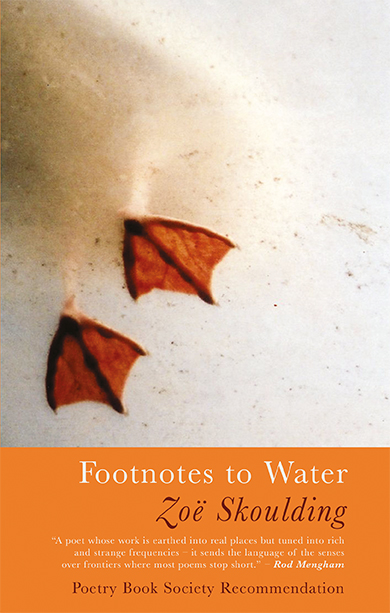
This week’s Friday Poem is ‘Secret Reverse’ by Zoë Skoulding from her collection Footnotes to Water which recently won the poetry category in Wales Book of the Year 2020.

In Footnotes to Water Zoë Skoulding follows two forgotten rivers, the Adda in Bangor and the Bièvre in Paris, and tracks the literary hoofprints of sheep through Welsh mountains. In these journeys she reveals urban and rural locales as sites of lively interconnection, exploring different senses of community, and the ways in which place shapes and is shaped by language.


Footnotes to Water is available on the Seren website: £9.99

Create your free Seren account and enjoy 20% off every book you buy from us.

Posted on

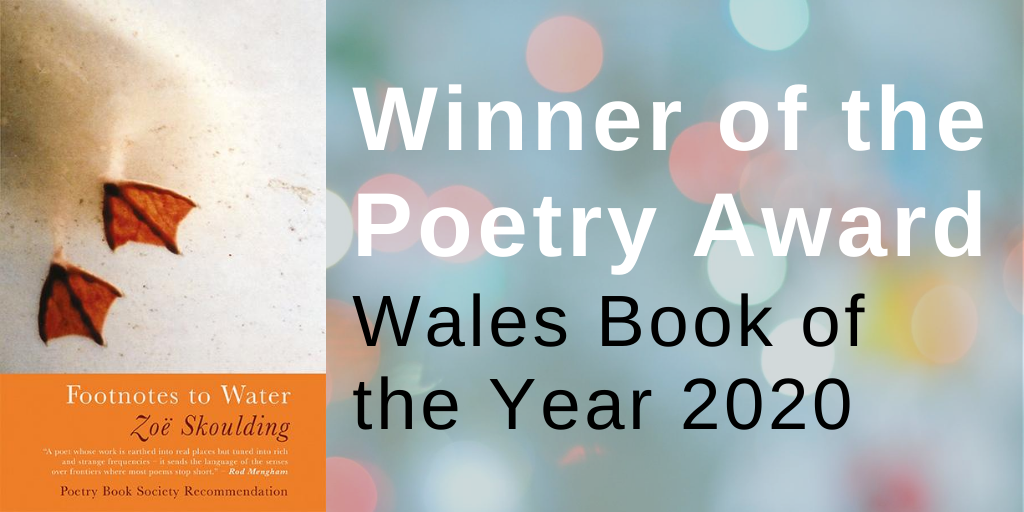
Zoë Skoulding wins the Poetry category in Wales Book of the Year 2020

We are delighted that Zoë Skoulding and her collection Footnotes to Water have won the poetry category in the Wales Book of the Year 2020.

In Footnotes to Water Zoë Skoulding follows two forgotten rivers, the Adda in Bangor and the Bièvre in Paris, and tracks the literary hoofprints of sheep through Welsh mountains. In these journeys she reveals urban and rural locales as sites of lively interconnection, exploring different senses of community, and the ways in which place shapes and is shaped by language.


Zoë was shortlisted for the award alongside two other titles, Erato by Deryn Rees-Jones and Fur Coats in Tahiti by Jeremy Over (Carcanet). The English-language winners were announced in a special awards programme on 31 July hosted by Nicola Heywood Thomas and broadcast on BBC Radio Wales.

Speaking about her win, Zoë said: “I’m delighted by this award, especially as Footnotes to Water is in conversation with Wales in all sorts of ways. Some of the poems grew out of dialogues with artists Ben Stammers and Miranda Whall, whose work explores Welsh landscapes through visual and performance art, while my own thinking about place and its relationships developed while I was editing Poetry Wales. I’m also glad that this award – and the shortlist – recognises the excellent work done by Seren Books in sustaining English-language poetry’s role in Wales’s cultural life.”

Amy Wack, poetry editor at Seren added: “Zoë Skoulding’s wonderfully inventive and subtly musical work remains both challenging and delightful, so pleased she has won this prize.” Lleucu Siencyn, CEO of Literature Wales, also commented that Zoë’s work “always feels fresh and new.”

The winner of English-language Book of the Year was Niall Griffiths with his novel Broken Ghost (Jonathan Cape) and Babel by Ifan Morgan Jones (Y Lolfa) was the overall winner of the Welsh-language award.

Speaking about the awards, Lleucu Siencyn said: “Wales Book of the Year is one of the highlights of our cultural calendar, and this year more than ever we are extremely pleased to be able to continue to shine a light on our incredible literary talents. Literature helps to guide us through our darkest hours, as well as bringing joy and hope to readers of all ages. Wales consistently produces excellent writers, and this Award is testament to this each year. Congratulations to all of this year’s winners!”

Wales Book of the Year is an annual award hosted by Literature Wales. Other categories include Fiction, Creative Non-fiction and, new for this year, Children and Young People. You can see the full list of winners in both Welsh and English on the Literature Wales website.


Footnotes to Water is available on the Seren website: £9.99

Watch Zoë reading alongside the other two shortlisted poets at our online WBOTY Poetry Shortlist Reading which is now available on our Youtube channel. 

[youtube=http://www.youtube.com/watch?v=1dVT-NARt5k]


Posted on

Zoë Skoulding wins the Poetry Category in Wales Book of the Year 2020

On Friday 31 July, it was announced that Zoë Skoulding and her collection Footnotes to Water have won the poetry category in the Wales Book of the Year 2020. The English language winners were announced in a special awards programme on BBC Radio Wales hosted by Nicola Heywood Thomas. 
Zoë was shortlisted alongside two other titles, Erato by Deryn Rees-Jones and Fur Coats in Tahiti by Jeremy Over (Carcanet). We were delighted to host all three poets at a special online reading last week ahead of the announcement which you can watch back here.
Speaking about her win, Zoë said: “I’m delighted by this award, especially as Footnotes to Water is in conversation with Wales in all sorts of ways. Some of the poems grew out of dialogues with artists Ben Stammers and Miranda Whall, whose work explores Welsh landscapes through visual and performance art, while my own thinking about place and its relationships developed while I was editing Poetry Wales. I’m also glad that this award – and the shortlist – recognises the excellent work done by Seren Books in sustaining English-language poetry’s role in Wales’s cultural life.”
Amy Wack, poetry editor at Seren added: “Zoë Skoulding’s wonderfully inventive and subtly musical work remains both challenging and delightful, so pleased she has won this prize.” Lleucu Siencyn, CEO of Literature Wales, also commented that Zoë’s work “always feels fresh and new.” 
The winner of English-language Book of the Year was Niall Griffiths with his novel Broken Ghost (Jonathan Cape) and Babel by Ifan Morgan Jones (Y Lolfa) was the overall winner of the Welsh-language award.
Speaking about the awards, Lleucu Siencyn said: “Wales Book of the Year is one of the highlights of our cultural calendar, and this year more than ever we are extremely pleased to be able to continue to shine a light on our incredible literary talents. Literature helps to guide us through our darkest hours, as well as bringing joy and hope to readers of all ages. Wales consistently produces excellent writers, and this Award is testament to this each year. Congratulations to all of this year’s winners!”
Wales Book of the Year is an annual award hosted by Literature Wales. Other categories include Fiction, Creative Non-fiction and, new for this year, Children and Young People. You can see the full list of winners in both Welsh and English on the Literature Wales website. 

Posted on

Friday Poem – ‘St Michael’s’ by Paul Henry

This week’s Friday Poem is ‘St Michael’s’ by Paul Henry from his collection The Glass Aisle.

The Glass Aisle Paul HenryThe Glass Aisle is Paul Henry’s tenth book of verse and features all the lyrical precision, empathy for the human condition and deep sense of temporal loss that have become the hallmarks of his work. The poems move between rage and stillness, past and present, music and silence. The title poem is a moving elegy to displaced workhouse residents, set on a stretch of canal in the Brecon Beacons National Park, in which a telephone engineer unwittingly connects the centuries.


The Glass Aisle (usually £9.99) is available for just £4.99 on the Seren website this weekend in our half-price Summer Sale!

We’ve got great deals across poetry, fiction and non-fiction all weekend on www.serenbooks.com. Sale ends midnight Monday 3rd August. Happy browsing! 

Posted on

An Interview with Euron Griffith

When he smiled it really did feel as if the chilly Caernarfonshire wind had stopped for a few seconds and as if the place had suddenly got warmer.

When Miriam fell in love with Padraig life seemed simple. But soon she discovered that love is a treacherous business. Everything changed when she met Daniel. She was taken down an unexpected path which would dictate and dominate the rest of her life.
Spanning three generations of a North Wales family in a Welsh-speaking community, Miriam, Daniel and Me is an absorbing and compelling story of family discord, political turmoil, poetry, jealousy…and football.

Miriam, Daniel and Me is the first novel in English by Welsh author Euron Griffith. In this interview, Euron tells us what inspired the novel and discusses what its like to bring a book out during a global pandemic. Scroll to the bottom to see the details of the virtual launch taking place this Thursday (30th July).

What was the inspiration behind Miriam, Daniel and Me?

Believe it or not, initially this was going to be a book about my lifelong obsession with the Beatles – a kind of ‘music memoir’ of how the band’s music reflected incidents in my own life. This seemed to make some kind of sense since I’d already written a short story collection called The Beatles in Tonypandy (which was a satirical fantasy on what ‘happened’ when the band moved to South Wales and took up pigeon fancying in 1967!) and so I wanted to write about them in a more personal and less surreal way. It soon became clear to me, however, that I was becoming more interested in the context of the piece – that is, my own experiences of my upbringing and my family history – than I was in the Fab Four’s peripheral and distant part in it. I found that the concept was becoming laboured and that I wasn’t making it come alive for myself and, therefore, it probably wasn’t going to work for anyone reading it. So the Beatles were soon rejected in a cruel, Decca-like fashion!

There were parts of my family history that I only had a vague knowledge of – my paternal grandfather for instance, whom I had never met because he died before I was born. I remember my granny and my dad telling me the story of how he had died suddenly in his chair after returning from the quarry one night but that was all I knew. I filled in the blanks myself – guessing here and there as to how things might have happened. The same was true of my mum. She had fallen in love with an Irishman before she met my dad but I didn’t know the whole story. As a kid I recall my maternal grandad showing me little bits of electrical handiwork this Irishman had constructed – little light switches etc. – so I knew he’d been an electrician and I’d seen photos of him so I knew he had red hair…but nothing much else. Only tantalizing fragments.

Once I’d stumbled across a photo of my mum walking down a street with him and, on the back, someone had written ‘Dublin’. She must have really loved him to go there for a visit. Especially in those days when travel wasn’t such a common thing. So here I did the same as I did with the story of my paternal grandad – I just tried to fill in the gaps. To make sense of it all. It soon grew into something of an obsession and, slowly, I saw that there was a novel brewing here. I weaved in my dad’s experiences as a poet and a goalie – how he had been invited for a trial with a big club once (in real life it was Bolton Wanderers but I changed it to Preston North End in this book…not entirely sure why to be honest!). Now, as I stand back and look at the finished piece, I can see that the overarching theme seems to be the notion of chance, often driven by love or passion, and of how it can affect the course of our lives.

The story is told through the eyes of multiple characters, particularly by three generations of Miriam and Daniel’s family. How is this inter-generational perspective important to the story?

The flippant answer would be that I get bored quite easily and I like to allow myself to dive into different characters and styles of narrative. But there is a more stylistic reason for it too. I love the way classic Victorian fiction such as Wuthering Heights and The Woman in White utilize a playful and effective way of presenting events through different viewpoints. I was also influenced in this by the films of Kurosawa and Quentin Tarantino. I was keen to hurl the reader back and forth without always giving an initial indication of when something was happening in ‘linear’ time because I thought it would heighten the dramatic effect. I suppose a simple example of this would be the rat poison incident (no spoilers!). The novel began with Miriam and Daniel’s story but, around this, there gradually grew the context of their lives- what happened before and what happened after (with the unnamed son). I played with time more outrageously in my last Welsh language novel Tri Deg Tri about a hitman where chapters were numbered in relation to the sequence of the central character’s ‘kills’ rather than to chronology. So I have form! Some readers found it puzzling but more, so I’m told, found it exhilarating!

My other challenge here – admittedly rather grand and insurmountable – was to try to write a kind of Welsh ‘bildungsroman’ – the story of a family and personal development featuring several characters. I was introduced to Buddenbrooks as a student and Thomas Mann’s masterpiece has stayed with me over the years. It certainly influenced me more strongly as this novel developed and the overall shape became clearer. Needless to say I could never come close to such a perfect piece of art but it gave me something to aim for! Aim high. Always aim high…

You build a clear picture of village life in 1950s and 60s Gwynedd by bringing in other members of the community and the events affecting their lives, namely the investiture of Prince Charles. Why was it important to you to bring this to life in Miriam, Daniel and Me?

It was a matter of context. Of filling in the canvas and making the whole world more real and multi-layered. I am a keen painter and there is a clear link, I reckon, between visual art and writing. Paul Klee once said that he liked ‘taking a line for a walk’ and that’s how writing begins for me. A line followed by another and, gradually (if you’re lucky), a world forms – a picture. Then it’s a matter of filling in the details. Picasso once said that the most difficult part of any painting was knowing when to stop. He was obviously right (when was Picasso wrong about anything??). In my own case I only recognise when to stop when it comes to re-writing. The first draft is always a sketch. I really don’t think you know what the book is until you’ve stepped back and studied the overall shape and pattern. It needs time. Re-writes. This novel went through at least three major re-writes! Curiously perhaps, this novel was also mainly written in London so there was an extra layer of distance there. James Joyce once said that he had to move to Zurich to write about Dublin. He wasn’t wrong about much either…

The book is coming out in very different circumstances to those any of us could have imagined but the BBC reported last week that Brits have been buying more books during lockdown. What makes Miriam, Daniel and Me a good lockdown read? What do you hope readers will take away from reading it?

Books and records are an obsession for me and if people are reading more and listening to more music then, in my world, that’s a good thing. Online trading is obviously booming in both these markets but I do worry about the wider context of physical retail – not only from the perspective of people’s livelihoods but also from a rather more selfish one. I really find wandering through shops and cities soothing and exciting so, in lockdown, I miss the bustle of the high street – the sights and sounds. When I was in London I would often hop on a bus in the afternoons and go to the middle of Piccadilly Circus and then wander around Soho just to soak up the atmosphere and work out things in my head to do with this novel and with other matters. I’m hopeful that things will return to normal soon.

In terms of what people will take away from this book there is the obvious factor of enjoyment of course but one of the reasons I wrote this book in English was because I don’t think north Wales and the ‘north Welsh experience’ has been explored as often in English language fiction as its southern counterpart. Most people when they think of Wales think rugby and the valleys but this is not strictly accurate. Rugby meant nothing to me when I was growing up and still doesn’t. Indeed, I vividly remember our PE teacher damning it as ‘a game for fat boys who are too slow for football’! My world when growing up was formed by television, football and pop music – the Monkees, The Man from UNCLE, Leeds United, Thunderbirds and Monty Python. Not by chapel or the Eisteddfod or Gareth Edwards. I never ‘got’ Shirley Bassey or Max Boyce and there were no coal mines in my part of Wales. I’m not entirely sure what ‘Wales’ is. My guess is that there are at least twenty versions of it and I didn’t think the story of mine had been told.

We’re hosting an online launch for the book later this week. What can attendees expect at the event?

Well Jon Gower is a perceptive reader and I’m intrigued to know what he thinks of the novel. He always has an interesting perspective on things. I’m thrilled that Rakie Ayola has agreed to read a few passages from the novel. She is such a brilliant actor. Hopefully the conversation and the readings will stimulate all the many thousands tuning in via Zoom to buy the novel and send it to the top of the Sunday Times best seller chart…

Finally, a question lots of writers have probably been asked recently, but have you found lockdown a particularly creative time? Is there anything you’re currently working on?

Writing never stops for me. After finishing this novel I immediately returned to a manuscript I started ten years ago and have been working on intermittently since then. I finally finished it just before last Christmas. It’s a peculiar, surreal ‘historical’ novel based on the adventures of a gentleman traveller. Influenced by ‘Don Quixote’ and more modern pieces such as ‘Life of Pi’ it features a man mistaken for Jesus, a three-legged cat, a serial killer and cannibalism. So it couldn’t be more different to Miriam, Daniel and Me! It’s called The Confession of Hilary Durwood. Since lockdown I’ve started another novel. I was up to 40,000 words before realising that it wasn’t much good so I scrapped it and started again. It’s much better now.

Before Covid struck I played regularly in my band Six Sided Men but, naturally, all that is on hold now. But I’ve been writing tons of songs and recording them myself on my little portastudio (driving my wife mad in the process as we have inadequate soundproofing!). I’m currently recording some Christmas songs I’ve written and will include these on a CD for friends when the season for merriment arrives…

I’ve also been painting and drawing. So yes. A worrying time in many ways. But I can’t say it’s been entirely unproductive…


Miriam, Daniel and Me is available now from Seren: £9.99

Join us for the virtual book launch – Thursday 30th July, 7:30pm. Euron will be in conversation with Jon Gower and actress Rackie Ayola will be reading excerpts from the book. Email [email protected] for the link. Full details here.

Create your free Seren account and enjoy 20% off every book you buy from us.

Posted on

Friday Poem – ‘Soundings, Newtown’ by Katherine Stansfield

This week’s Friday Poem is ‘Soundings, Newtown’ by Katherine Stansfield from her new collection We Could Be Anywhere By Now

In her second collection, We Could Be Anywhere by Now, Katherine Stansfield brings us poems about placement and displacement full of both wry comedy and uneasy tension. Stints in Wales, Italy and Canada, plus return trips to her native Cornwall all spark poems delighting in the off-key, the overheard, the comedy and pathos of everyday life.

‘multi-layered and full of surprising transitions’ – Patrick McGuiness

We Could Be Anywhere By Now is available on the Seren website: £9.99

Create your free Seren account and enjoy 20% off every book you buy from us.

Watch Katherine reading her poem ‘The suitcases’ on our Youtube channel

[youtube=http://www.youtube.com/watch?v=RaU7tFJQpD0]