Posted on

Friday Poem – ‘Steel’ by Paul Henry

To celebrate the Six Nations and St David’s Day on the 1st March, this week’s Friday Poem is ’Steel‘ by Paul Henry from The Brittle Sea: New and Selected Poems.

This cover shows an abstract painting by Antony Goble of a red moon-shaped face amidst a swirling blue seal The text reads: Paul Henry, The Brittle Sea, New and Selected Poems

With a musician’s ear and an artist’s eye, Paul Henry’s poems of love and fatherhood, informed by the Welsh-speaking community of his childhood, bridge both the rural and urban experience. The Brittle Sea reacquaints readers with Henry’s vast gallery of characters, from the boy having his hair cut in ‘Daylight Robbery’ to the ghosts of his long, Newport poem, ‘Between Two Bridges.’ The new poems section includes the popular ‘Steel’, inspired by the Welsh national rugby team; others which revisit some of ‘The Visitors’ from The Milk Thief; and a moving elegy for the painter Anthony Goble.

Steel

(i) 10

Turn like a key
in the game’s lock
and open the score
with a kick –
open a door in the air
onto blue sky.

I dreamt I opened a door
in the sky
and half the world cheered.
I dreamt I surfaced
into a roar.
No sky was like this before.

Dart like a hare
through a hedge at dusk
and open the score
with a try –
open a door
in the earth.

I dreamt I opened a door
in the earth
and rose into light
out of an underworld
where, for years,
I carried their ghosts on my back.

Flash like a link
in a steel chain
like the sun on the sea
or a wave
in the industry
of a rising tide.

I dreamt I surfaced
into a roar.
The seagulls
shrill as whistles
were red and white.
I dreamt my ghosts had taken flight.

The Brittle Sea is available on the Seren website: £9.99

Paul Henry’s forthcoming collection As if To Sing is available to pre-order now on the Seren website. Publishing 11th April 2022.

Create your free Seren account and enjoy 20% off every book you buy direct from us.

Posted on

Celebrating Welsh Dark Skies Week

The 19th to the 27th February 2022 is the inaugural Welsh Dark Skies Week, a week-long series of events designed to raise awareness of light pollution and how it impacts wildlife, our health and our view of the stars. Wales has one of the largest percentages of protected dark skies in the world. The events this week also recognise the effort undertaken to preserve these protected landscapes for future generations.

In his book Dark Land, Dark Skies, astronomer Martin Griffiths marries the constellations as we know them with ancient Welsh stories from the Mabinogion to create a new perspective on the the night skies. Find out more in this extract.

This cover shows a photo of a black sky filled with stars. The text reads: Dark Land, Dark Skies, Martin Griffiths

In Dark Land, Dark Skies astronomer Martin Griffiths subverts conventional astronomical thought by eschewing the classical naming of constellations. He researches the past use of Welsh heroes from the Mabinogion in the naming of constellations, combining astronomy with a new perspective on Welsh mythology. The result is an informative and provocative guide to star-gazing which will delight amateur and professional astronomers alike. 

Dark Land, Dark Skies

One cannot escape the majesty of the heavens, the overwhelming perception of being a very small part of such a monumental edifice as the starry sky above us. Yet at the same time, one cannot help but feel at one with it. Such is the magnitude and wonder of our universal home that it comes as no surprise that the heavens have been studied from the time that man first walked the Earth. Every ancient civilization looked to the stars, grouped them into constellations and imbued them with a narrative hoping that the wisdom seen in the night sky would have a marked effect upon the course of life they could lead.

The ancient peoples of Britain, and especially the Cymru or the tribes that eventually would live in the land of Wales, also had their own cultural affinity for the sky. Many of the tales they told were shared in oral traditions that have been lost over the centuries. Others were recorded in post-Roman Britain by bards who kept the traditions alive.

In the immortal words of Monty Python: “what have the Romans ever done for us”? Well, they left us an invaluable system of writing and Roman script, so ancient tales began to be recorded by those who could read and write after the Roman system of education. This script was used to create the first poems and stories about Wales that drew upon some earlier oral traditions and tales. The oldest collected tales are from sources in thirteenth century Wales and probably date back to the fifth and sixth centuries, the time of the poets Taliesin and Aneirin. Both feature the lives of the princes of an extended kingdom of Wales: Aneirin was born in Edinburgh and wrote his classic tale of battle and loss Y Gododdin after the Anglo-Saxon invasion of eastern England. He is the first to mention some of the deeds of King Arthur. Conversely, Taliesin probably moved from court to court as his works in the Book of Taliesin praise king Urien of Hen Ogledd (now northern England and southern Scotland) and Brochfael Ysgithrog of Powys amongst others. This shows that Welsh as a language was highly influential in Britain at the time, and was probably the lingua franca of most of the country. So, tales of the great deeds and how they fitted into the sky would be commonplace in Celtic, early English and Pictish culture due to this literary influence.

The majority of old Welsh tales and poetry are known from a few volumes, Hanes Taliesin, the Black Book of Carmarthen, the Red Book of Hergestand the White Book of Rhydderch. Collectively some of these tales, poems and insights became the Mabinogion, the folk tales of Wales which were translated into English and published by Lady Charlotte Guest, albeit in a rather bowdlerized Victorian fashion, as a way to bring these tales to the masses that flooded into Wales during the eighteenth and nineteenth centuries to work the iron and coal that put the country at the forefront of the industrial revolution. It also raised the language and culture of Wales to a status probably not enjoyed previously and gave Welsh literature, folklore and storytelling a similar status to classical Greek and Roman myths and poetry.

Today the Mabinogion and its related texts are a great resource of academic scholarship and argument. But that is not what I intend to explore here. Instead I will take some of these ancient tales and marry them to the constellations that they pre-figure in the sky or at least are associated with in legends and tales across the Celtic systems of Wales, Ireland and Scotland, including that of some English folk tales that have an origin in Celtic myths. I will do this to show that there is a rich culture of sky lore that ties events, stories and meanings together in a way that is fairly unique to Wales, and which is as important as the classical Greek myths that are usually used to illustrate the night sky.

Also of importance to this book is the fact that the night sky is threatened by increasing light pollution and that the education system that disseminates such myths, in English, Welsh or science classes, is also threatened. Many people in urban areas have never encountered the Milky Way or seen a truly dark sky. Additionally, they have probably not been introduced to the night sky or its store of treasures in a way that ties the wonders of our modern understanding to the cultural roots of the past. This book is intended to redress that balance, not only to show some of the beauty of the night sky, but to marry that beauty to the ancient Celtic landscape and tales of Wales.

The number of dark sky parks and dark sky reserves is now increasing due to the coordinated efforts of the International Dark Sky Association, the Commission for Dark Skies in the UK and other interested bodies globally. The scourge of light pollution and the carbon footprint necessary to generate the power to light up the night sky needlessly is now being recognized by smaller groups and public interest bodies such as local councils and national parks.

Wales is fortunate to have two International Dark Sky Reserves: Brecon Beacons National Park and Snowdonia National Park, areas where the dark night sky is preserved for future generations. These beautiful landscapes and their pristine skies are joined by the Elan Valley Dark Sky Park in mid-Wales and by ongoing work toward ensuring dark sky communities in Anglesey and the Pembroke Coast National Park. Wales may truly be called the first Dark Sky Nation, a fact of which we can all be proud as the heritage of both land and sky are safeguarded for future generations.

Capitalizing on this status it is possible to build and utilize a small observatory for public education and to enhance the experience of the night sky for everyone. The Brecon Beacons International Dark Sky Reserve has such an observatory and a teaching classroom at the National Park Visitor Centre, which has been used extensively for training and for public events since it opened in 2014.

Using such an observatory can be a wonderful experience, especially for urban-based astronomers who don’t have access to very dark skies. Even those who may have portable equipment and have taken advantage of the dark sky status of the National Park enabling them to enhance their viewing will find the facilities at the observatory will allow access to the wonders of the night sky that they cannot reach from light-polluted areas.

In the case of the Brecon Beacons Observatory (BBO), its 30cm f5 reflector on a driven EQ6 mount thrilled over a thousand visitors in its first year of operation. Fitted with a piggybacked 120mm refractor for DSLR imaging or just visual observing and an Atik 314L CCD camera for imaging of objects, this small observatory has added to the experience of tourists and local astronomical societies within the national park and in south Wales generally. The BBO also has the advantage of a classroom at the visitor centre to enable education throughout the year. It is a place where the public can receive astronomy presentations and enjoy the warmth and conviviality of hot drinks on tap!

George Borrow, the nineteenth century Victorian gentleman traveler wrote in his book Wild Wales of the brooding, dark landscapes he encountered as he traversed the country. Those landscapes still exist in the heights of the Snowdonia mountains, the Cambrian range, the wine red hills of the Brecon Beacons, the shaded uplands of Mynydd Preselli and in the moorland landscapes of mid Wales. The mysterious waters of Wales’ lakes, mountain tarns, rivers and seas are at the heart of many tales that tie semi-mythical figures who trod the land with the starry patterns of the sky. That is the landscape and skyscape that I wish to bring to life and share with generations to come: the spectacle, wonder, curiosity and pride aroused in me from these old tales that I first learned as a boy. I hope that I have done them justice.

As so many of these old tales have been passed down orally, many aspects of them have changed over the years. Some of the associations between land, tale and sky are just discernable, whilst others are obvious in their placement with a particular constellation. Others share common themes across many cultures, and tales were probably shared among peoples, evolving and dispersing as their cultures fractured after the Roman withdrawal from Britain and greater Europe. It is not my intention to gerrymander tales into particular groups, but to make those possible connections plain and tell not just the Welsh side of the story but to include the classical interpretations too.

I hope that the reader enjoys this journey through the Welsh mythological landscape. I also hope that knowing some of these tales and their heavenly associations will bring a new interest to the night sky and any stargazing experience they will have.

Martin Griffiths BA BSc MSc FRAS FHEA

Brecon Beacons Observatory

Visit discoveryinthedark.wales for more information about Welsh Dark Skies Week 2022.

Dark Land, Dark Skies is available on the Seren website: £9.99

Create your free Seren account and enjoy 20% off every book you buy direct from us.

Posted on

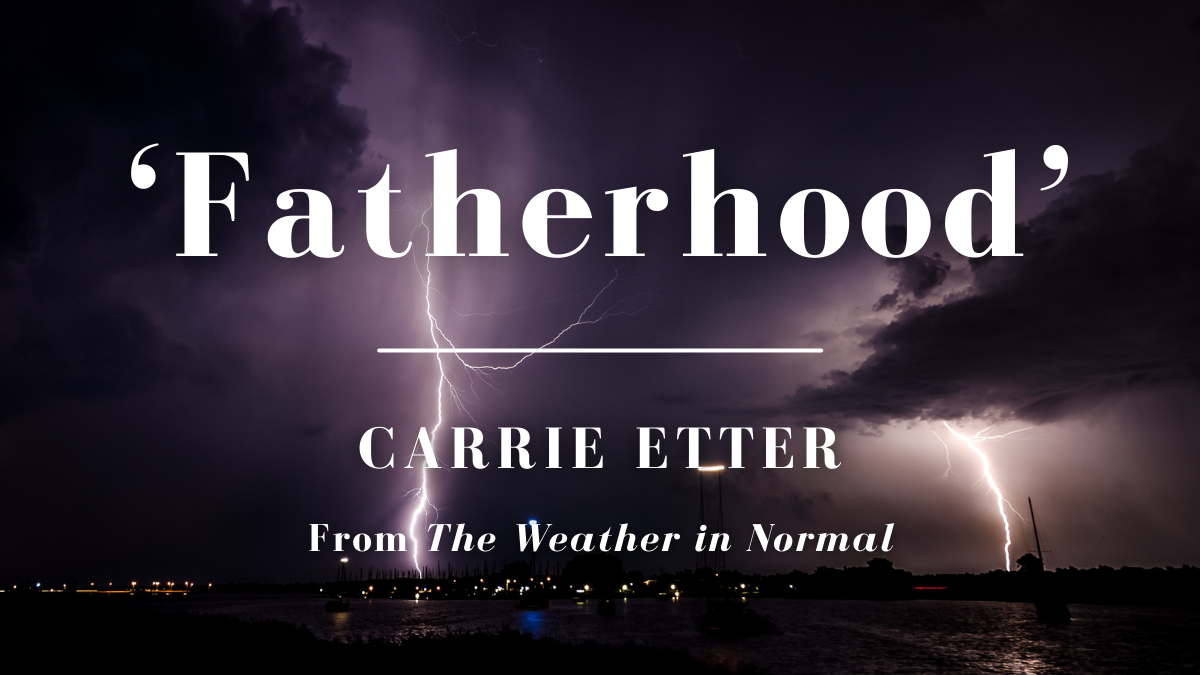
Friday Poem – ‘Fatherhood’ by Carrie Etter

This week’s Friday Poem is ‘Fatherhood’ by Carrie Etter from her collection The Weather in Normal.

This cover shows a straight road stretching into the distance beneath a story sky. A single bolt of lightening strikes the ground in the distance. The text reads: The Weather in Normal, Carrie Etter.

Carrie Etter is known for beautifully expressive and formally inventive verse. The Weather in Normal, her fourth collection, explores the changes to her hometown of Normal, Illinois following her parents’ deaths, the sale of the family home, and the effects of climate change on Illinois’ landscape and lives. The author’s restlessly inventive use of multiple tones, shifting line lengths, and fresh turns of phrase are as much a means of conveying complex and paradoxical emotions as they are a determined formal strategy.

Fatherhood
The weather belongs to everyone, so you may say, but in our family, it
was his. It was his study by internet, television, radio, barometer, and
long rides cycling past the cornfields in all their seasons and moods.
He witnessed and reported, and when I moved away, he expanded his
research accordingly, learned my temperature, precipitation, wind speed,
and humidity. He marveled at my extremes – the Northridge earthquake,
a tornado in London. By phone he told me my weather, and sometimes I
listened. Sometimes I spoke of the sun and the rain as though I held one
in either hand.

The Weather in Normal is available on the Seren website: £9.99

Create your free Seren account and enjoy 20% off every book you buy direct from us.

Posted on

Poetry for Valentine’s Day

Celebrate Valentine’s Day with poetry collections that explore many different kinds of love. Don’t forget to sign up to our book club for 20% off all books you buy directly from us.

The Brittle Sea: New and Selected Poems by Paul Henry

This cover shows an absract painting by Anthony Goble. It give the appearance of sea with a red boat, a brick church and a moon like face amongst the waves.

With a musician’s ear and an artist’s eye, Paul Henry’s poems of love and fatherhood, informed by the Welsh-speaking community of his childhood, bridge both the rural and urban experience. The Brittle Sea reacquaints readers with Henry’s vast gallery of characters, from the boy having his hair cut in ‘Daylight Robbery’ to the ghosts of his long, Newport poem, ‘Between Two Bridges.’ The new poems section includes the popular ‘Steel’, inspired by the Welsh national rugby team; others which revisit some of ‘The Visitors’ from The Milk Thief; and a moving elegy for the painter Anthony Goble.

Heat Signature by Siobhán Campbell

This cover shows an abstract painting of red flowers that look like flames.

Heat Signature is the intelligent, provocative new collection of poems from Siobhán Campbell. An Irish poet, Campbell has inherited a rich vocabulary, the necessary ‘slant’ point of view, and a store of lively anecdote. This is a poetry that resists rapture and/or easy solutions, it rather glories in difficulty: the cussed, intractable nature of humanity, of a natural world beset with swarming bees, weeds and feral horses. There is a beautiful balance throughout between the forthright and the ironical. Heat Signature continues her fascination with her homeland in all its incarnations, both ancient and modern. These poems challenge preconceived notions as they resist cliché.

Masculine Happiness by David Foster-Morgan

This cover had a predominantly green and black background with a painting of a young man wearing a red and black striped top on the right hand side.

Masculine Happiness is a provocative yet subtle collection which explores the author’s ambivalence towards models of masculinity handed out to us by the media and modern society. Complex, ironic, layered, fashioned with an acute and subtle intelligence, these poems are as likely to reference Elvis as Borges. There is also a considerable amount of humour here, along with astute satire and insightful character poems. Foster-Morgan’s work repays the careful attention of thoughtful readers.

You by John Haynes

This cover has a pale yellow background. A close up photo of a Nigerian woman's face sits in the middle. She is wearing a checked head scarf and wide round glasses.

You is a book-length poem by the late poet John Haynes. The ‘You’ of the title is the narrator’s partner and wife of many years. The book is not just a celebration of, and meditation on, personal love and devotion, but a record of how such love moves out of a family and is refracted out into the community and the wider world. The tensions inherent in this are compounded by the cross-cultural nature of the union. The narrator is a white British man and his wife was born and raised in Nigeria. Exploring a partnership based on culturally quite different – and in some aspects painfully incompatible –conceptions of ‘love’, the poem  is knit together by philosophical themes of ‘I’ and ‘you’ seen from many perspectives. Shortlisted for the T.S Eliot Prize.

Other Women’s Kitchens by Alison Binney

This cover shows a colourful abstract painting of a kitchen inhabited by shadowy figures.

Other Women’s Kitchens by Alison Binney’s introduces us to a gifted new voice who writes with flair and feeling about coming out and coming of age as a gay woman in 21st century Britain. Winner of the Mslexia pamphlet prize for poetry, the collection explores the challenges of discovering and owning a lesbian identity in the 1980s and 1990s and the joy of finding both love and increased confidence in that identity as an adult. An adroit admixture of the heart-wrenching and the humorous, the book features shaped and ‘found’ pieces, traditional narrative and compact prose poems. Beautifully entertaining, pointedly political and often very funny, Other Women’s Kitchens is essential reading.

Erato by Deryn Rees-Jones

This cover shows a blurred black and white image of a woman dancing with her arms out to the sides.

Taking its title from the muse of lyric poetry, Rees-Jones’s fifth collection Erato questions how we know and write about the beauty and the horrors of the world. Documentary-style autobiographical narratives are set alongside lyric fragments and poetic sequences as the repetitions of trauma and the errors and erasures of memory are explored. This is a book full of flames and scars, landscapes and animals; at its heart is a desire for the transformative music that runs beneath words, and an understanding of the bodies we inhabit when we love. Shortlisted for the T.S Eliot Prize.

A Second Whisper by Lynne Hjelmgaard

This cover shows an abstract painting made up of blue, grey and splashes of yellow with two figures in the foreground.

A Second Whisper is a thoughtful and sensitive collection that reflects the changing identities of a woman: in motherhood, in widowhood, in friendship and grief. There are elegies to the loss in 2014 of her mentor and partner, the poet Dannie Abse which are a tribute to their deep friendship. There are also poems to her late husband who died in 2006 and for their children and for relationships from the author’s past in New York City and Denmark. The poems are both elegiac and celebratory: they move and change tone as the author travels to the past and negotiates through the geography of grief and feelings of displacement in London, and finally opens to her new life in the present.

Browse a wide range of fantastic poetry collections on our Poetry pages, or visit Coming Soon to pre-order books coming out in 2022.

Posted on

Friday Poem – From ‘You’ by John Haynes

With Valentine’s Day on the 14th February, this week’s Friday Poem is taken from the long-poem You by Costa-Award winning poet John Haynes.

You is a book-length poem by the late poet John Haynes. The ‘You’ of the title is the narrator’s partner and wife of many years. The book is not just a celebration of, and meditation on, personal love and devotion, but a record of how such love moves out of a family and is refracted out into the community and the wider world. The tensions inherent in this are compounded by the cross-cultural nature of the union. The narrator is a white British man and his wife was born and raised in Nigeria. Exploring a partnership based on culturally quite different – and in some aspects painfully incompatible –conceptions of ‘love’, the poem  is knit together by philosophical themes of ‘I’ and ‘you’ seen from many perspectives. Shortlisted for the T.S Eliot Prize.

that they flew back across the whole Sahara
sleeping on the wing, as you begin
to now, with those small sounds, back to Kagoma –
that house where I met your mother in
her starched tall headtie and her Dutch wax print
and just a little shy to meet your White
Man, but so glad with wrinkles smiling tight –

just as I bend across you, turn the lamp
off, draw the curtains, thinking with what skill
I managed it on that rickety camp
bed, making love with not the faintest squeal
or crunk of springs. Like press-ups, I recall,
rugby-fit then, mouth open while I howled
into the dark not letting out a sound,

or that night, at the dam, when we made love,
remember, there beside the road, half in
the car half out, with confidence enough
to dare the world to drive towards us, then
with full light on, and nights at Number Ten,
insane with flesh, and resurrected new
again each time as neither I nor you.

You is available on the Seren website: £8.99

Create your free Seren account and enjoy 20% off every book you buy direct from us.

Posted on

Friday Poem – ‘Sailing by Silvership’ by Polly Atkin

This week’s Friday Poem is ‘Sailing by Silvership’ by Polly Atkin from her most recent collection Much With Body.

This cover shows a painting of a swimmer floating on her back in a blue-green lake.

Much With Body is the startlingly original second collection by poet Polly Atkin. The beauty of the Lake District is both balm and mirror, refracting pain and also soothing it with distraction. Much of the landscape is lakescape, giving the book a watery feel. There is also a distinct link with the past in a central section of found poems taken from transcripts of the journals of Dorothy Wordsworth, from a period late in her life when she was often ill. In common with the works of the Wordsworths, these poems share a quality of the metaphysical sublime. Their reverence for the natural world is an uneasy awe, contingent upon knowledge of our fragility and mortality.

Sailing by Silvership
The moon is a ship
and we are sailing in her
how can we not talk about her?
She glistens
and we glisten
she throws out nets of herself, trailing
clouds like weeds
and we walk them as bridges
to the stars, arm in arm, singing.
And the stars themselves
are glistening aren’t they?
like specks of quartz in dark rock, spangling
the great unknowable
expanse as it squeezes
into this particular wedge of night
the swell of this road
the dark fell sea
soon, we will be there, sister
waving from the deck
of the one you call
dipper – so big we can sit in it! – no
so big
it will carry us away.

Much With Body is available on the Seren website: £9.99

Create your free Seren account and enjoy 20% off every book you buy direct from us.