This week’s Friday Poem is ‘Roadblock’ by Ilse Pelder from her newly published debut collection Auscultation.
Ilse Pedler is a veterinary surgeon who works in Kendal. Her debut collection is Auscultation, which means listening and specifically, in medicine, listening to sounds that come from the body’s internal organs. If listening is a central theme of this collection, it is also about being heard. There are poems about vets waiting rooms and surgical instruments, about crisis calls, about overhearing farmers and pet owners and colleagues. There are also poems about surviving a stern childhood and a heartbreaking sequence about being a stepmother.
To celebrate publication of his new collection Karaoke King, Dai George has created a playlist of songs which tie in with the collection. Read on to find out what he chose and why.
This confident second collection by Dai George addresses the contentious nature of the times. Always deeply thoughtful but also alternately ebullient, angry, curious, ashamed, the poet moves through urban and digital spaces feeling both uneasy and exhilarated. As with the Auden of the inter-war period, there is a feeling of history shifting, as a younger generation confronts its ethical obligations, its sense of complicity and disappointment. Ecological crisis hovers in the background, glimpsed in the ‘Fooled Evening’ of a world whose seasonal rhythms have fallen out of joint. Karaoke King also contains numerous reflections on popular culture, culminating in ‘A History of Jamaican Music’, a sequence at the heart of the volume speaking to urgent contemporary questions of ownership and privilege, pain and celebration.
Karaoke King – A Playlist
The Lumineers – ‘Ho Hey’
The Platters – ‘The Glory of Love’
Teddy Pendergrass – ‘I Don’t Love You Anymore’
McFadden and Whitehead – ‘Ain’t No Stopping Us Now’
Frank Sinatra – ‘New York, New York’
Big Star – ‘Nightime’
David Bowie – ‘Station to Station’
Treorchy Male Voice Choir – ‘Myfanwy’
Lord Laro – ‘Jamaican Referendum Calypso’
The Ethiopians – ‘Train to Skaville’
The Skatalites – ‘Guns of Navarone’
The Uniques – ‘People Rocksteady’
Alton Ellis – ‘Rocksteady’
Derrick Harriott – ‘The Loser’
The Paragons – ‘On the Beach’
The Techniques – ‘Love Is Not a Gamble’
Lee ‘Scratch’ Perry – ‘Croaking Lizard’
The Congos – ‘Nicodemus’
Bob Marley & the Wailers – ‘No Woman, No Cry’
The Uniques – ‘My Conversation’
Gregory Isaacs – ‘Soon Forward’
Sister Nancy – ‘Only Woman DJ with Degree’
Yellowman – ‘Zungguzungguguzungguzeng’
Sizzla – ‘Babylon A Use Dem Brain’
Count Machuki – ‘More Scorcha’
The Heptones – ‘Party Time’
I-Wayne – ‘Living in Love’
The Maytals / Sister Nancy – ‘Bam Bam’
Charles Trenet – ‘La Mer’
Bruce Springsteen – ‘Thunder Road’
Dusty Springfield – ‘Wishin’ and Hopin’’
Bob Dylan – ‘Just Like Tom Thumb’s Blues’
In another lifetime, I tried to be a music journalist. A teenage pop nerd, I grew up reading too many issues of Mojo and the NME, and built my identity in large part around the songs that gave me solace, joy, a sense of difference. One way or another the journalism thing didn’t happen, but my new collection of poems, Karaoke King, maybe represents an attempt to grapple with the legacy of that obsession.
Poetry, of course, can’t offer what journalism can: it can’t give you facts, analysis, coherent narrative, or if it tried to do that it would be very bad at it. What it can do, though – maybe – is capture how songs hit the mind. It can sift significance, and work towards some understanding of how an individual stands in relation to these musical artefacts that are at once fixed, specific, culturally determined, and yet endlessly transmissible from radio to radio, mouth to mouth, ear to ear. From the liturgical prayers I heard being sung at Canton Uniting, my childhood church, to the Neighbours theme tune, Karaoke King is full of songs overheard, half-remembered, reapproached, transposed – hauntings and visitations. I thought it would be fun, and maybe interesting, to put together a playlist for the collection, with a set of ‘sleeve notes’ fleshing out the story of how these songs came to be there.
The first four tracks all come from ‘Poem on 27th Birthday’. Set in a hilltop bar in Italy, and written more or less in situ in September 2013, it was the first poem I finished after wrapping on my debut collection, The Claims Office. I tried to be more open and porous in writing than I’d allowed myself to be till that point, and for me that meant tuning into the ambient sounds, letting them bleed into a collage. The dominant tune is an earworm blaring from a nearby car stereo, a sweet-natured, folky track I recognised but couldn’t place – later I found out it was called ‘Ho Hey’ by the Lumineers. It’s the sort of song that Adolescent Me would have scorned, but in a charmed moment it came across, in the words of the poem, ‘as nothing less than the Glory of Love’, a nod to the great doo-wop song of that name by The Platters.
The other songs filter in from a compilation of ’70s funk and Philadelphia soul that the barman switched on to replace the slick elevator jazz that had been playing till then. So we have a singer I recognised, Teddy Pendergrass, singing a song I didn’t know in the moment but later tracked down as ‘I Don’t Love You Anymore’ – one of his first solo singles, a four-to-the-floor disco ripper about breaking somebody’s heart – and this soon flows into ‘Ain’t No Stopping Us Now’ by McFadden and Whitehead. Songs touching songs, overlapping, building resonances. I most certainly did love the addressee of the poem, so it’s the McFadden and Whitehead song that takes over, its message of empowerment modulating through the speaker into gratitude for love.
More earworms, next, with Frank Sinatra’s‘New York, New York’, overheard on one of my many circuits of Clissold Park in Stoke Newington over recent years. The poem it’s taken from is called ‘The Park in the Afternoon’, which unsurprisingly is about parks in the afternoon, but also the neoliberal cult of productivity that turns people into a political problem if they have nothing to do at that time of day. I loved the weird euphoria of this song, with its glitzy promise of inclusion – I wanna be a part of it! – being reclaimed as an anthem of solidarity or defiance.
‘Night Time’ by Big Star is one of the darker songs on this playlist, a theme tune for a run of poems in the first section of Karaoke King which map a hard time in my life – a dark night of the soul. The song itself is quoted in a poem called ‘Rock vs Pop’, an elegy to Roddy Lumsden. Roddy and I bonded originally over music, meeting on an internet forum called Black Cat Bone where debates like ‘Rock vs Pop’ could become seriously heated. Big Star were the sort of group that exposed how hollow that dichotomy is, and I know Roddy was a big fan of their legendary, troubled third album, Sister Lovers. It’s another song about wanting to be a part of it – At night time I go out and see the people – only this time there’s no Sinatra-esque bravado: the irony of that desire is painfully apparent the moment you hear Alex Chilton’s fragile, haunted vocal.
David Bowie’s ‘Station to Station’ is more literally about a long night of the soul – a long and disoriented journey. The poem I wrote about it for Alex Bell and John Canfield’s ‘Bowieoke’ night (and subsequent anthology Cold Fire) tries to capture the sense of blackout and damage on that record, but also to deconstruct the iconography of the Thin White Duke, his persona of the time. Whiteness is of course a part of that formulation, and it’s one of the tacit themes of this book that white pop music culture must grapple honestly with its numerous, often unspoken debts to Black musicians and Black musical idioms.
The place in the book where I’ve tried to confront this legacy, as openly as possible, is ‘A History of Jamaican Music’. The reggae songs on this playlist all offer up quotations and allusions from that sequence, and taken together I think they make for a great, roughly chronological listen. I’ve written about the genesis of this sequence before, so don’t want to belabour the point. All I’ll say here is that, just as these musical selections offer one, partial journey through the rich heritage of reggae, so too do the poems, from my own, very subjective perspective. I wanted to reflect honestly on my relationship to a music and a culture that is too often enjoyed in a passive or exploitative way by British people. These are indeed songs of joy – and songs that can, and should, be enjoyed widely, I believe – but also struggle and complexity; songs, moreover, that could never wholly belong to me, or anyone in my position.
Before we get to them, though, we pass through a song from a culture that is indisputably my own. ‘Myfanwy’ is beautiful, of course, and probably familiar to many people. The title poem of the collection remixes it as a death fugue, a mouldering totem for a certain dubious, romantic myth of Welshness – so I’m glad to pay tribute to it here as God, or the Treorchy Male Voice Choir, intended it. Reading that poem, the eagle-eyed might spot a few references to Twin Town, a film I still love despite its ridiculous, shallow, very unromantic vision of Welshness. (The title of the collection itself, Karaoke King, is a moniker given to the film’s hapless Elvis wannabe, Dai Rhys.) The film’s final scene of a sea burial serenaded by a suited and booted male voice choir crooning ‘Myfanwy’ sums up much of what is funny and pathetic about those old myths and their modern revivals. Maybe one day we’ll be able to hear ‘Myfanwy’ differently again, stripped of all the pageantry.
There’s a wistful turn to the final few songs on the playlist. Charles Trenet’s ‘La Mer’ wafts in like the last day of summer or the first of autumn, a mood I wanted to channel for a poem called ‘September’s Child’. That in-between, nostalgic cusp state more or less represents the situation with my hair right now. ‘Poem in which my hairline recedes’ is the vessel for those (rather trivial) anxieties, and Bruce Springsteen’s ‘Thunder Road’ is the sonic foil – another yearning cusp song, only this time one that stands on the brink of impossible self-realisation and success.
After that, yet more ‘Wishin’ and Hopin’’ from Dusty Springfield, one of my favourite singers. From my teens I’ve always been drawn to classic girl group pop and its soft-soul, adult-oriented offshoots – Dusty, Dionne Warwick, the songs of Bacharach and David, Goffin and King. I saw in this music a model for my own hopelessness in love: solace and fellow feeling in a woman’s voice, when it was women that I yearned for. The poem ‘Obsolete Heartbreak Suite’ is a type of farewell to all that, and an attempt to reckon with the gendered dynamics of the art form, with its unequal distribution of male and female creative labour. I still love all those Brill Building songs but the drama and intensity is second-hand now, thankfully.
Finally, we come to ‘Just Like Tom Thumb’s Blues’ by Bob Dylan. After listening to the glorious official version from Highway 61 Revisited, do seek out the alternate takes that are collected on The Cutting Edge, a box set covering Dylan’s time in the studio during the famous ‘Thin Wild Mercury’ years of 1965-66. It’s the sound of those false starts and early drafts that I wanted to capture in ‘The Mercury Mine’ – Dylan’s painstaking, instinctive graft as he toys with a phrase until he gets it right, rearranging speech parts, nudging them into better arrangements. It’s something of a cliché to talk about ‘pop perfection’, and I’ve loved enough brilliant, three-minute pocket symphonies to understand what people might mean by it. But I think a space for poetry opens up whenever we encounter pop imperfection – hesitance, provisionality, the formation of ideas. That’s one way into it, anyway. Another might be to follow what happens when we encounter perfect music amid the mess and imperfection of our lives.
This week’s Friday Poem is ‘September’s Child’ by Dai George from his new collection Karaoke Kingwhich was published this week.
Dai George’s confident second collection Karaoke King, addresses the contentious nature of the times. Always deeply thoughtful but also alternately ebullient, angry, curious, ashamed, the poet moves through urban and digital spaces feeling both uneasy and exhilarated. As with the Auden of the inter-war period, there is a feeling of history shifting, as a younger generation confronts its ethical obligations, its sense of complicity and disappointment. Ecological crisis hovers in the background, glimpsed in the ‘Fooled Evening’ of a world whose seasonal rhythms have fallen out of joint. Karaoke King also contains numerous reflections on popular culture, culminating in ‘A History of Jamaican Music’, a sequence at the heart of the volume speaking to urgent contemporary questions of ownership and privilege, pain and celebration.
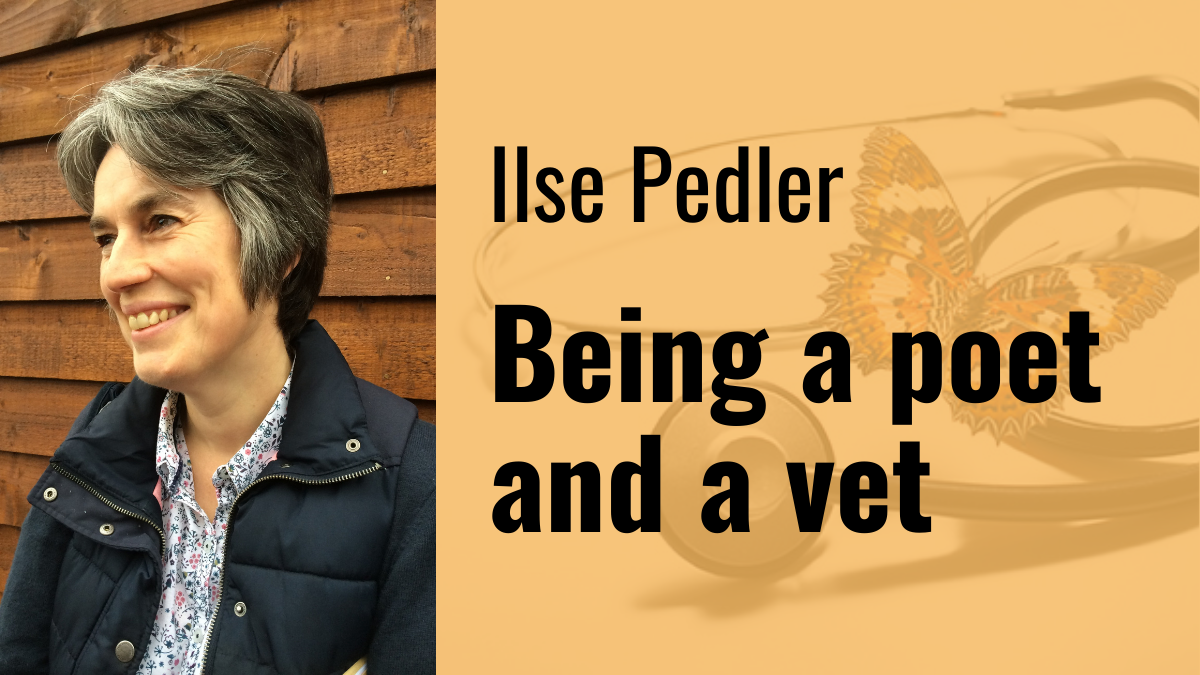
This week we publish Ilse Pedler’s debut collection Auscultation. In this post she reflects on finding time to write around her career as a vet and how this inspires her poetry.
Auscultation means listening and specifically, in medicine, listening to sounds that come from the body’s internal organs. If listening is a central theme of this collection, it is also about being heard. Ilse Pedler is poet of breadth and depth. There are poems about waiting rooms and surgical instruments, about crisis calls, about overhearing farmers and pet owners and colleagues. There are poems about surviving a stern childhood and a heartbreaking sequence about being a stepmother. This is a compelling set of poems from a striking new voice.
“Unique and utterly original.” – Kim Moore
How do you juggle writing poetry with a demanding career, particularly a career like veterinary medicine? Being a vet is not so much a job as a way of life. You come to live to the rhythms of animals, their needs take priority over your own. Work becomes a river; fluid, broken over rocks, never ceasing.
I’ve always written but during university and early years in practice, life as a vet was so all-consuming, poetry was squeezed to the very periphery. Slowly though, it began to filter back, sometimes it was people’s stories, sometimes it was the relationship between an animal and its owner. I started to feel the need to write down what I was experiencing. I also became frustrated at how little time I had to devote to poetry, until I went to a reading by Dennis O’Driscoll who worked full time through all his career. His comment on the dilemma of work and poetry was ‘Just write’. This became my mantra in the following years and I found myself jotting down fragments and ideas in between seeing clients or after I had finished an operation and on more than one occasion, I pulled over into a layby on the way back from a visit to write a few lines.
At first, I was hesitant about sharing my poems. I thought, because I hadn’t studied English or had a background in the arts, my work probably wasn’t up to much. It wasn’t until I went on a poetry course and another participant said, ‘isn’t it wonderful, you have a second language.’ I realised that being a vet may actually have its advantages.
As a vet I had a rich variety of experiences and emotions to draw on. I’ve seen cases of cruelty and neglect but also moments of extreme tenderness and dedication, I’ve known people go without food so they can afford medication for their pets and I’ve known people whose only reason for getting up in the morning is their animals. The consulting room is a privileged place and consulting effectively is an art as well as a science. The ability to draw out the back story and to get to the heart of the matter is a skill that is learnt over time. Farms are also unique; they are places of rough practicality and particular language; there is a bluntness there but also a gentleness.
We vets spend a lot of our time reading and writing clinical notes. They are our observations of patients and although factual, these notes are far from ‘clinical’, they are a record of what we’ve seen, felt, heard or smelt. Medical language is full of colour and dimension, it is muscular and vital. We observe our patients closely and we record what we feel about them. I found not only did I did have a whole other language to draw on but I had a scientist’s eye for detail and precision.
I feel so incredibly privileged to be a vet; animals have an honesty and in the case of animals like horses and cattle, a majesty too. They love and trust unconditionally and I am constantly inspired by them. If I can capture any of this in my poems, I will feel I have truly become a poet.
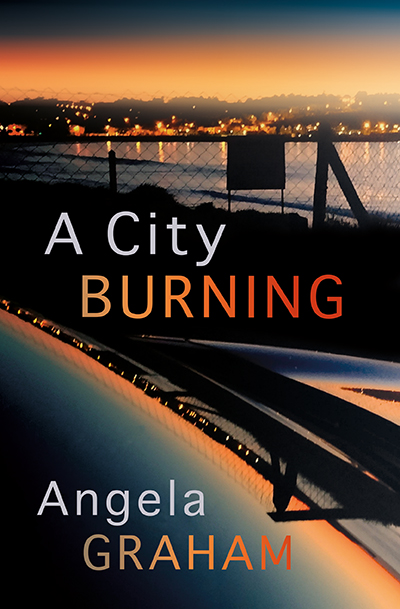
We are delighted that Angela Graham’s debut short story collection A City Burning has been longlisted for the Edge Hill Short Story Prize 2021.
The prestigious award, now in its fifteenth year, is the only national literary award to recognise excellence in a published, single-authored short story collection.
The 15-strong longlist represents an exciting range of new writing from the UK and Ireland.
Billy Cowan, organiser of the prize, said: “Although it has been a tough year for the publishing industry, it is great to see the short story in such a healthy state with more collections entered this year than 2020. This made the longlisting process very difficult as there were many, many strong entries. Our team of readers finally narrowed it down to a list of fifteen writers that include two previous Edge Hill Prize winners as well as many new writers with first collections by small independent publishers.”
Mick Felton, publisher at Seren, added: “I’m absolutely delighted to see Angela Graham’s A City Burning on the Edge Hill Prize longlist. To be with so many emminent practitioners is a great achievement for a debut collection. We knew A City Burning is outstanding so it’s great to have this recognition.”
The judges of the 2021 prize are 2020 winner Shelley Day, literary agent Elise Dillsworth and Dr Kim Wiltshire, writer and senior lecturer in Creative Writing at Edge Hill University.
A short list will be announced by September, with the winner of the £10,000 prize announced in November. A £1,000 Reader’s Choice Award will also be presented to one of the shortlisted authors.
The longlist in full is:
Alice Ash Paradise Block (Profile/Serpent’s Tail)Annabel Banks Exercises in Control (Influx)Kevin Barry That Old Country Music (Canongate)Adrian Duncan Midfield Dynamo (Lilliput Press) Angela Graham A City Burning (Seren)Rosanna Hildyard Slaughter (Broken Sleep Books) Rosemary Jenkinson Lifestyle Choice 10MG (Doire Press) A L Kennedy We are Attempting to Survive our Time (Jonathan Cape)Louise Kennedy The End of the World is a Cul-de-Sac (Bloomsbury) Jo Lloyd The Earth, that Great Exchequer, Ready Lies (Swift Press)Graham Mort Like Fado (Salt)John O’Donnell Almost the Same Blue and other stories (Doire Press)Alexandros Plasatis Made by Sea and Wood in Darkness (Spuyten Duyvil)Fernando Sdrigotti Jolts (Influx)Hannah Vincent She-Clown (Myriad Editions)
A City Burning is available on the Seren website as both paperback and eBook.
Find out more about the prize on the Edge Hill University website.
This week’s Friday Poem is ‘Midnight, Dhaka, 25 March 1971’ by Mir Mafuz Ali from his collection Midnight, Dhaka.
Midnight, Dhaka is the debut collection by Mir Mahfuz Ali. As a boy, Mahfuz witnessed atrocities and writes about them with a searing directness in poems like ‘My Salma’: ‘They brought Salma into the yard, / asked me to watch how they would explode / a bullet into her’. His trauma becomes transformative, and his poetry the key to unlocking memories of a childhood that are rich in nuance, gorgeous in detail and evocative of a beautiful country. Influenced by Rabindranath Tagore (1861-1941) and Jibanananda Das (1899-1954), as well as modern British poets, Mahfuz brings his own unique voice in these poems, which celebrate the human capacity for love, survival and renewal.
This week’s Friday Poem is ‘The Guns’ by Katrina Naomi from her collection Wild Persistence which was published this time last year.
Wild Persistence by Katrina Naomi is a confident and persuasive collection of poems. Written following her move from London to Cornwall, it considers distance and closeness, and questions how to live. She dissects ‘dualism’ and arrival, sex and dance, a trip to Japan. The collection also includes a moving sequence of poems about the aftermath of an attempted rape.
“Funny, moving, surprising, unflinching and, above all else… joyous.” – Helen Mort
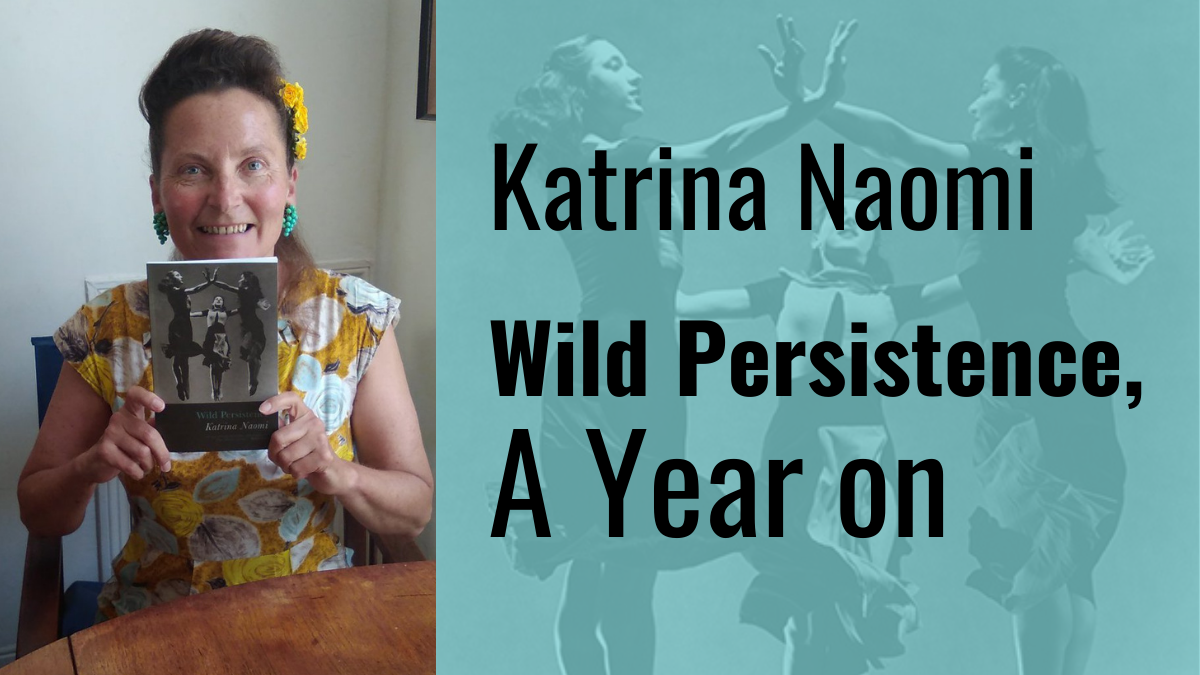
A year on from publication of her collectionWild Persistence, poet Katrina Naomi reflects on her experience of publishing a book during the pandemic.
A year ago, when I realised I couldn’t hold the launches for Wild Persistence that we’d planned in Cornwall and London, I’ll admit to having a few tears. Daft but I felt that Wild Persistence was the best book I’d written and I really wanted to get it out there. Book shops were closed, as was pretty much everything else. How the hell was this new collection going to find its audience?
Katrina Naomi with a copy of Wild Persistence
I remember talking to Amy, my editor, about possibly shifting the launch back from June 2020 to September 2020. I’m glad we didn’t; with hindsight, nothing would have changed.
Seren said: ‘How about a virtual launch?’. I’d never done anything on zoom before, I barely knew what it was. In short, I was terrified of it. How would I get any connection with people via a cold screen; there’d be no feedback, and no drinks (and no cake), and no nattering afterwards? Can you tell that I hated the idea? But it was all that was possible.
I did a trial run with Seren, tried to pretend Zoom was where it was at, and that I was looking forward to the launch. I didn’t trust or understand the technology. The morning of the launch, I practised my poems in the park, in the mizzle, reading to a friend, us both sitting well away from each other, as though we’d had an argument. That evening, to try to get over my terror, I wore one of my favourite outfits, a red and white ‘40s suit, wore the new shoes I’d bought for the original launches – even though no one could see them. But I knew I’d got them on. I dabbed cologne on my neck and wrists, and put a flower in my hair. I was as ready as I could be.
I remember how sick I felt, I hadn’t been able to eat, until I saw that over 100 people were waiting to be admitted to the launch. People attended from France, Canada, the US, as well as friends from up my street. It gave me a wider audience than I could have imagined. I really, really enjoyed it.
Since then, I’ve been doing readings at events across the UK, and in the US. All from my little room, with a glimpse of Penzance harbour between my neighbours’ roofs. It still feels slightly unreal but I’ve come to love performing into my screen, remembering to prop the laptop on two dictionaries and to speak into the camera, marked by two lion stickers either side of the camera’s wonky dot.
Katrina Naomi signing copies of Wild Persistence in The Edge of the World bookshop
But I didn’t get to go to Mexico to work on a project, (environmentally, this might not be a bad thing), and it seems people don’t buy as many books at online launches and readings. Still, I’ve been doing lots of radio and podcasts, which has been great. Seren say the book’s been doing well. And I’ve been selling signed copies of Wild Persistence via my website all year, reusing recycled envelopes so I’ve only a handful of copies (and envelopes) left. I recall one woman buying a copy of Wild Persistence, then ordering another 30, ‘to give to my friends’. My local bookshop, The Edge of the World, has been reordering and I’ve signed three or four batches there, since they’ve reopened. I haven’t been further than Cornwall, I’d love to know that my collection’s in other bookshops in other towns and cities. But I don’t know if that’s true. What’s been great has been people (particularly people I don’t know) posting photos of Wild Persistence on Twitter; I’ve seen my book propped up on garden steps, or next to a mug of tea with breakfast, or in an artist’s studio, and, once, on the end of an Essex pier. I’ve loved that.
Wild Persistence on the shelf in The Edge of the World bookshop
But I’ve missed seeing people. I haven’t been able to do a single reading, live, in public, in a room, with people. I miss seeing people’s reactions – whether they’re bored or excited by a particular poem. It’s harder to gauge which poems work online, you don’t hear the collective hush or the poetry ahhh, or get a laugh or an intake of breath when a poem hits home.
A year on and I’ve just had my first festival ask if I’m willing to read live, in a room, with people. I hesitated for a moment, and smiled. Though they couldn’t see that. But I’ve said yes. Yes. Yes. And I’ll probably wear my new shoes.
Katrina Naomi
Wild Persistence by Katrina Naomi is a confident and persuasive collection of poems. Written following her move from London to Cornwall, it considers distance and closeness, and questions how to live. She dissects ‘dualism’ and arrival, sex and dance, a trip to Japan. The collection also includes a moving sequence of poems about the aftermath of an attempted rape.
“Funny, moving, surprising, unflinching and, above all else… joyous.” – Helen Mort