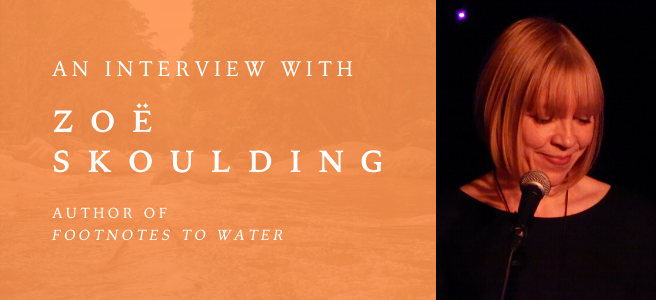
 Zoë Skoulding is a poet, critic and translator who has lived in north Wales since 1991. She is the author of a number of poetry collections including The Museum of Disappearing Sounds (Seren), which was shortlisted for the Ted Hughes Award, and Remains of a Future City (Seren), which was long-listed for Wales Book of the Year. In 2018 she was a recipient of the Cholmondeley Award from the Society of Authors for her contribution to poetry.
Her new collection Footnotes to Water follows two forgotten rivers and tracks the literary hoofprints of sheep through Welsh mountains. In these journeys she reveals urban and rural locales as sites of lively interconnection, exploring the ways in which place shapes and is shaped by language. In this interview she gives us a deeper insight into these connections and tells us about some of the processes behind her poetry.
Water can quite literally reflect us, and the symbol of the river features heavily throughout the collection. Why do you think water is so expressive of identity?
I’m more interested in water that is hidden, or that has disappeared, than in reflective surfaces. I don’t think water necessarily expresses identity at all, though it does tend to be a central concern of Welsh writing – there’s Tryweryn, of course, with the idea of loss of language and identity. I was drawn to the Adda in Bangor because it seemed to be the shape of a void I noticed in the city, but it’s not just about language – it’s also about an economic logic that destroys a community’s relationship with itself and its non-human surroundings. On the other hand, water is what connects us to each other and to the rest of the physical world, so it’s a way of thinking about new kinds of belonging.
You use the Welsh language throughout certain poems, although you write primarily in English. Why is that?
I can’t write in Welsh, but in writing about Bangor I wanted to reflect my experience of hearing the city, which is that Welsh is a constant, if fragmentary presence, and one I value. The occasional Welsh phrases are all quotation because my relationship to Welsh is that it lives in my ears, but not in my mouth. One day that may be different, but for now this is the best way I can respond to where I am.
Is this a collection to be read aloud? How could speaking the poems affect our understanding of them?
For me, reading and writing poetry is very much about the sound and weight of words, whether they are sounded aloud or voiced in the head, so sound and meaning are always intricately connected.
The collection brims with varying experimental forms. Can breaking form challenge our conceptions of the world around us?
I like having a constraint to work against, so the book begins and ends with sonnet sequences, although they might not be immediately recognisable as such. In both cases, I was thinking about the form of a river, and the shape that gives it pressure and movement. In the first poem there’s a seven-syllable line, which is more common in Welsh poetry than in English, and it has the effect of wrong-footing the expected rhythm. In many of the forms I used I was trying to find ways of tripping up my expectations of a very familiar city.
In the collection, you seem inspired by the landscape, letters, news reports, and the literature and voices of others. What inspired you the most? Is there somewhere you often look to for inspiration when beginning to write?
I walk and I read, and in some ways these can be quite similar kinds of exploration. ‘Heft’ is about both of those things at once, a journey though text and landscape.
In the poem, ‘Walking the Adda: A Collaboration’ you incorporate ‘comments made on and after public walks’. How did you approach incorporating the voices of others into your work? Would you say the role of voice is particularly important to this collection?
This was a joint project with the artist Ben Stammers in which we walked the route of the underground river with anyone who wanted to join us. At the end, people added their comments anonymously to a giant map he’d drawn, and these are what I have quoted – so although there are a few spoken comments there as well, most were written down. I arranged them as a prose poem, continuous but with multiple voices. The sense of listening to a place composed of many voices is central to my understanding of cities.
How would you describe the poems’ function as footnotes alongside Ben Stammers’ visual art?
I don’t think they really work in this way as I was not interpreting his photographs. Most of the time we made parallel, separate explorations of the route of the river and what we could discover about it. We did have some very useful conversations though, and Ben’s expert knowledge of birds certainly informs ‘Gull Song’.
You play with the idea of bodies, whether the ceaseless flow of the body of water reflected in the form, the female body in ‘Teint’, or the physical body threatened by flood, disease or pollution. Would you say the collection aims to subvert the boundaries between the human body and the elemental world?
Given the current ecological crisis it’s important to challenge the belief that humans are somehow separate or aloof from the material world. What if we could imagine human existence as a footnote to water, a co-incidental life form existing alongside many others? At the same time, of course I can’t completely sustain this view because my perspective is human, and I’m also concerned that human bodies are not all treated equally, as is revealed by the story of any city. When I write I try to make new paths of connection in language so that different relationships might be possible.
Footnotes to Water is available on the Seren website: £9.99
Create your free Seren account and enjoy 20% off every book you buy from us.
Don’t miss the launch of Footnotes to Water taking place at 8pm on Thursday 14th November at the Aulkland Arms in Menai Bridge. Zoë will be joined by guest readers Fiona Cameron, Peter Hughes, Rhys Trimble and Lee Duggan plus there will be music from The Groceries (Alan Holmes). Find the full details on our website.


 A fascination for history, both as a source of human drama and a field for artful speculation, characterises this collection of poems by Sheenagh Pugh. In Afternoons Go Nowhere the past seems more relevant to the present than ever, human nature never entirely predictable and often non-sensical, the natural world seeming full of a paradoxical beauty. Complex but with clear themes and lucid, musical language, Sheenagh Pugh’s tenth collection will delight discriminating readers.








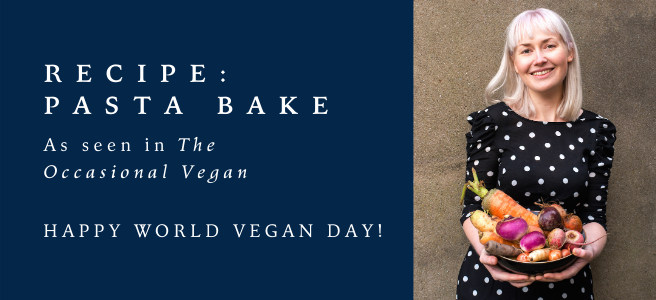
 To celebrate we’re giving you a sneak peak at the deliciousness that waits inside with this tasty recipe for pasta bake. Not only does it taste amazing it is also healthy and a great way to use up any pumpkins you may have left over from Halloween. It may not be the quickest recipe, but it’s well worth the wait.


