Posted on

Friday Poem: ‘Chinese Lacquer Egg’, Deryn Rees-Jones

Friday Poem Chinese Lacquer Egg Deryn Rees-Jones

We’d like to wish you a very happy Easter, and in celebration our Friday Poem today is ‘Chinese Lacquer Egg’ by Deryn Rees-Jones.

Deryn Rees-Jones What It's Like To Be Alive Selected Poems‘Chinese Lacquer Egg’ first featured in TS Eliot Prize-shortlisted Burying the Wren, and more recently in What It’s Like to Be Alive: Selected Poems. ‘Something is beginning’, it starts: there is a change, in outlook as well as nature. With intense lyricism the poet calls on the Roethkean ‘small things’ of the universe – birds, flowers, eggs – mysterious, and magical as well as ordinary.
What It’s Like to Be Alive features poems from Burying the Wren and four other collections, showcasing the arc of development in her writing over twenty-five years as she visits and revisits the concerns that are the mainstay of her writing: memory, love, desire, and heartbreak in all its manifestations.


A Chinese Lacquer Egg

Something is beginning. We feel it in the raw edges
of our dreams, our bodies hostage to light, to weather.
It is filling us with the weight of summer
which floats like helium through our wintered bones.
We wonder at it all, surprised by warmth, a sudden downpour –
the ruffled line of birdsong, a forgotten bulb
forcing its way through sodden earth towards the sun.
Or this Chinese lacquer egg, which appeared one morning
in my outstretched palm. Beyond the sound
of aeroplane or train, as we drift asleep, hands cupped
to the pillow, it shares its oval mysteries. Listen!
Between breath and silence it is showing itself.
In these shortened nights it is not unlike rapture,
an unworded prayer its indelible hum.


What It’s Like to Be Alive is available from the Seren website: £12.99
Join our free, no-purchase-necessary Book Club for a 20% discount every time you shop with us


Posted on

Win a copy of Heat Signature by Siobhán Campbell

Win Heat Signature by Siobhan Campbell

Enter our monthly giveaway to win April’s prize: a copy of Siobhán Campbell’s new poetry collection, Heat Signature.

To enter, simply sign up to the Seren newsletter before 1st May:
https://www.serenbooks.com/newsletter/signup

Heat Signature Siobhan Campbell giveaway

Siobhán Campbell has won awards in the National Poetry Competition, the Troubadour International Poetry Competition, the Templar Poetry Prize and most recently was awarded the Oxford Brookes International Poetry Prize. Heat Signature is her fourth full collection and follows Cross-Talk (Seren, 2009).

About Heat Signature:
Siobhán Campbell’s new collection is packed full of her lively, frequently provocative poems. An Irish poet, Campbell has inherited a rich vocabulary, the necessary ‘slant’ point of view, and a store of lively anecdotes. This is a poetry that resists rapture and/or easy solutions, it rather glories in difficulty: the cussed, intractable nature of humanity, of a natural world beset with swarming bees, weeds and feral horses. This is a poetic voice that once encountered, is never forgotten.


The winner of this giveaway will be chosen at random from all our email subscribers on 1st May 2017, so make sure you sign up to Seren News before this deadline to be in with a chance of winning.

Feeling generous? Why not invite your friends to enter, by signing up using the link below:
http://serenbooks.com/newsletter/signup


Posted on

Legend of the Month: Ruth Bidgood

Legend of the Month Ruth Bidgood

Each month we are shining the spotlight on one fantastic Seren author in honour of Wales’ Year of Legends. Our selection for April is the poet Ruth Bidgood.

Ruth Bidgood turns 95 this year, and her poetry career spans over five decades. She was born in Blaendulais, near Neath, educated at Oxford, and worked as a coder in Alexandria, Egypt in World War Two. She has lived in mid-Wales since the mid-sixties.

Legend of the Month Ruth Bidgood

She has published fourteen books of poetry, including The Fluent Moment (Seren, 1996), Singing to Wolves (Seren, 2000), and her New and Selected Poems (Seren, 2004). Her twelfth collection, Time Being (Seren, 2009), won the Roland Mathias Prize and was a Poetry Book Society Recommendation. Her most recent collection is Land Music (Cinnamon, 2016). As well as poetry, she has written a prose book about Wales, Parishes of the Buzzard (Goldleaf, 2000), and published many articles in country historical journals.

Matthew Jarvis writes of Bidgood’s achievement: ‘The heart of Ruth Bidgood’s poetry is her varied and intertwined rendition of the mid-Wales area that she has made her home… Artistically, what she has achieved in such material is nothing less than a mid Wales epic.’

Here is ‘Legacy’, from New and Selected Poems, which featured as our Poem of the Month in the April edition of Seren News:

Ruth Bidgood 'Legacy' New and Selected Poems


Find more of Ruth Bidgood’s poetry on the Year of Legends page, alongside books by March’s featured author, Dannie Abse.


Save

Posted on

Friday Poem – ‘Newborn’, Graham Clifford

Friday Poem 'Newborn' Graham Clifford

Our Friday Poem this week is ‘Newborn’ from The Hitting Game by Graham Clifford.

The Hitting Game, Graham Clifford

‘Newborn’ is a disarmingly intimate poem which tenderly describes the ‘unfurling’ of a precious new life,  the minute changes in her being, and her otherwordly fragility.
The Hitting Game is Graham Clifford’s debut collection, ‘inventive and grounded, witty and vulnerable’ (Michael Laskey). There is a gentleness and empathy, humour and pathos, with poems full of unexpected dramas and fresh enxhantments which provoke as well as delight.


Newborn

She nearly isn’t here. So soft
I have to watch to know
I’ve touched this pink steam
somehow holding her shape.

Dimmer switch screwed almost shut
we are stock-still
nocturnal desert-mammals, saucer-eyed,
cramping in thunder-struck poses.
Her spider-leg eyelashes
rest on a web that has us while she dreams
the leaf-edge of her country.

Unfurling by millimetres in spiked air,
anemone fingers splay then clench
as she tunes herself in,
becomes herself minutely, frost
fringing the shore of the cleanest puddle.


The Hitting Game is available from the Seren website: £9.99
Join our free, no-purchase-necessary Book Club for a 20% discount every time you shop with us

Posted on

Friday Poem – ‘Cream teas, Sunday’, Katherine Stansfield

Friday Poem Katherine Stansfield Cream tea, Sunday

This week our Friday Poem is Katherine Stansfield’s ‘Cream teas, Sunday’, from Playing House.

playing house katherine stansfield‘Cream teas, Sunday’ is a sickly-sweet vision of chaos in the pursuit of a cream tea. ‘Stampedes’ of customers interrupt the calm sophistication of a tea room, laying waste to the food and finery with not so much as a 50p tip on the way out.
Playing House is full of delightfully witty poems such as this, which present an unsettling view of the domestic; the author’s eye is satirical yet sympathetic, the voice distinctive.
‘Striking imagery, strange leaps of thought, wit and menace aside, the unmistakeable thrill of Katherine Stansfield’s poetry is in the voice. It addresses the world directly, takes it personally, and comes at the reader from constantly unexpected angles, a tangible, physical thing.’ – Philip Gross


Cream teas, Sunday

The four o’clock rush stampedes in at three
to besiege us, heathens sweating scones
for Sunday’s sore visitor gods. Raging and raw
we keep out cats, flies, the customers
still crash right through with sugar in their eyes.
Quick – lay your hands on the cream
to banish mould and I’ll speak in tongues
of jam. Hell opens to burn the slovenly
and pour forth fruitcake and smoke.
I weep into my apron.There’s no change
or tips.Tea cosies drown in Lapsang floods,
exhausted pots shatter and teaspoons bolt,
menus make for the door and coffee jars
revolt.You spread the charm like soft butter
on a split and I’ll give sticky grace on not quite
clean plates.Will that appease them?
Our fake accents turn with the milk
come six. Prayers pass in a kettle’s pant,
returning to water and air: tomorrow
please rain, please rain, please rain.


Playing House is available from the Seren website: £9.99
Join our free, no-purchase-necessary Book Club for a 20% discount every time you shop with us


Posted on

Friday Poem – ‘Roadkill Season’, Polly Atkin

Friday Poem Roadkill Season Polly Atkin

Our Friday Poem this week is ‘Roadkill Season’, from Polly Atkin’s recently released debut, Basic Nest Architecture.

Basic Nest Architecture Polly AtkinA meshing-together of beauty and gore, ‘Roadkill Season’ is almost ritualistic in its depiction of food preparation and feasting. Sweet and savage images clash: the brutal origin of the meal is not placed at a distance but embraced, an essential element in the pleasure gained.
Basic Nest Architecture is Polly Atkin’s first collection of poetry, and follows her Mslexia Prize-winning pamphlet, Shadow Dispatches, and her Michael Marks nominated Bone Song. The complex, intelligent, densely metaphorical lyrics for which she is known are often inspired by the beauties of the Lake District, her home for the last decade.

Join Polly Atkin at the Lancaster Literature Festival for the Basic Nest Architecture launch tomorrow, Saturday 25 March.


Roadkill Season

In Eighteenth-Century House it was roadkill
season. Pheasant, hooked out from under
the dented bumper, last breath condensed
in a plastic bag, matured for a week
in the stainless steel back sink, to build up
flavour. Beautiful dead! I never
saw a thing alive so lovely.
The basin, silvered like the lake in winter,
swirled with colour, like dead trees and diesel.
You stank like the kill itself, like the mulchy
scrub you stumbled out of, stupid
and gorgeous, in love with the tarmac. Poorman’s
Peacock. Dumb bundle of plumage and flesh.
Laura popped your cooling heart
in her gob like a sweet; burst it between
her sharpening teeth. Kate and Anna
carved your breast to split together.
Your meat was purple as the sky at dusk.
We each hooked a finger to halve your wish-bone,
squeezed our eyes closed, and heaved.
We gathered scraps. Kate buried the shell
to dig up and sculpt into artefact later.
We dried out your feet on radiators.
You clutched hot air as they hardened to stars
we bent into brooches, gifts for each other,
then salvaged the best of your wings and fine tail
and stitched new faces of your feathers.


Basic Nest Architecture is available from the Seren website: £9.99
Join our free, no-purchase-necessary Book Club for a 20% discount every time you shop with us

Save

Posted on

Three Poems for World Poetry Day

In celebration of World Poetry Day, we are featuring three poems by Seren poets, which you can read below.

Coinciding with the start of Spring, World Poetry Day is the perfect opportunity for us to brighten up your week with some of our favourite poems. It has been dreadfully difficult to narrow it down, but we hope you enjoy our selections: poems from Kim Moore, Paul Henry, and Rhian Edwards.


The Art of Falling Kim MooreKim Moore: ‘And the Soul’
Taken from Kim Moore’s outstanding debut, The Art of Falling – which was shortlisted for the Cumbria/Lakeland Book of the Year – ‘And the Soul’ considers the animalistic nature of the soul, be it domestic (‘And if it be a cat, find some people/ to ignore’) or primal.


And the Soul
And the soul, if she is to know
herself, must look into the soul…
– Plato

And the soul, if she is to know herself
must look into the soul and find
what kind of beast is hiding.

And if it be a horse, open up the gate
and let it run. And if it be a rabbit
give it sand dunes to disappear in.

And if it be a swan, create a mirror image,
give it water. And if it be a badger
grow a sloping woodland in your heart.

And if it be a tick, let the blood flow
until it’s sated. And if it be a fish
there must be a river and a mountain.

And if it be a cat, find some people
to ignore, but if it be a wolf,
you’ll know from its restless way

of moving, if it be a wolf,
throw back your head
and let it howl.


Boy Running, Paul Henry

Paul Henry: ‘Moving In’
This poem is taken from Boy Running, Paul Henry’s latest collection, which reached the shortlist for the Wales Book of the Year Poetry Award (2016). Paul is currently touring with Stornoway singer-songwriter Brian Briggs as they perform their collaborative work, The Glass Aisle – a haunting piece which crosses the borders between poem and song lyric. Find the full list of events here.


Moving In
I cannot see the flowers at my feet…
Keats – ‘Ode to a Nightingale.’

They look and wonder what they’re doing here,
those who’ve moved with me across the years –
Dylan Thomas, Picasso, Nightingale Ann,
Goble, David Trevorrow, young Fanny Brawne…
all strewn about this flat where I hide.
(Did I dream, last night, of a tide
laying its artefacts on sand?) They stare
but do not judge, or change, or care.

Dylan’s just opened Manhattan’s cigar box.
‘Try one,’ he says, ‘before you die. Fuck books.’
Pablo’s still pushing against his pane.
He listens for a nightingale in vain.
Goble tilts back in his top hat.
He and Trevorrow could not have shared a flat
but I loved them both, and Fanny Brawne.
There are crows on my roof. The light has gone.


Rhian Edwards: ‘The Universal Doodle’
Taken from Rhian Edwards’ new poetry pamphlet, Brood, ‘The Universal Doodle’ carries on the pamphlet’s ever-present theme of birds by musing on the appearance of a murmuration cloud of starlings. Keep an eye on our website, as numerous launch events are on the horizon – and we would love for you to celebrate with us.


The Universal Doodle

A scattering corralled, lassoed
into the universal doodle of birds.
A mutable speech bubble

of pondering ‘m’s. This is the bombast
of starlings as they corkscrew the sky.
Each twist and fold is summarised

to a simile like iron filings,
flocked and flung across the sky
by the metaphorical whims of a magnet.

Can you hear the pathetic fallacy?
The siren song of a metal’s hum
crooning behind clouds, a bit like a God.


We hope you enjoyed our World Poetry Day selection. If it has inspired you to expand your poetry collection, then you can find our full list of Seren poetry books here.

 

Posted on

A literary Mother’s Day Gift: the Writing Motherhood anthology

Writing Motherhood 30% off Mother's Day

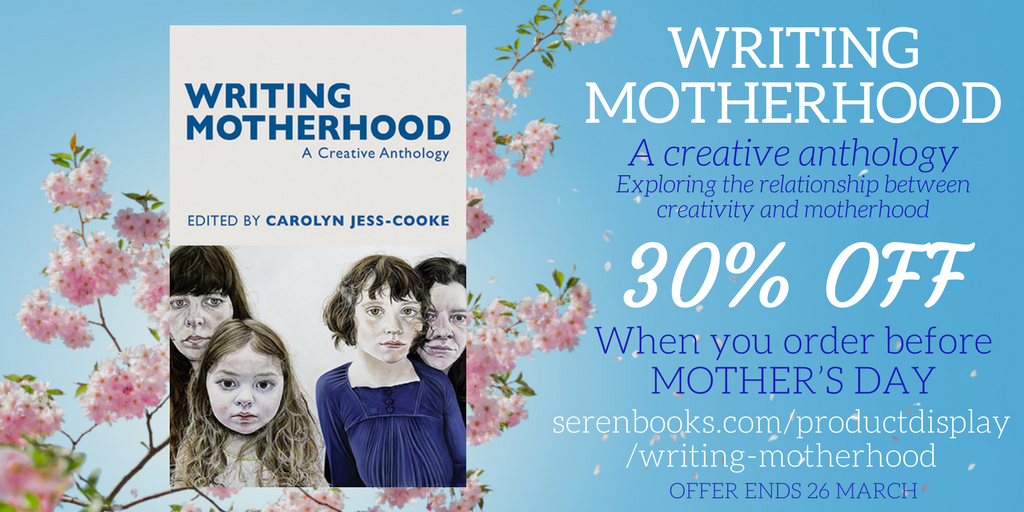
Today we welcome the arrival of Writing Motherhood, a creative anthology of poetry, interviews and essays by established writers, edited by Carolyn Jess-Cooke.

Writing Motherhood Carolyn Jess-CookeThe perfect literary gift for Mother’s Day, Writing Motherhood explores the relationship between creativity and motherhood, with contributions from writers such as Carol Ann Duffy, Sharon Olds and Hollie McNish. Until Sunday 26 March, you can buy Mum her copy at 30% off, direct from the Seren website.

‘This is a truly inspiring collection, all the more so for its wit and its grit, its poetry and its honesty; here we have women producing ‘good art’ despite – and often  because of – ‘the pram in the hall.’ – Shelley Day

Read a free excerpt from Carolyn Jess-Cooke’s Introduction, below.


INTRODUCTION

There is no more sombre enemy of good art than the pram in the hall.
– Cyril Connolly

This book presents a selection of the most important contemporary
writing by women on the tensions between motherhood
and writing.
Cyril Connolly wrote about the ‘pram in the hall’ in his 1938
book Enemies of Promise, yet his caveat is directed at men (he took
it as given that women create babies, not art). Nonetheless, the
quote is still in use to capture those devastating effects brought to
artistic creation by a new baby. I’m not alone when I admit the
arrival of my first child felt like stepping inside a whirlwind. I had
plenty to worry about – SIDS, whether she was gaining enough
weight, whether we could afford maternity leave, etc. – but I do
remember that among my worries was a serious concern that I
might never be able to write again. My brain felt completely
scrambled. I could barely construct a text message for weeks,
months. Time was disjointed. It seemed to take an inordinate
amount of time to do even the smallest task. I remember thinking,
over and over, why did nobody tell me how hard this is? After the birth
of my son, however, writing proved effective in pushing back the
darkness of postnatal depression, and also inspired a new direction
in my creative practice; I had always thought I would only
ever write poetry, but the problem-solving, immersive elements of
narrative proved much more potent in batting back depression.
After the births of our third and fourth children, let’s just say that
I became a bit more creative in how I managed my time.
PUBLISHING MOTHERHOOD

In 2014, Arts Council England funded my Writing Motherhood
project to tour literary festivals in the UK to discuss the impact of
motherhood on women’s writing. I had read a number of reports
and articles that claimed the key to literary success was childlessness,
or for a woman to have just one child, or at least to bear in
mind that each child ‘costs’ a female writer four books. None of
these reports aimed their caveats at men. I became curious – and
not a little dismayed – by the idealization of motherhood, and by
the casual sexism that was prevalent and unchallenged in discourses
about motherhood. I set up the Writing Motherhood
project because I wanted to empower mothers and to encourage
them to talk about their experiences. Although the assumption
about mothers and writing was that we just didn’t have the time
or inclination (we’re all too busy dealing with that pram in the
hallway!), I perceived that other forces were at work, prohibiting
women’s writing from making it into the public sphere and/or
being perceived as good literature.


A few highlights from the kalaidescope of female experience featured here are Carolyn Jess-Cooke’s interview with Sharon Olds (where she discusses her famous rejection by a US literary magazine for writing about her children), excerpts from Hollie McNish’s motherhood diary, and Carol Ann Duffy’s beautiful portrait of being and having a daughter. This is a poignant and beautiful book celebrating motherhood, recognising it not as the ‘enemy of good art’, but often as its inspiration.

Writing Motherhood 30% off Mother's Day

Writing Motherhood: 30% off until Mother’s Day (26 March). Order your copy now


Posted on

Friday Poem – ‘Translating Mountains from the Gaelic’, Yvonne Reddick

Friday Poem Translating Mountains from the Gaelic Yvonne Reddick

Our Friday Poem this week is ‘Translating Mountains from the Gaelic’ from Yvonne Reddick’s Mslexia Poetry Prize-winning pamphlet, Translating Mountains.

The difficulty and occasional humour of translating language is at the forefront of this poem, yet alongside this we see a daughter contemplating how she will take her lost father on one last memorialistic mountain trek.

The poems of Yvonne Reddick’s prize-winning pamphlet, Translating Mountains, are all multi-layered compositions. They tell of grief for a beloved father as well as a close friend, who both died in mountain-climbing accidents. These poems are also hymns to stunning landscapes, with mountains and place names often in a craggy, atmospheric Gaelic. Full of tension, emotion and action, this writing grips our attention.


Translating Mountains from the Gaelic

A pebble on the tongue –
my clumsy mouth stumbles their meanings:

I mumble Beinn Laoghail to Ben Loyal,
Beinn Uais to Ben Wyvis,

humble Beinn Artair
from King Arthur’s Hill to The Cobbler –

turn Bod an Deamhain
from Demon’s Penis to Devil’s Point,

stammer on An Teallach
with its rearing anvils and impossible spelling,

my throat a stream-gorge
where quartz chunks chatter against each other –

my English rolling off their sharp consonants.
Next summer, I’ll shoulder my red rucksack,
a Platypus bottle, and a vial of Dad’s ash

up Schiehallion –
Fairy-Hill of the Caledonians –
via the less-worn path.

A deerfly, its eyes peridot ringstones,
will pincer my skin for blood,

my voice a trespasser,
echoing charred moors and razed crofts.

Dad, I’ll pour your English dust
for the hungry roots of the hill’s oldest pine –

a speck of you will lodge in a walker’s boot-tread,
the breeze catching a mote of your collarbone,

the rain will seep through you,
mingle you with Aonach Bàn,
Loch Teimheil, Sìdh Chailleann.


Translating Mountains is available from the Seren website: £5.00
Join our free, no-purchase-necessary Book Club for a 20% discount every time you shop with us


Posted on

Seren’s women on the books that have inspired us

Seren's women on the books that have inspired us

To mark International Women’s Day 2017, Seren’s female staff have come together to shine the spotlight on the books that have inspired us. Countless works of literature written by female writers have changed the world; the few mentioned here have personally changed us.

Sunshine, Melissa Lee-Houghton (Penned in the Margins, 2016)
Sunshine Melissa Lee HoughtonSuggested by Rebecca Parfitt, Editorial Assistant for Poetry Wales

“It both shocked and enthralled me in equal measure. Here is a poet laying her soul and body bare for all to see and its as uncomfortable as it is beautiful. Her poems have an energy that crackles on the page and her verse often long and sprawling as to almost seem unkempt. A truly authentic and honest contemporary female voice.”


A Girl Is a Half-Formed Thing, Eimear McBride (Galley Beggar Press, 2013)
A Girl is a Half-formed ThingSuggested by Rosie Johns, Marketing & Communications Officer

“Girlhood, growth and sexuality – this book is uncompromising in its depiction of the protagonist’s agonising journey through all of these. After puberty, she is seen by the men in her life (including her uncle) as a simply sexual thing. In reality she is fragmented, transgressive, troubled. There is nothing toned-down or dishonest about this book which, sadly, might explain the author’s staggering 9-year search for a publisher.”


Shakespeare’s Wife by Germaine Greer
Shakespeare's WifeSuggested by Amy Wack, Poetry Editor

“I’m a fan of this book by Greer, a scholarly and provocative imaginary life of Anne Hathaway, Shakespeare’s wife. Greer constructs a plausible and sometimes unexpected Elizabethan England based mostly on her research sifting the actual records from Stratford at the time. I know Greer can be wrong-headed and stubbornly persistent, but I always appreciate that her goal is to get people to think, to argue back, to defy received opinions!”


International Women’s Day has been observed since the early 1900s, and commemorates the moment for women’s rights. The day is also an opportunity to celebrate women’s achievements. This year the campaign centres around calling people to #BeBoldForChange – to help forge a better working world, and a more gender-inclusive world. Join in and be bold.