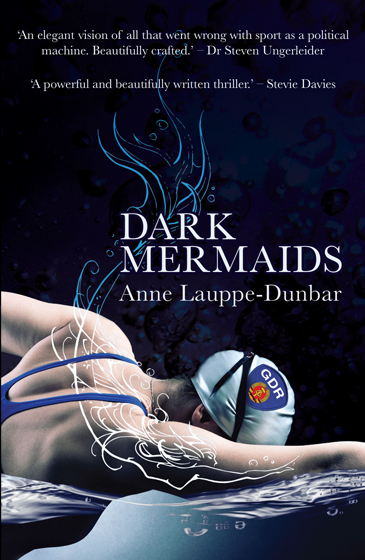
We had a chat with Anne Lauppe-Dunbar about her debut novel, Dark Mermaids, which is out today!
Anne Lauppe-Dunbar is a Creative Writing tutor at Swansea University, where she also studied for her PhD. She had a short story published in Sing Sorrow Sorrow (ed. Gwen Davies) and has had stories, essays, papers and poems published with Cinnamon Press, Seventh Quarry and New Welsh Review. Dark Mermaids is her first novel.

A shocking story of the horrors of a political system that doped its youngsters to sporting superhero status, and then left them to fend for themselves. Shortlisted for the Impress and Cinnamon First Novel Prize, this East German noir thriller is set in 1990, a year after the fall of the Berlin Wall.
Unhappy West Berlin police officer Sophia is called on to investigate the murder of her childhood friend Kathe, after her beaten body is discovered in Sophia’s local park. Sophia is forced to return to the hometown she fled as a teenager with her enigmatic father Petrus, and Mia – a frightened child who turned up on her doorstep. She must investigate Kathe’s murder and care for a mother she believed abandoned her. As she reluctantly delves into the sordid Stasi secrets of those she grew up with, Sophia uncovers a web of horrors about her own abusive past as a child-swimming star in the former GDR. But her hunt for the truth has not gone unnoticed by those close to her, people who still have too much to hide.
How did you become so interested in the East German doping scandal? What about it compelled you to write?
I was researching my mother’s family in the former GDR. The family were wealthy but lost everything under the communist regime. My mother managed cross over the border over ‘no man’s land’ in 1949. I was looking at maps when I stumbled across something called ‘Complex 08’, and clicked on the link to reveal a monster named ‘State Theme 14.25’. The more I read, the more complex and vile a beast I saw. I knew then I simply had to write about the GDR Doping Scam Theme 14.25. But I needed a fictitious angle, a way in which to tell the story, and that’s when I created Sophia and Mia because I wanted more than a hunt for clues. I wanted a story about a woman finding out who she was by going back and claiming her true self.
You must have done a lot of research while writing the novel. Did you ever worry that it was going to turn into non-fiction or did you achieve a healthy balance of fact and fiction from an early stage of the writing process?
I became completely obsessed with detail and research. I have boxes of Stasi files ordered from the Ungeleider Archive in the University of Austin, Texas. Fascinating reading, as they list the drugs given to each athlete, the side effects, the results. I found myself absorbed reading about clandestine meetings between informers, doping doctors, sport coaches and the Stasi. My knowledge of medicine is basic, so I read up on what steroids might do, how, why, and what were the worst scenarios – all proven by further reading and research: bones not holding muscle, liver failure, children born with clubbed feet, reminiscent of the thalidomide horror, former athletes in pain from chronic muscle fatigue, sex changes. The more I read, the more I had to write.
I went to Berlin and walked around the area where I wanted Sophia to live, so that I could really know her. I drew from my research into my mother’s East German home town and wove the story around solid fact. I tried to speak with former athletes and found silence. Finally I was permitted to visit Kienbaum, a sports training camp outside Berlin. Here I began to live my protagonist’s life. I have never been as electrified by research as I was over those three days. I wrote and found myself entering Sophia’s mind, her broken heart, her longing for escape and something other than the sum of swimming, drugs, sex, winning.
I fixated on how a swimmer would swim. How she might be the water, and become a thing that lived inside water – a mermaid, fierce, loyal to a fault, yet mistrusting. All of the research, the mermaids, the Stasi meetings, how to move hands to swim faster, how to breathe, stopped narrative flow. All those careful (utterly precious) lists I’d thought vital, were boggy research, not needed. So I had to let it go. Gillian Slovo told a group of us, at a long ago Cheltenham Literary festival, how research must be a gossamer curtain, so pale it can hardly be seen, yet key to the landscape of the novel. Stevie Davies put it in a nutshell: ‘Mermaids are secondary. Narrative is primary’.
Nowadays there are so many more women – authors and characters – in the crime/thriller genre, from Kate Atkinson to Gillian Flynn to our very own Jo Mazelis. What is it that attracted you to the genre?
I love thrillers that grab you by the throat and don’t let go, yet far better are those rare thrillers that do all of that, but so much more. They teach you something about a specialized world, or portion of history. Take Boyd’s novel Restless. A book that uncovers a past we would never dream of. Fiction? Thriller? Yes, but so much more. In every spy story, every thriller, then is an element of truth. From Larsson’s, The Girl with the Dragon Tattoo, to Brown’s, The Da Vinci Code. All stories create (to a greater or lesser extent) a believability through their characters quest for truth, riches, revenge. I loved having the freedom to write about something dark. A Minotaur lurking is frightening, ugly, yet so beautiful. The hardest thing I found was to write Sophia’s truth, not to focus on a thriller that withheld every reveal to a pre-plotted reveal. The trend now is for plot to be a frontal device. I knew if I manipulated Sophia to perform in a pre-plotted narrative I would have a puppet, not true character (like each one of us) who is a complexity of contradiction. I followed, allowing her to find and search. To anguish over things half remembered, to fall in love with a child when she was unable to love herself. I think this was the hardest of things, as the idea of a literary historical/thriller is difficult to sell.
Were you wary of writing about an unhappy police officer in a genre that seems to be brimming with miserable detectives? What is it about Sophia that made you want to tell her story?
I was in Berlin to see a screening of Katharina Bullin, ‘And I Thought I was The Greatest’, followed by a panel of German experts on doping and the court case the athletes brought against the state that harmed them. The film was about a former GDR volleyball player. Katharina was there. As the audience fired rapid questions at a panel after the viewing, I watched her. How she sat, moved, whispered to her companion: the film maker and director Marcus Welsch. She wore a flat felt cap, pale blue with a brim. Her clothes were army fatigues – dark soft green. Men’s clothes. She was tall, built like a man, gentle and rough at the same time. We went for a beer. Katharina refused to speak with me, even though Marcus introduced us, and then I had her – my character. Sophia is fragmented by her past. If that means she is miserable, so be it. She’d been taught to be grateful for a chance to be noticed, trained, and fed with fresh produce – hard to get in the GDR. Her parents would have had a car, a TV, holidays that not many were permitted. She had to be tough. Perfect. A winner. And then the people who’d made her turned their backs on her and would have preferred if she’d died. Getting her to open up was hard. The more I wrote her, the more enigmatic she became, until I couldn’t see her. She was, I realized later, a version of me. Difficult, at times. A perfectionist, a loner who needed people but was never truly easy in her own skin. I had to find her again, and I did this by allowing Mia into her life, and by allowing Sophia to recognize and let slip that she did care, feel pain and longing, even though she does her best to pretend she does not. By allowing her to be broken, a woman who lives only a portion of her life in the real world; I give her the possibility joy, a chance at living inside her skin and feeling her way into a new future.
What will you be working on next?
I am writing a novel, a thriller if you like, about Hitler’s ‘tears of the wolf diamonds’ and the child terrorists he named Werewolves. A German musician is searching for these diamonds in Germany, as he has (supposedly) been able to decode the music sheet on which the runic signs tell where these diamonds are hidden. My story is in two timelines. Aachen 2015; the city in which the Mayor (post WW2) was assassinated by a group of young werewolves. The second story line is set in April 1945 as the Russians and Americans began their assault near the Elbe into what would become the GDR. There are two protagonists. Kat is thirteen when her mother is raped and murdered by Russian soldiers. Sasha is twenty-five and living in the shadow of her own mother’s death. Both deaths are linked to the diamonds and the werewolf movement.
Finally, what’s the best book you’ve read so far this year? We’re always on the lookout for recommendations!
Anna Funder, All That I Am
Douglas Botting, In The Ruins Of The Reich
Murial Spark, Loitering With Intent
Stevie Davies, Awakening
Petra Hammesfahr, Die Mutter
Elena Ferrante, My Brilliant Friend
Books I love:
Barbara Kingsolver, The Poisonwood Bible
Annie Proulx, The Shipping News
Anna Applebaum, The Gulag
Mark Roseman, The Past In Hiding
Steven Ungerleider, Faust’s Gold
Kristin Carshore, Bitterblue
Anne Michaels, Fugitive Pieces
And many many more…
Order Dark Mermaids from our website.

 he 17th century.
 Du Maurier is an absolute genius and (IMHO) Rebecca is her most well-known novel for a very good reason. The story is so compelling that if I had to choose between carrying on reading and free pizza, I might just pass on the pizza. Shocking, I know.
 Jess | Marketing Assistant

 “Around this time each year I dig out an old battered copy of M.R. James’ Collected Ghost Stories and read about three or four and then put the book away again for the following year. I do this because they are so good, I want to savour the collection for as long as possible. This year I will have read the final few. What will I do next year? Probably start from the beginning again!”


