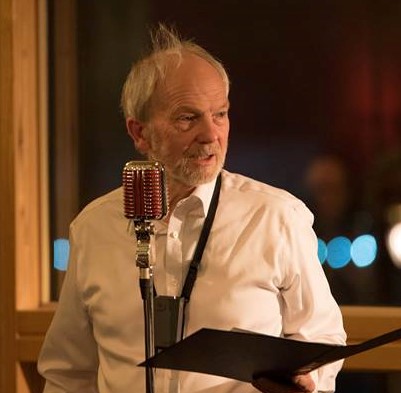
This week’s Friday Poem is ‘Even in dreamscapes’ by Christopher Meredith from his most recent collection Still.
Christopher Meredith’s new poetry collection Still, uses the title word as a fulcrum to balance various paradoxical concerns: stillness and motion, memory and forgetting, sanity and madness, survival and extinction. Lively and thought-provoking, this is a beautifully crafted, humane and intelligent collection.
“Lyrical, always surprising, Meredith ‘fixes stillness’ in absences here. His perfect ear tunes in so precisely – especially to the natural world, it’s ‘edge of sense’ – we are left haunted á la Frost, by a deep lonliness in the human condition.” – Paul Henry
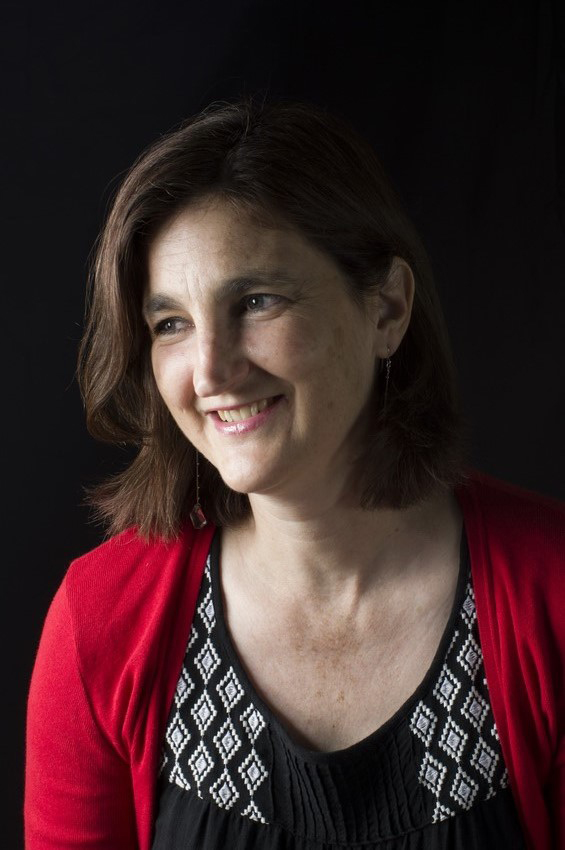
Our Friday Poem this week is ‘How I Hold the World in This Climate Emergency’ by Cath Drake from her debut collection The Shaking City, which is longlisted for The Laurel Prize 2021.
The shaking city of Australian poet Cath Drake’s debut poetry collection is a metaphor for the swiftly changing precarity of modern life within the looming climate and ecological emergency, and the unease of the narrator who is far from home. Tall tales combine with a conversational style, playful humour and a lyrical assurance. The poet works a wide set of diverse spells upon the reader through her adept use of tone, technique, plot and form. She is a welcome new voice for contemporary poetry.
We’re delighted that Cath Drake’s debut collection The Shaking City has been longlisted for The Laurel Prize 2021.
Set up by UK poet laureate Simon Armitage in association with the Poetry School, The Laurel Prize is awarded annually for the best collection of nature or environmental poetry to highlight the climate crisis and raise awareness of the challenges our planet is facing, and potential solutions for saving it.
The 2021 award is judged by poets Maura Dooley (Chair) and Imtiaz Dharker and ClientEarth Founder, Lawyer and poet James Thornton. The winner will be announced in a ceremony at The Yorkshire Sculpture Park on Friday October 8 2021. A programme of readings and workshops will be announced soon.
The full longlist is as follows:
Ricky Ray The Sound of the Earth Singing to Herself (Fly on the Wall Press)Sean Hewitt Tongues of Fire (Penguin)Ash Davida Jane How to Live with Mammals (Victoria University Press)Anja Konig Animal Experiments (Bad Betty Press)Tim Cresswell Plastiglomerate (Penned in the Margins)John Kinsella Brimstone (Arc Publications)Rasiqra Revulva Cephalography (Wolsak & Wyn)Kristen Lang Earth Dwellers (Giramondo Publishing)Cath Drake The Shaking City (Seren Books)Gregory Leadbetter Maskwork (Nine Arch Press)Jen Hadfield The Stone Age (Picador)Will Burns Country Music (Offroad Books)J R Carpenter This is a Picture of Wind (Longbarrow Press)Kirsten Luckins Passerine (Bad Betty Press)Daisy Lafarge Life without Air (Granta)Natalie Diaz Postcolonial Love Poem (Graywolf Press)Thomas A Clark The Threadbare Coat (Carcanet)Barbara Kingsolver How to Fly (Faber)Sean Borodale Inmates (Penguin)Dom Bury Rite of Passage (Bloodaxe)
Congratulations to all those on the longlist, including 100 Poems to Save the Earth contributors Sean Hewitt, John Kinsella, Jen Hadfield and Dom Bury.
The Shaking City is available on our website: £9.99
This week’s Friday Poem is ‘Bocca della Verita’ by Robert Seatter from his new collection The House of Everything. The poems in this collection are all inspired by artefacts and spaces in Sir John Soane’s Museum. Sir John Soane was born on this day in 1753.
Universally captivating, Sir John Soane’s museum in London is a labyrinth of evocation and imagination. In The House of Everything, Robert Seatter conjures it up in a personal and poetic trail, capturing the tragic story of the man who created it and the eclectic collection he gathered within its walls. No matter if you have never visited the place before – the texts are intercut with a series of striking collages made by the poet himself which help to conjure the unique message of this book: how to make material our elusive dreams and imaginings.
On the walls of the Colonnade in Sir John Soane’s Museum is ‘a mouth of truth’ from a Roman fountain, similar to the one that famously features in Roman Holiday, the 1953 film which made a star of the then unknown Audrey Hepburn.
This autumn, brothers Owen and Tom Morgan, founders of critically acclaimed, family-run restaurant group Bar 44 publish their first cookbook, Bar 44 Tapas y Copas, bringing a mouthwatering taste of modern Spain to kitchens up and down the UK.
To celebrate the book’s publication we’re hosting three in person launch events at the Bar 44 restaurants in Cardiff and Bristol. Tickets are on sale now.
Tuesday 19th October, 6-9pm – Bar 44 Cardiff
Tickets £40 per person (£60 for couples). Each ticket includes a copy of the book plus drinks and nibbles on the night. £10-15 from every ticket will also be donated to Velindre Cancer Centre. Find the full details here.
Thursday 4th November, 6-9pm – Bar 44 Bristol
Tickets £40 per person (£60 for couples). Each ticket includes a copy of the book plus drinks and nibbles on the night. £10-15 from every ticket will also split between the charities Llamau and Streetsmart. Find the full details here.
We hope to see you there!
Please note: These events will take place subject to the current Covid-19 guidelines in Wales and England remaining the same. Any changes to the event will be communicated to ticket holders as soon as possible.
Please contact [email protected] with any queries or concerns.
Alison Binney’s pamphlet Other Women’s Kitchens is the winner of the Mslexia Poetry Pamphlet Competition 2020.
For me, the kitchen is often the most appealing room in any home. In the house where I grew up, we had a dining table at one end of the lounge, which was only ever used when guests came round. All our other meals were eaten in the kitchen, so all the most interesting, impactful conversations I can remember are located around that small table, in the most intimate space in the heart of the house.
Some of my happiest memories are of cooking with my Mum – first as a small child entrusted with cutting out mince pie lids or stirring jelly cubes into boiling water, and later as an equal, experimenting together with Delia’s latest twists on old favourite recipes. And that kitchen was where the action happened too – the chip pan fire that we put out with a wet tea towel; my Mum’s shrieking encounter with a mouse that leapt from a sack she’d brought in from the garage; the gash from the cheese slicer to which my left thumb still bears witness. So much, also, that was less dramatic but more influential – all those conversations over cooking, over eating together, overheard from the family phone on the kitchen wall.
When I was hunting for a title for my first poetry pamphlet, I was not surprised, then, to be drawn to the final phrase of my poem Every time I came home: ‘dreaming of other women’s kitchens’. This poem recounts a time in my life when I was finding it hard to live up to what I felt were impossible ideals: a time when it seemed as if all my school and university friends, my cousins, and all the children of everyone my parents knew, were getting married, and then having children. Where the family kitchen had always been a space of comfort and camaraderie for me, I no longer felt confident in my place there, uncertain, like so many young gay people, about how my identity as a lesbian might fit with my parents’ expectations of me. The idea of other women’s kitchens, where I might experience an easy acceptance and a sense of fulfilment that I could not otherwise be sure of, felt like a very appealing fantasy.
It struck me, once I looked at the pamphlet through this lens, just how many of the poems in it are located in kitchens, or in kitchen-like spaces, or make reference to food. There’s the makeshift kitchen in a wicker barn where Anne Lister and her partner Ann Walker brew tea and coffee on the last day recorded in Anne Lister’s diary. There are the married women who ‘came home hungry, smelling of lentils’, after their encounters in a supermarket car park. There’s ‘tea with the lady mayoress’ in a found poem sourced from an old edition of the Girl Guide Handbook. And then there’s the kitchen as the location of a first date – probably just the sort of kitchen, complete with ‘individual chocolate mousses’, that my younger, uncertain self would have been delighted to know was waiting for her in the not-too-distant future.
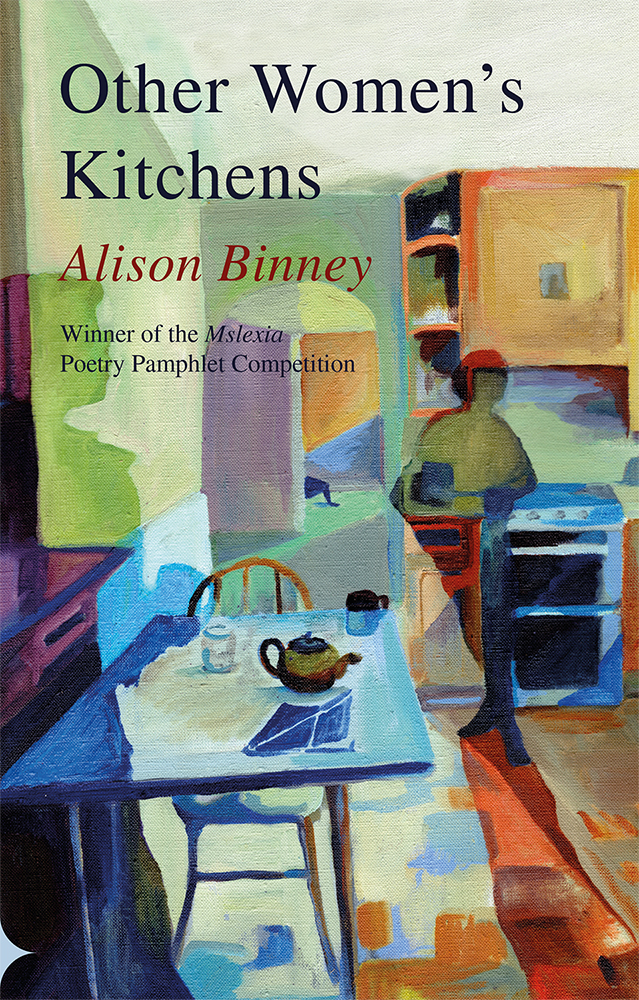
I’m thrilled that the cover for Other Women’s Kitchens, painted so skilfully by Kate Winter, captures the mood as well as the appearance of my parents’ kitchen. I also love the shadowiness of the two superimposed figures, which allows plenty of space for imagination and interpretation. The teapot at the centre represents for me that sense of comfort and companionship integral to the essence of a kitchen – the place not only where significant things happen, but in which, so often, they’re mulled over, digested, poured out.
Alison Binney
Other Women’s Kitchens is Alison Binney’s debut pamphlet of poems and introduces us to a gifted new voice who writes with flair and feeling about coming out and coming of age as a gay woman in 21st century Britain. The collection explores the challenges of discovering and owning a lesbian identity in the 1980s and 1990s and the joy of finding both love and increased confidence in that identity as an adult. An adroit admixture of the heart-wrenching and the humorous, the book features shaped and ‘found’ pieces, traditional narrative and compact prose poems. Beautifully entertaining, pointedly political and often very funny, Other Women’s Kitchens is essential reading.
This week our Friday Poem is ‘On Wonder Woman’s Island’ by Alison Binney from her debut pamphlet Other Women’s Kitchens which is the winner of the Mslexia Poetry Pamphlet competition 2020.
Other Women’s Kitchens is Alison Binney’s debut pamphlet of poems and introduces us to a gifted new voice who writes with flair and feeling about coming out and coming of age as a gay woman in 21st century Britain. The collection explores the challenges of discovering and owning a lesbian identity in the 1980s and 1990s and the joy of finding both love and increased confidence in that identity as an adult. An adroit admixture of the heart-wrenching and the humorous, the book features shaped and ‘found’ pieces, traditional narrative and compact prose poems. Beautifully entertaining, pointedly political and often very funny, Other Women’s Kitchens is essential reading. Seren is thrilled to be presenting this author’s first collected work.
Robert Walton, author of Sax Burglar Blues, has won first place in the English Language Poem Competition at the North American Festival of Wales for his poem ‘On Clevedon Pier, June 2020’. Fellow Welsh poet Mike Jenkins was awarded first place in the Welsh language category for his poem ‘Nid Ffin’.
The two poetry composition competitions (Welsh and English language) are part of the festival’s Eisteddfod. This year the theme for both categories was “Hiraeth.” The winners were announced at the festival’s Opening Ceremony on 2nd September.
The prizes honor David Llewelyn Williams of Vancouver, BC, Canada (1937– 2021), a friend and former Trustee of the North American Festival of Wales and a longtime member of its Eisteddfod Committee. Originally from Prestatyn, Wales, he was highly knowledgeable of Welsh poets and poetry, and entered and adjudicated numerous competitions (composition and recitation) in North America and Wales alike. He was highly instrumental and influential in establishing these very competitions.
For more details about the festival and future competitions, visit festivalofwales.org.
We are delighted to announce the publication of Other Women’s Kitchens by Alison Binney, the winner of the 2020 Mslexia Poetry Pamphlet Competition.
Seren poetry editor Amy Wack, who judges the competition said: “Heart-wrenching, succinct, lyrically musical, with a deeply personal theme, these poems won me over for their honesty and for educating me in this very particular politics of difference.”
Other Women’s Kitchens explores the challenges of discovering and owning a lesbian identity in the 1980s and 1990s and the joy of finding both love and increased confidence in that identity as an adult. Alison writes with flair and feeling about coming out and coming of age as a gay woman in 21st century Britain. Beautifully entertaining, pointedly political and very funny.
On winning, Alison said: “I’m so thrilled to have my debut pamphlet published by Seren – a publisher I’ve admired for a long time. This particular collection of poems is very close to my heart; I hope they will resonate with others, too.” Read more about ‘how she did it’ on the Mslexia website.
The Mslexia Poetry Pamphlet Competition is now open for entries for 2021. Closing date 6th December.
Other Women’s Kitchens is available now for £5.00.
This week’s Friday Poem is ‘The Storyteller’ by Abeer Ameer from her debut collection Inhale/Exile. This poem is also featured in 100 Poems to Save the Earth.
Abeer Ameer writes of her forebears in her first collection, Inhale/Exile. Dedicated to the “holders of these stories”, the book begins with a poem about a storyteller on a rooftop in Najaf, Iraq, follows tales of courage and survival, and ends with a woman cooking food for neighbours on the anniversary of her son’s death.
“…these poems remind us that even in the darkest times, there is light, and there is love.” – Katherine Stansfield
Inhale/Exile is currently half-price in our bank holiday summer sale. Buy before midnight on Monday 30th August and get your copy for just £4.99! Buy now.
Zoë Brigley and Kristian Evans, co-editors of 100 Poems to Save the Earth, are joining us at Virtual First Thursday on Thursday 2nd September. Tickets are £2.74 (inlc. admin fee) and available through Eventbrite https://www.eventbrite.co.uk/e/168074853411. We’ll also hear some of the contributors read their poems.
This bank holiday weekend, get 50% off all books on our website* in our half-price summer sale. Ends midnight Monday 30th September.