
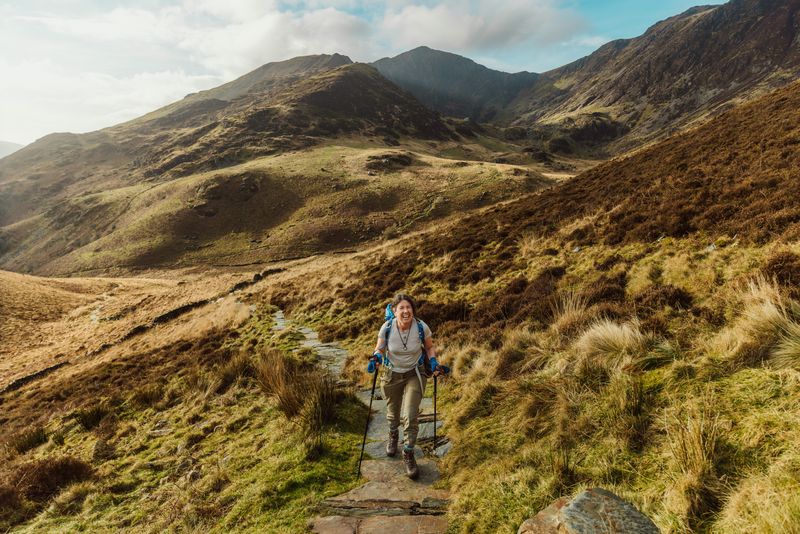
In today’s guest post, Julie Brominicks shares one of the stories she uncovered whilst researching her new book Cader Idris: Let the Mountain Speak. Whilst writing, she interviewed countless regular visitors to learn more about the mountain and what it means to them. As this story shows, our collective memory is a powerful tool in preserving stories of our landscapes. Buy the book to find out what else she learnt whilst getting to know this beautiful and important summit.
Cader Idris: The Summit Café and the Secret Spring
I happened to be interviewing the author Jon Gower the day I heard that Seren Books had accepted my proposal to write a book about Cader Idris. “I once met someone related to the family who ran a café on the top,” Jon said. This was astonishing news. What café?
Over subsequent months, as I accumulated Cader people, I asked them all about the café. A paraglider, runner, harpist. A Christmas-tree grower. Farmers and members of Mountain Rescue. I gathered sheep, crawled about with botanists, and helped re-build a drystone wall — but no-one remembered the café.
It didn’t matter. I had more than enough to write about and eventually I stopped asking, filing the summit café into a mental holding bay where it percolated with other mountain mysteries, like the spring at the top of Llwybr Madyn (the Fox’s Path). What spring? I hear you ask. What spring indeed.
An eighteenth-century guide called Richard Pugh had apparently used a spring at the top of Llwybr Madyn, to quench his clients’ thirst. And I kept coming across an oft-published diary entry made in 1871 by Francis Kilvert.
‘After leading me for a few steps, he began to go over what seemed to be the edge of a precipice…’ wrote Kilvert about his expedition with Richard Pugh. ‘Suddenly the old man stopped at a beautiful little spring in the almost perpendicular bank, pulled out his tumbler and gave me a draught of the clear sparkling water…’
Where was this delightful spring? I looked for it every time I scrambled up or slithered down Llwybr Madyn, but eventually parked it in my mind with the summit café, and that’s where both would have stayed if I’d not kept on meeting extraordinary people.
Ninety-two-year-old botanist Arthur Chater, for example, who spoiled me with fancy biscuits at his home in Aberystwyth while waves smashed the jetty outside his window. Arthur poured tea while sharing his memories of studying plants on Cader Idris — and a childhood visit to the summit café with his parents. His father had complained about the price of tea, but his mother had been sympathetic. “Whisht!” she’d hushed him, in her Scottish accent. “If you’d had to carry everything up in your rucksack, you’d charge something like that too!”
And then there was Emyr Lewis, who regaled me with tales of trout in the mountain lakes, and scuffles with poachers on the rivers. “You should meet my friend Edwyn,” said Emyr. “His father used to run a café on the summit.”
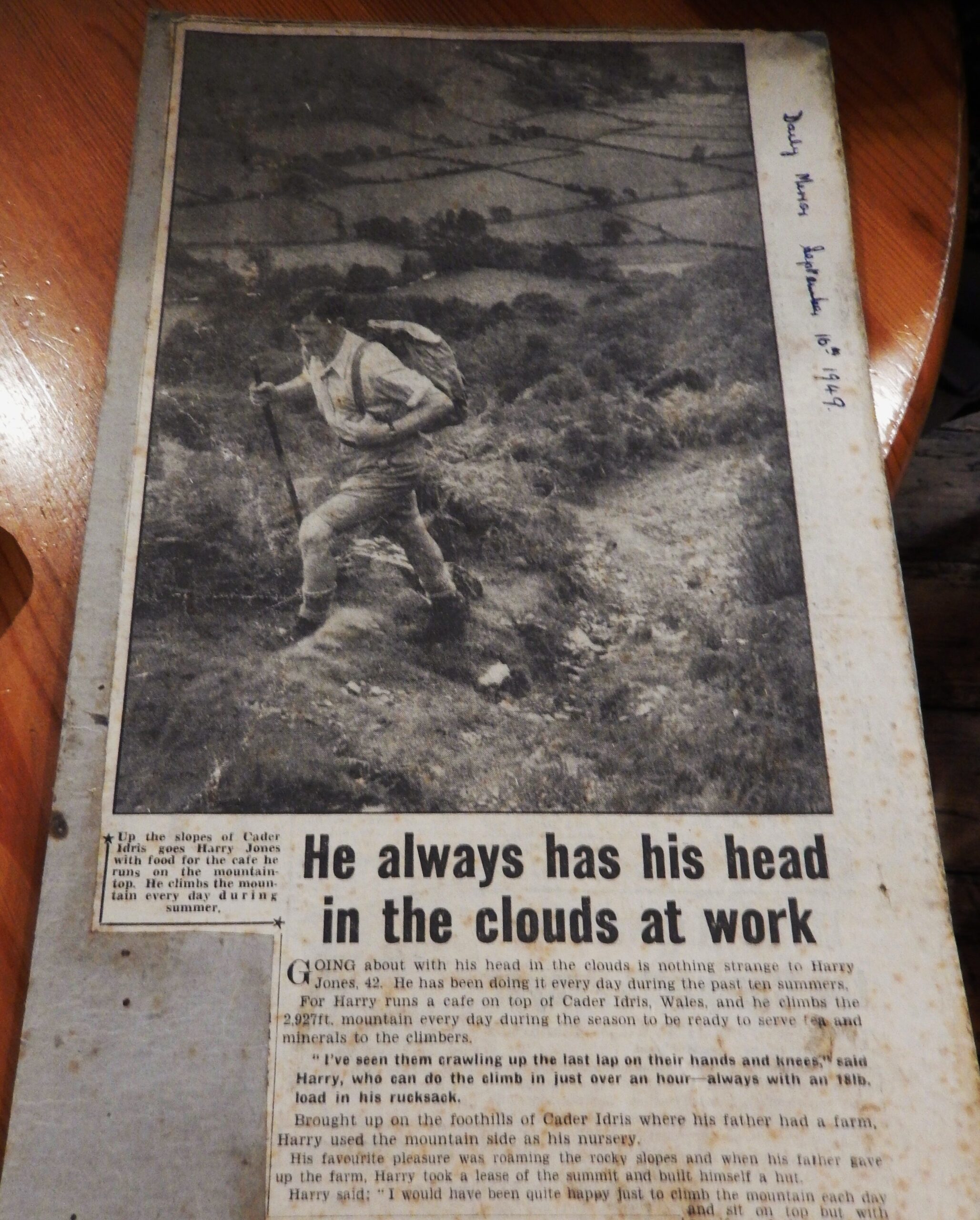
And so it was that I finally sat down with Edwyn Jones, over tea and cake in Dinas Mawddwy. After he and Emyr had recounted various childhood exploits from pig-killing to scrumping, Edwyn spread a sheaf of newspaper cuttings onto the table. They featured his father Harry Jones, who ran the summit café just before and after the Second World War.
“He used to walk up every day, and carry everything with him. Lemon squash, chocolate, tea, postcards. Even the water,” Edwyn ventured with a twinkle, but I knew better. “Did he not use the spring at the top of Llwybr Madyn?” I asked, while Edwyn wept with laughter and spluttered on his cake crumbs.
“The first thing he did on reaching the top, was fill the containers with water from the spring,” he said. “Then he covered the spring so everyone would think he’d carried the water up, and not mind paying double for their tea!”
Eventually the café closed, and in the 1960s, the building Harry had used for his café, (the same one Richard Pugh’s father had built to shelter visitors) was reconstructed by the council, in a slightly different position. You can still see the original fireplace, and Harry’s stoves no doubt, are still under the stones where he buried them.
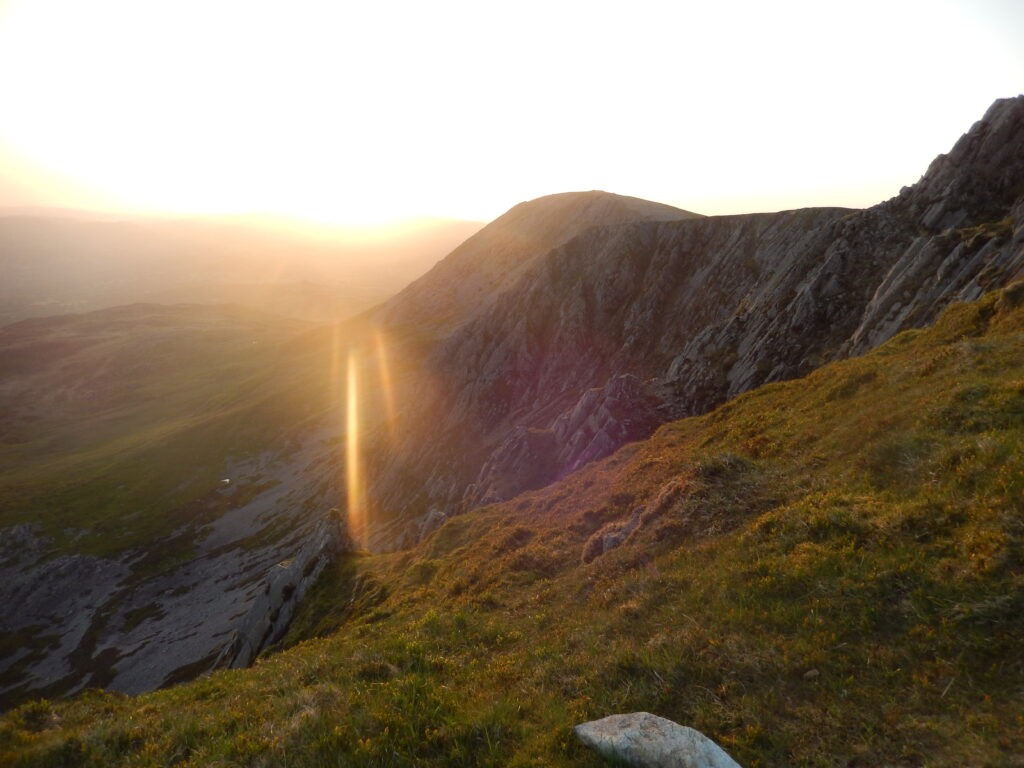
And the spring? Edwyn told me exactly where it was but a damp patch was all I found. I could have missed it — I am easily distracted by clouds or by ferns, or patterns cast by shifting winds on the lakes below. Anyhow, when I most needed one, at the end of a superhot hike, I discovered a different spring on the other side of the summit in a clatter of scree. Less lovely than the one described by Kilvert, but the water was cold and sweet.
Like memories, springs can shift over time, due to drought, or changes in earth or groundwater. And sometimes, like stories, they pop up when you need them.
Julie Brominicks
Photo of Julie on Cader Idris by Dan Struthers


