
Blog
5th December, 2025
Guest Post: Deryn Rees-Jones on writing ‘Hôtel Amour’ in Paris
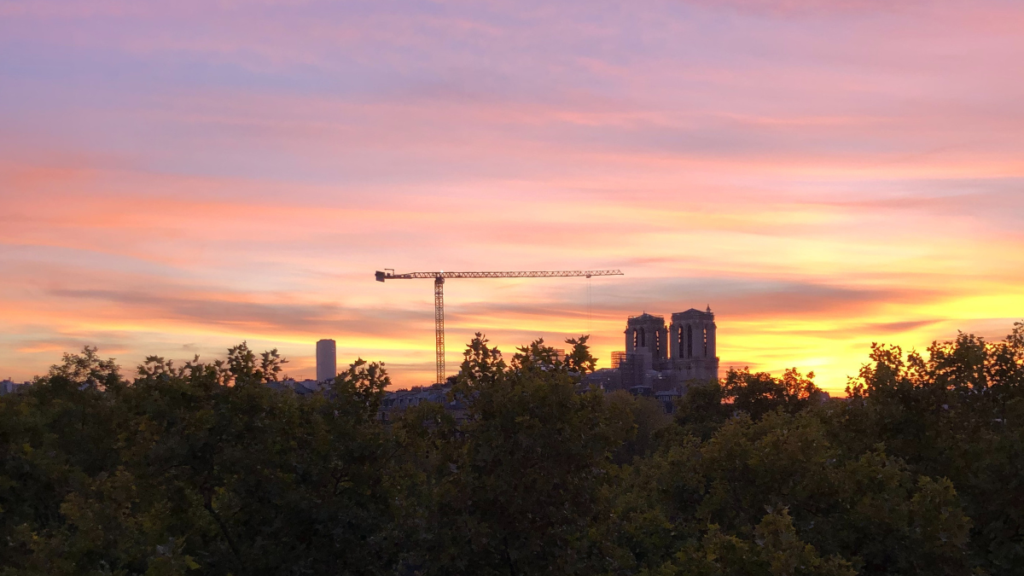
In this guest post, poet Deryn Rees-Jones reflects on time spent in Paris whilst writing her collection Hôtel Amour, offering an insight into her writing process and the inspirations behind the book.
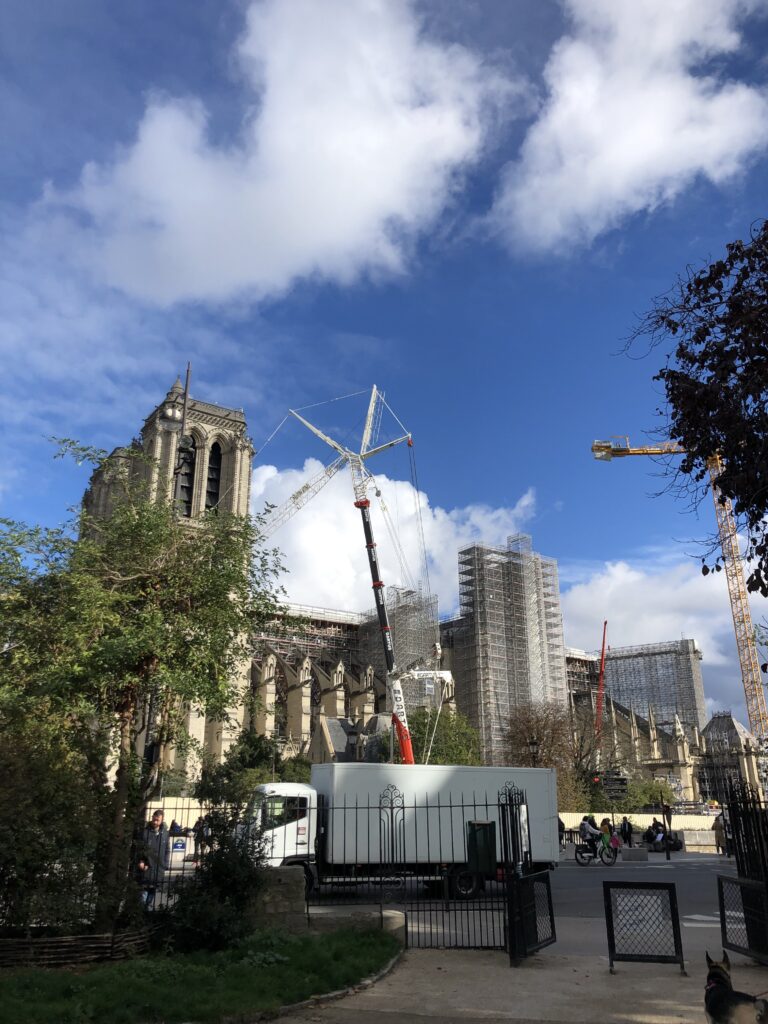
On the evening of my arrival, early in October 2022, my room at the Cité International des Arts, Paris, was rich and glowing with late evening light. An intense orange and pink sunset was a startling backdrop to the view of nearby Notre-Dame, still then under radical reconstruction, after the fire of 2019. Throughout the autumn months, and into winter, the large bare room, with its lino floor, tiny corner camp bed, two ring stove and sink, and artists’ easels, was my home. Around me, artists and writers and composers from across the world were being supported in residencies, and all about me people were quietly going about their work. Living spaces, each week, were transformed into open studios. Sometimes I would hear people rehearsing a song, or playing the piano. The building – the most international of hotels – felt both very alive and very still. I kept my own room empty except for a handful of postcards, and once, towards the end of the residency, I allowed myself a bunch of flowers, bought after a late-evening walk on the Île Saint-Louis. Looking back, the radical simplicity of the life I was living was like an act of devotion to life itself.


I first visited Paris when I was fifteen. For me, Paris was synonymous with the modernist writers I was then discovering: Hemingway, Stein, Joyce. Later, I came to read them differently, alongside Woolf, Jean Rhys, and Hope Mirrlees. But it would also become for me the Paris of French philosophers, of Simone De Beauvoir, Satre, Foucault, and later, so-called ‘French feminisms’. It was a place of ideas, and a place of a language that I was haltingly learning to enjoy as a new sound in my mouth. Over the next forty years, after that first visit, I managed to return numerous times, so that my memory of the city and its geography became a series of regular waystations to punctuate my life.
For the three months of my residency, though, Paris functioned as a concentrated dreaming and thinking space as well as a space for an ongoing recovery from the damage a wild-type covid infection, which I’d caught early in the pandemic, had left in its wake. I slept beside the huge studio windows with the Seine’s river traffic at my feet, and could never quite bear to draw closed the huge, slightly-dilapidated black-out curtains on the floor to ceiling windows. Not far from where I was living was a room, in the Quai D’Anjou, where Baudelaire wrote ‘L’invitation au voyage’; and it didn’t take much for the windows of my own room to also bring to mind Baudelaire’s prose poem ‘Les Fenêtres’. I wrote several versions of the poem, in lyric mode, playing with perspective and gender, and although those poems never made it into the book, they remain important under-seams to its conception. As the dark nights drew in, Paris came alive with lights; the river traffic continued in its flow and beyond my room, if I walked the short distances I could manage, the distant Eiffel tower would loom in and out of view, shimmering on the hour like a glittering clock-hand.
What emerged as I was writing (and importantly not writing, too) was a desire to think about self and time and the world in the context of the pandemic, as I looped back to the narrative of my last book, Erato. That earlier book used solid blocks of prose narrative, alongside lyric, to hold each mode alongside each other in creative tension. I think, then, of Hôtel Amour, as a sequel; it picks up and shakes, and breaks and repeats images and narratives from Erato in the context of the geography of Paris, and continues them and also retranslates them, giving shape to moments from a life, but also reinventing them. In my imagination Paris was a place of compressed history, of post-war reconstruction after the Occupation. I was not drawing parallels, but it was difficult, too, not feel the weight of history at every corner.

It is only towards the end of writing a book that a book’s meanings start to emerge afresh, and to sometimes even diverge from an original loose idea or plan. Nothing in the book points to fixed solutions, analogies, as it plays with silence, memory, form. Ideas of breath and song, how we locate ourselves and create, and how we attempt to give memory a provisional resting place in narrative, are bedded into the three sections of the book’s architecture. The first and last sections of ‘poetic prose’, and the central sonnet sequence they frame, might be seen as visualising a heart and lungs; they feel to me as well like an image of a bird (my namesake) or an angel. The twenty-five sonnets at the book’s heart also configured themselves to me as a concertina. They drag their long lines across the page, creating, with a space at their centre at line 7, a fractalled version of the larger structure of the book, turned on its side. Trying to find a vehicle for thinking through became the space of the hotel and its multiple etymological roots and connections to the hospital, and the hostel. And yes, love is at the centre of the book, in its many manifestations, what it makes in and of us, its drive towards life, and possibility.
So much has happened in the world since I started the book, in the wake of Brexit in 2019. The pandemic, the invasion of Ukraine, the atrocities committed in Gaza, has doubtless transformed our relationship to time, illness, violence, mass death, and the climate’s ongoing destruction, in ways we are not yet even able to reckon with. The passing of time has made me more aware of the vertiginous nature of subjectivity, of poetry’s potential to hold us, demand that we pay attention, as we try to go about our daily lives. This is a book born out of an enforced retreat, but it is also a book about recovery and return. As I write this, Paris is transitioning slowly into autumn, slowly shaking itself away from its summer of intense heat. I am glad to have been here again, for a while.
Deryn Rees-Jones


