Fiction
Category: Fiction, Literary Fiction
Number of pages: 272
ISBN: 9781781727201
Publication date: March 25, 2024
Price: £9.99
“A hauntingly vivid story of the Great Plague of 1666, written with spare grace and intelligence, along with a compelling historical realism. A very fine and very moving fiction.” – Dr Rowan Williams
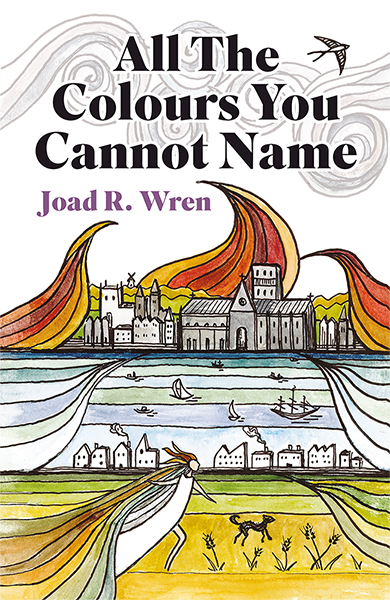
It is 1666 and the bubonic plague still haunts London. Just outside the old Roman walls, where they have lived for six good years, printers James and Ellie White have managed to escape its ravages. The city too has survived, but now sits in a cloud of wounds. After over a year, something like everyday life has been restored, and the preacher Solomon Eagle wants a book printed, in which he moralises on the meanings of the plague and the judgements of God.
James and Ellie accept his commission and set to work but James is plagued by a breathless trepidation. Then everything changes when the unexpected happens.
Caught in the dream-like place between the past and their future, with former lives to unlive and a grief they can hardly speak, they must hold onto each other, and their love, in order to survive.
Lyrical and visceral in equal measure, All the Colours you Cannot Name is a compelling and deeply tender story of love and death.

Joad R. Wren
Joad R. Wren is a Welsh writer, now based in London and Folkestone. He was born and grew up in Cardiff, was educated at the University of East Anglia and Oxford University, and taught at the Universities of Oxford, Aberdeen, East Anglia, and Queen Mary, University of London. He held visiting posts in Florence, Granada and Paris. He departed academic life in 2022 in order to write full time.
In that past life he wrote about early modern Europe: about cheap print and news, angels, the role of the imagination in political thought, and the capacity of utopia to carry us beyond the horizons of our own thinking. Among the dozen books of which he is the author and editor are: News Networks in Early-Modern Europe (Leiden, 2016), The Invention of the Newspaper: English Newsbooks, 1641-1649 (Oxford, 1996; 2005), Pamphlets and Pamphleteering in Early-Modern Britain (Cambridge, 2003); Milton’s Angels: The Early-Modern Imagination (Oxford, 2010); and (ed.) The Oxford History of Popular Print Culture, vol. 1: Cheap Print in Britain and Ireland To 1660 (Oxford, 2011). His last academic book will be the forthcoming edition of Milton’s Latin Defences, for Oxford’s The Complete Works of John Milton, gen. eds. Thomas N. Corns and Gordon Campbell, for which he hopes to be rewarded in Heaven.
He intermittently contributes to TV and radio documentaries, talking about the history of printing, seventeenth-century print culture, seventeenth-century women, news and pamphlets. He has written for The Guardian, the TLS, the LRB, the TES, History Today, BBC History and other journals.
His other interests are mainly parenting, running, making and looking at art, making and listening to music, and staring at the sea. Under the name ‘The Unattached’ – a collaborative project with more accomplished musicians – he writes and performs avant-folk music. Their second album, Requiem for Dead Dogs, will be released by Gare du Nord in 2023.
“It’s a rare book that moves so quietly, that delves so deeply into what it feels to love and to face loss. A memorable, slow triumph.”
Antonia Senior - The Times