Books Books
Category: Bestsellers, Individual Collections, Poetry
Number of pages: 72
ISBN: 9781781724590
Publication date: October 1, 2018
Price: £9.99
Out of stock
Poetry Book Society Recommendation, Winter 2018
‘It’s well-nigh impossible to convey with quotation how Etter’s use of language, form, restraint and space combine to such impressive effect.’ – Stride magazine
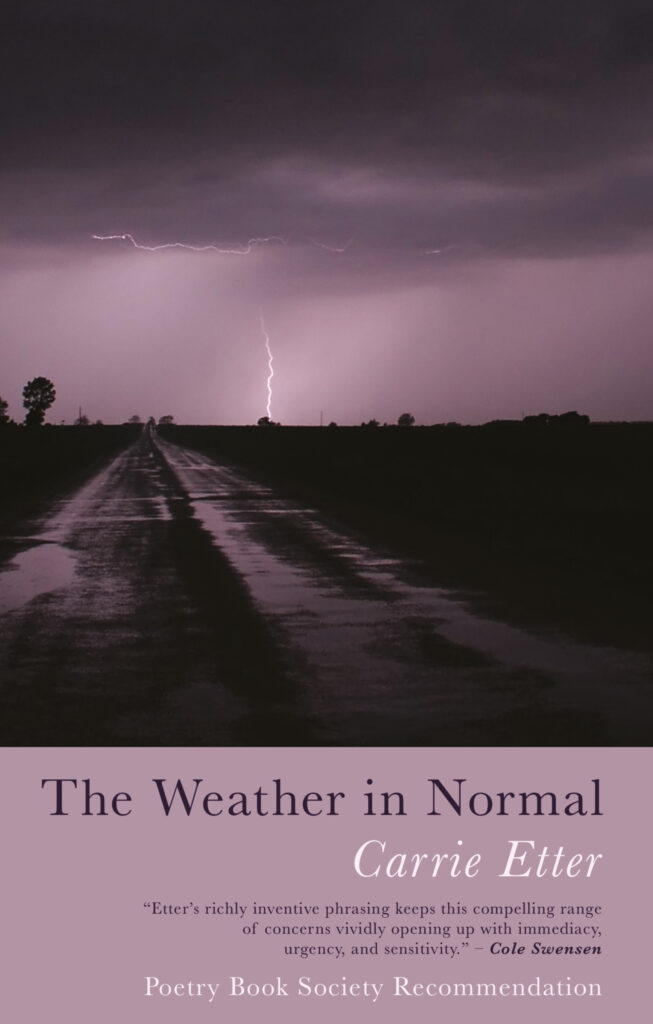
Carrie Etter’s fourth poetry collection focuses on her hometown of Normal, Illinois, in the American Midwest. The Weather in Normal is not a set of straightforward memories but a slowly shifting entity, like a moving storm. The book opens with ‘Night Ode’, a poem set on a single street at night, the protagonist walking and feeling the oppressive summer heat, the humming of cicadas and the various ages she has walked the same road: “sixteen, nineteen, twenty-four, thirty-seven…”. This introduces us to the main themes of memory and recollection, of mature reflections on youthful experiences, of multiple, shifting perspectives.
The first of the book’s three arcs explores the family’s relationship to the weather and place, from the father’s obsession with the weather, to the brutal effects of the winters on the family, resulting in broken bones, the recognition of poverty, and the father’s paralysis. Yet the relationship to place also includes its appreciation. Etter offers us a vivid impression of the American prairie with its cornfields extending to the horizon. She muses on the various meanings of ‘Prairie’ and understands a landscape can haunt the imagination the way the past haunts the present.
The second arc explores the effect of the loss of the family home in the long poem ‘Afterlife.’ The house is a place of memory and of dream, an upbringing in a house crowded with sisters and then with her sisters’ children: “once three sat atop/ the upright piano/ playing the keys/ with their feet”. What is it to return, in imagination, to the house in which her father died? Can one ultimately relinquish one’s childhood home to its new owners?
The book’s final arc concerns the effects of climate change in Illinois, in part through the long poem, ‘Scar’, chronicling these effects—the greater occurrence of extreme weather, the loss of species, etc. – as well as human responsibility for them. Just as The Weather in Normal begin with music in ‘Night Ode’, so it ends with ‘And Now for a Kind of Song,’ a eulogistic poem relishing the poet’s relationship to Illinois.

Carrie Etter
American expatriate Carrie Etter has published four collections of poetry, including The Tethers (Seren, 2009), winner of the London New Poetry Prize, and Imagined Sons (Seren, 2014), shortlisted for the Ted Hughes Award for New Work in Poetry. She also edited Infinite Difference: Other Poetries by UK Women Poets (Shearsman, 2010), a TLS Book of the Year, and Linda Lamus’s posthumous collection, A Crater the Size of Calcutta (Mulfran, 2015). Individual poems have appeared in The Guardian, The New Republic, The New Statesman, The Penguin Book of the Prose Poem, Poetry Review, and The Times Literary Supplement. She also writes short stories, essays, and reviews, and has received grants from Arts Council England and The Society of Authors. After many years teaching at Bath Spa University, in 2022 Etter joined the creative writing faculty at the University of Bristol.
Photo Credit: Fabrizia Costa.
“
Her formal command of free verse is also impressive. It feels as if each word counts, but this is not an austere collection; it has a richness about it that is deep and dark and, despite the grief in the poems, somehow remains very positive.
This is – in the best sense of the word – a lovely collection of poems, and one I shall be returning to again and again.”
Steven Waling, Write Out Loud
“Under the guise of its quotidian title, The Weather in Normal is all the more blistering when it reveals its true nature: abnormality is its nucleus, and the climate its concern.”
Sophie Baggott, Wales Arts Review